Shimla, June 7: Fresh hopes of opening international markets for Himachal Pradesh's organic fruits emerged at a stakeholder workshop in Fagu on Saturday, where the Centre unveiled a renewed strategy to promote exports of agro-processed horticultural products.
The initiative promises new opportunities for the state's growers of stone fruits, juices, concentrates and other value-added products, but it also raises a familiar question: can Himachal finally convert its horticultural potential into sustained export success?
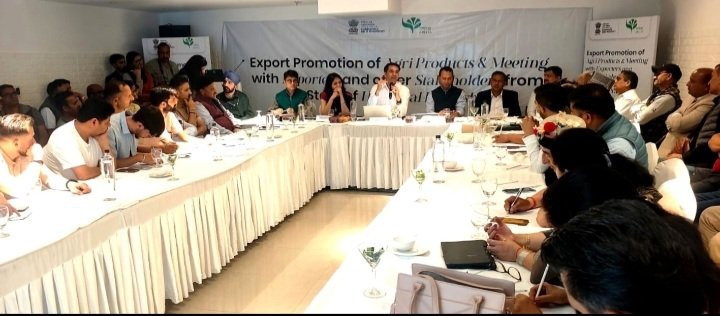
The stakeholder consultation on "Export of Agri-Processed Food and Beverage Products from Himachal Pradesh" was organised jointly by the Agricultural and Processed Food Products Export Development Authority (APEDA) and the Himachal Pradesh Horticultural Produce Marketing and Processing Corporation (HPMC).
Chairing the workshop, Monica Gaur, Director, Ministry of Commerce and Industry, said the Government of India has formulated a new strategy for international exports of agro-processed fruits that could create significant global opportunities for Himachal's organic produce.
She stressed the need to strengthen market linkages, value addition and export-oriented infrastructure to help local products compete in overseas markets.
The focus was on expanding exports of high-value horticultural products, particularly plums, peaches, apricots and cherries, along with processed products such as fruit juices, concentrates, jams, squashes, pickles and canned foods.
Additional Secretary, Ministry of Commerce and Industry, Nitin Yadav, urged stakeholders to leverage central government schemes aimed at connecting Himachal's horticulture sector with global markets and boosting exports of premium fresh and processed produce.
HPMC Managing Director D.C. Rana highlighted the corporation's role in procurement, processing, branding and marketing of horticultural products.
He said linking farmers to processing and export value chains could enhance incomes while creating entrepreneurship opportunities in rural areas.
Participants discussed international market access, buyer-seller linkages, branding, packaging, traceability standards, quality certification and export promotion schemes.
Deliberations also focused on long-standing bottlenecks such as logistics, post-harvest management, product aggregation, cold-chain infrastructure and export facilitation.
However, APEDA and other agencies have conducted similar export-promotion initiatives in the past, and stakeholders acknowledged that the biggest challenge remains translating policy intent into actual export volumes.
Despite being a leading horticulture state, Himachal continues to export only a small fraction of its produce directly, with inadequate cold-chain networks, fragmented production, high transportation costs and limited market intelligence often constraining growers.
Industry representatives and farmer producer organisations attending the workshop maintained that unless these structural issues are addressed, the state's export ambitions may continue to remain largely confined to conference halls rather than global supermarket shelves.