

What Nepal’s Bhotekoshi Flood Teaches the Himalayan States
SHIMLA/DEHRADUN/ NEW DELHI:
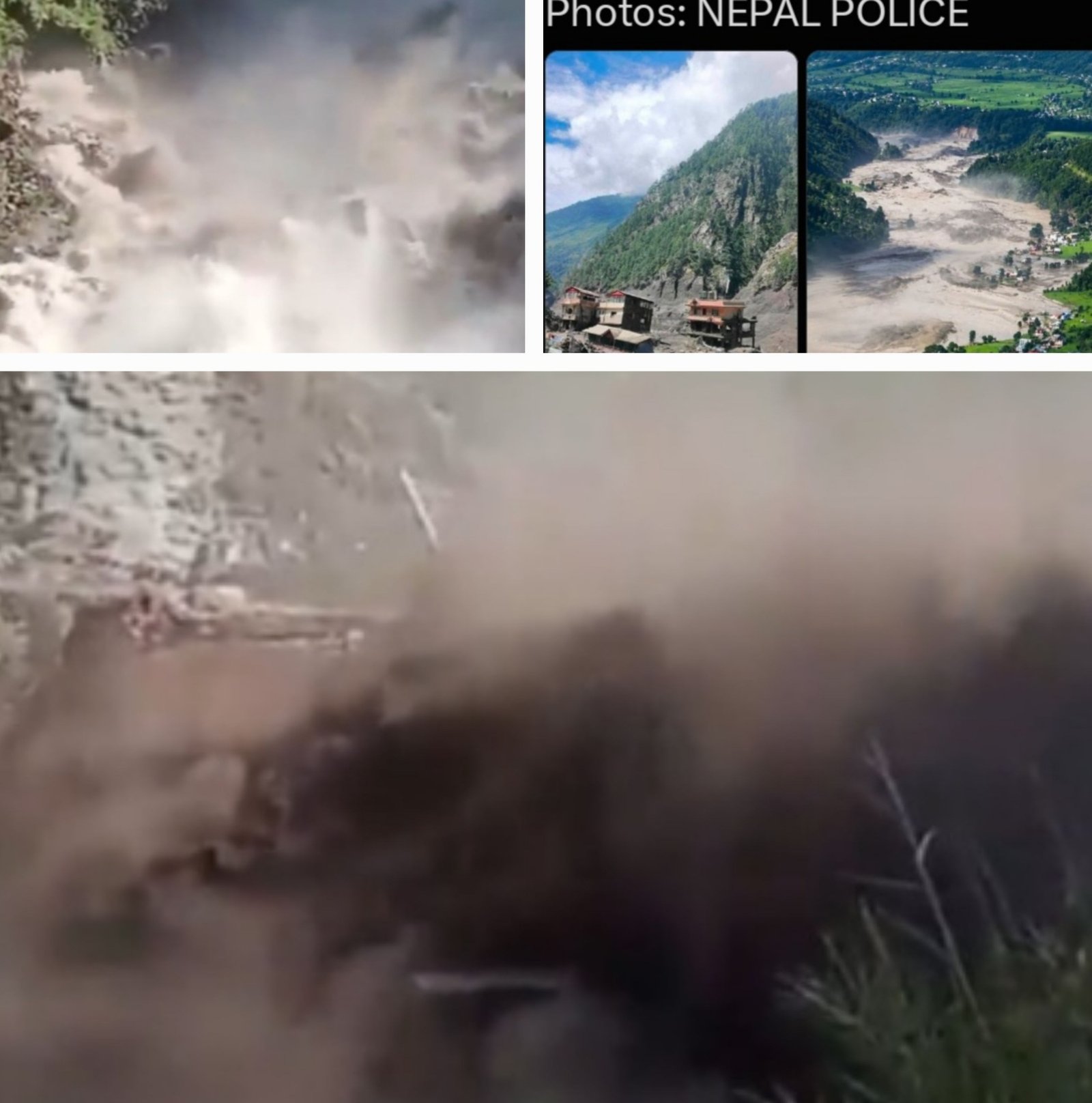
The devastating flash flood that swept through Nepal’s Rasuwa district on Wednesday is more than a disaster story. It is a warning for the entire Himalayan region.
The Bhotekoshi, which enters Nepal from Tibet, suddenly surged through Timure and Syabrubesi, washing away settlements, roads, bridges and critical infrastructure.
Nepalese authorities have warned communities downstream along the Trishuli basin to remain on high alert.
The precise cause of the flood has not yet been officially established, and reports of an earthquake-triggered landslide or blockage on the Tibetan side remain to be independently confirmed.
The scale of the impact on Nepal’s hydropower ambitions is already becoming clear.
Preliminary assessments indicate that 14 power projects with a combined capacity of about 748 MW have been affected, including projects in operation and under construction. The 220-kV transmission infrastructure has also suffered damage.
But the most painful dimension of the disaster is human.
A Kailash Mansarovar pilgrimage group was caught in the flash flood at Gyirong in Tibet while returning from the pilgrimage.
Sadhguru said 77 people were at an immigration centre when the flood struck and that there was initially no official information about their whereabouts.
He said 495 members of the groups had returned safely, while hundreds remained in Tibet or Nepal and rescue efforts were continuing.
The plight of pilgrims and travellers must therefore remain at the centre of the international response.
These were not merely infrastructure users caught in a natural disaster; they were people travelling through a trans-Himalayan pilgrimage corridor where weather, geology, river behaviour and border logistics can change within minutes.
A warning for Himachal, Uttarakhand and Sikkim
The Bhotekoshi disaster should force India’s Himalayan states to ask a difficult question: Are we planning infrastructure for the Himalayas we have, or for the Himalayas we wish we had?
Himachal Pradesh has already witnessed the devastating consequences of cascading Himalayan hazards—from the Parechu flood in the Sutlej basin to cloudbursts, landslides and sudden river surges in the late1990s.
Uttarakhand has experienced the Kedarnath catastrophe and the more recent Dharali disaster. Sikkim has faced the consequences of extreme GLOF floods in a Tista river fragile mountain environment that damaged NHPC power project in excess of Rs 600 Crore and Killed many.
The Brahmaputra basin presents an even larger downstream risk.
The lesson is clear: a hazard does not have to remain confined to the point where it begins.
A landslide can block a river. A blocked river can suddenly burst. The resulting surge can destroy bridges, hydropower stations, roads, settlements and pilgrimage routes dozens or even hundreds of kilometres downstream.
That is the cascading-risk problem that Himalayan infrastructure planners can no longer ignore.
The China factor
The disaster also raises a strategic question for India.
The Himalayan river systems originate largely in the Tibetan plateau before flowing into Nepal, India and Bangladesh.
Any major alteration of these rivers upstream has consequences far beyond the country where the project is located.
China’s planned mega hydropower project on the Yarlung Tsangpo/Brahmaputra has consequently generated concern in India over downstream water security, ecological disruption and disaster risk, Saud strategic affairs expert Dr Brahma Chellaney.
Calling it a “water nuclear bomb” may capture the political anxiety, but the more important question is scientific: what happens when very large infrastructure is placed in an active seismic and landslide-prone mountain system?
The Himalayan region is capable of producing earthquakes of magnitude 8 or greater.
Seismologist Roger Bilham has noted that historical evidence suggests Himalayan earthquakes can reach about magnitude 8.2 and that major sections of the Himalayan seismic zone have accumulated strain.
Research on Himalayan seismicity has also produced estimates of long recurrence intervals for magnitude-8 events, including roughly 700–1,100 years under different modelling assumptions.
That should not be interpreted as a prediction that an earthquake will occur on a particular date. It is instead a reminder that long recurrence intervals do not mean low consequence.
The real question is accountability. The Bhotekoshi tragedy raises an uncomfortable question: who is accountable when an upstream event in one country produces catastrophic consequences downstream in another?
If the final investigation establishes that a landslide, river blockage, glacial event or other sudden natural process on the Tibetan side generated the flood, there must be a transparent mechanism for sharing real-time hydrological, seismic and disaster information with downstream countries.
Nepal, India, Bhutan and Bangladesh cannot afford to receive warnings only after a Himalayan river has already crossed its danger level.
The issue is therefore bigger than Nepal’s damaged hydropower projects. It is about transboundary early-warning systems, mandatory data sharing, seismic monitoring, dam safety, cumulative environmental assessment, downstream evacuation plans and independent scrutiny of mega projects in fragile Himalayan basins.
India cannot wait for the next warning, warn the experts.
For Himachal Pradesh, Uttarakhand and Sikkim, the warning is stark.
Every hydropower project, highway, tunnel, bridge and pilgrimage route in a high-risk valley has to be assessed not only against a cloudburst or normal flood, but against a compound disaster. The earthquake followed by landslide, landslide followed by river blockage, and river blockage followed by a sudden flood wave.
Pilgrimage corridors deserve special attention. Kedarnath, Kailash routes, Char Dham routes, Hemkund Sahib and other Himalayan pilgrimage circuits routinely carry large numbers of people into terrain where evacuation can become impossible within minutes.
The Bhotekoshi flood has shown how quickly a pilgrimage route can turn into a disaster zone.
The question now is not whether the Himalayas are dangerous. They always have been.
The question is whether governments are prepared for the next cascading Himalayan disaster.
India needs a permanent Himalayan risk forum bringing together seismologists, glaciologists, hydrologists, dam-safety experts, disaster managers, defence and intelligence agencies, environmental scientists and representatives of the affected Himalayan states.
Its mandate should be simple: identify the risks before nature identifies them for us.
The worst lesson from Nepal would be to treat the Bhotekoshi tragedy as an isolated flood.
It is a warning from the Himalayas. Will the Modi Government say something on China and wake up from its complascence ?
#NepalFlood #HimalayanDisaster #Brahmaputra #HimachalPradesh