
ITDA Reform: The Last Mile Cannot Remain a Government Cliché
NEW DELHI/ SHIMLA: If the Ministry of Tribal Affairs and NITI Aayog really want to reach the “last man in the row”, they must first stop looking at tribal development through the comfortable lens of institutions, rankings and dashboards—and start looking at the tribal families who have remained outside the benefits of development.
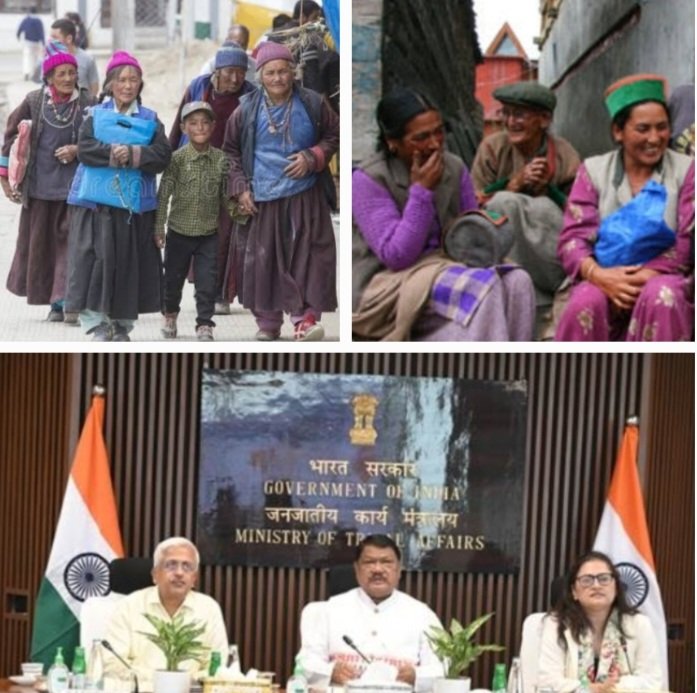
Union Minister Jual Oram and NITI Aayog Member Dr. R. Balasubramaniam released a national framework and operational guidelines to strengthen ITDAs and ITDPs, (Integrated Tribal Development Agencies (ITDAs) and Integrated Tribal Development Projects), translating nationwide consultations across 217 tribal development agencies in 19 States/UTs into an actionable last-mile delivery roadmap.
The exercise is being presented as a major reform of the institutions responsible for taking government schemes to tribal communities.
But the real test will be whether these guidelines can identify and empower those tribal households that have remained invisible even within the tribal development system.
The Ministry says the framework is based on a nationwide consultation covering ITDAs and ITDPs, with assessments designed to identify institutional gaps.
It proposes better convergence of schemes, evidence-based planning, digital governance, outcome-based monitoring, capacity building and stronger administrative structures.
In simple terms, the government wants ITDAs to stop functioning merely as another layer of administration and become active delivery platforms for tribal development.
Instead of different departments implementing schemes in isolation, the ITDA is expected to bring them together, identify gaps, monitor outcomes and ensure that benefits actually reach tribal households.
The framework introduces a common assessment methodology for ITDAs and ITDPs. Institutions will be assessed across 15 parameters grouped into five broad institutional domains.
The idea is to measure where an agency is weak, prepare an institution-specific improvement plan and periodically monitor whether it is improving.
This is where the concept of evidence-based governance comes in. Rather than relying only on official reports saying that a scheme has been sanctioned, released or implemented, the administration is expected to look at measurable outcomes—how many families actually received the benefit, what assets were created, whether livelihoods improved and which villages or households remain uncovered.
The proposed ranking and real-time monitoring architecture draws from the experience of the Aspirational Districts Programme and Aspirational Blocks Programme.
The philosophy is straightforward: identify lagging areas through data, concentrate administrative attention there, track progress continuously and push departments to work together.
But tribal development cannot be reduced to a dashboard.
The biggest danger is that the system may end up measuring the performance of institutions without adequately measuring the deprivation of the people those institutions are supposed to serve.
Tribals have not changed uniformly across India. The experience of Bakarwals in Jammu and Kashmir, Gaddis and Pangwals of Chamba, Lahaulas of Lahaul, Spitians of Spiti, Kinnauras of Kinnaur, Jaunsaris of Uttarakhand and numerous tribal communities of the Northeast is vastly different.
Geography, traditional occupations, landholding, market access, education, migration and exposure to modern infrastructure have produced sharply different levels of development within tribal societies themselves.
Reservation, political representation and the emergence of an educated tribal elite have undoubtedly created new opportunities—but these gains have not necessarily travelled down to every tribal household.
A new tribal middle class and professional class has emerged in many regions. That is a positive sign.
But the danger is that policy conversations increasingly get dominated by those who have already acquired access to education, government employment, political networks and modern markets, while the poorest and most geographically isolated tribal families remain outside the conversation.
This is the hidden inequality within tribal communities that a genuinely evidence-based framework must confront.
The phrase “last mile” therefore needs a much sharper definition. It should not simply mean the last village on a government map.
It should mean the last excluded household—the family without productive land, reliable income, irrigation, connectivity, market access, quality schooling, healthcare, digital access or a sustainable livelihood.
A cursory village visit can easily miss this deprivation. Officials may visit a panchayat headquarters, meet elected representatives, inspect a completed project and return with a favourable report.
But the poorest families may live on the margins of that same village, without productive assets or the social and economic capital required to access government programmes.
The new framework must therefore go beyond counting infrastructure and beneficiaries.
The real question should be: who has still received nothing?
This requires household-level mapping of deprivation. ITDAs should identify tribal families that lack productive assets, secure livelihoods, marketable skills, access to credit, modern agricultural and horticultural inputs, storage, transportation, education and healthcare. Such households should become the first priority for convergence of schemes.
The issue of land and productive assets is particularly important. A tribal family may technically be a beneficiary of several welfare schemes and yet remain economically vulnerable if it has little productive land, no irrigation, no livestock, no horticultural asset, no market linkage and no stable source of cash income.
Welfare saturation without livelihood creation can reduce deprivation temporarily without breaking its cycle.
That is why ITDA reform must connect tribal welfare with the productive economy. Agriculture, horticulture, livestock, forest produce, handicrafts, tourism, local processing, renewable energy and digital markets can create sustainable incomes if communities are given technology, credit, infrastructure and market access.
The convergence principle proposed by the Ministry is therefore potentially important. Convergence simply means that different government departments should work around the needs of the same family rather than each department operating separately.
A household needing livelihood support may simultaneously require irrigation, road connectivity, skill training, credit, market access and digital connectivity. The ITDA should be capable of bringing these interventions together.
The proposed strengthening of Governing Councils and greater participation of Panchayati Raj Institutions can also improve accountability—provided participation is substantive and not merely procedural.
Similarly, the Ministry's proposal to strengthen technical manpower addresses a genuine problem.
Many tribal areas require specialised capacity in engineering, agriculture, horticulture, livelihoods, finance, digital systems and project management. An agency cannot deliver complex development projects effectively if it is dependent entirely on a small administrative staff.
The proposal to improve fund flow, including the possibility of direct transfer of funds to ITDAs, could also reduce delays. But financial autonomy must go hand in hand with transparent accounting, social audit, public disclosure and measurable outcomes.
Digital governance can make monitoring faster, but technology cannot substitute for field intelligence.
A dashboard can show that a road has been completed; it cannot automatically reveal whether the road is usable during winter.
A database can show that a household received a subsidy; it may not reveal whether the asset is productive. A photograph can prove that a building exists; it cannot establish whether it is actually serving the community.
This is why the proposed Performance Improvement Roadmap for individual ITDAs should include a strong deprivation index, not merely an institutional performance score.
The Ministry's national exercise began with consultations and field-level assessments and culminated in the National Conclave on Strengthening ITDAs and ITDPs at Vigyan Bhawan on June 3, 2026.
The exercise involved Project Officers, State Tribal Welfare Departments and Tribal Research Institutes and sought to bring field realities into the national framework.
That consultative approach is welcome, but the next phase must be more uncomfortable: go deliberately to the excluded, the remote and the economically weakest tribal households.
If NITI Aayog and the Ministry of Tribal Affairs want a real picture, they should construct a separate “left-out tribal households” database for every ITDA/ITDP area. These families should be tracked until they acquire sustainable productive assets and access to essential public services.
The same principle can be applied to tribal settlements in the Himalayan belt. The problems of a remote Kinnauri village, a Gaddi settlement in Chamba, a Lahaul village or a Spitian habitation cannot be understood through identical national parameters. The framework must have national standards but local solutions.
The Ministry itself says it wants to move away from a one-size-fits-all approach. The real challenge is now to ensure that this principle survives implementation.
India does not need another layer of bureaucratic jargon around “last-mile delivery”; it needs a system capable of naming the families who are still at the end of that last mile—and then moving resources towards them.
The success of the new ITDA framework should ultimately not be judged by how many workshops were held, how many dashboards were created, how many institutions were ranked or how many meetings were conducted.
It should be judged by whether the poorest tribal family in the remotest settlement has more land productivity, better income, better services, stronger market access and greater dignity than it had before the reform.
That would turn the Ministry's technical framework into a genuine social transformation. Otherwise, the language of “last mile”, “convergence”, “real-time monitoring” and “evidence-based governance” risks becoming exactly what India's tribal communities need least—a new vocabulary for an old distance between government and the people.
#TribalDevelopment #ITDA #LastMileDelivery #HimachalPradesh