

Arunachal Border Row: Old Warning, Fresh Debate and a Little Girl Who Captured India’s Heart
ITANAGAR: It began with a warning in Parliament. It has now turned into a wider debate over border vigilance, Chinese claims and the morale of India’s security forces.
Former Arunachal Pradesh MP Tapir Gao has revived his earlier warning over Chinese PLA activity along the frontier, recalling that he had raised the issue in Parliament in 2019 but, according to him, his concerns were not taken seriously.
Gao said he had cautioned that Chinese forces had occupied or intruded into areas along the frontier dating back to 1984–85, citing Chamdrung Chu Valley in Tawang, Longju, Bisa, Original Maza and Asapila in Upper Subansiri, Andrela Valley and Andrela Pass in Dibang Valley, and Glaitakru and Hadigra passes in Anjaw district.
He argued that greater attention to such warnings could have helped prevent later confrontations, including incidents reported around Serra 4 and 5 in Upper Subansiri.
Gao has now called for greater vigilance and public awareness along the frontier, arguing that residents of border villages should be permitted to visit and maintain their land and property in border areas while cooperating with the Army and paramilitary forces to protect India's territorial integrity.
Rijiju pushes back
Union Minister and Arunachal Pradesh MP Kiren Rijiju has, however, urged restraint over claims of large-scale Chinese penetration deep inside Indian territory.
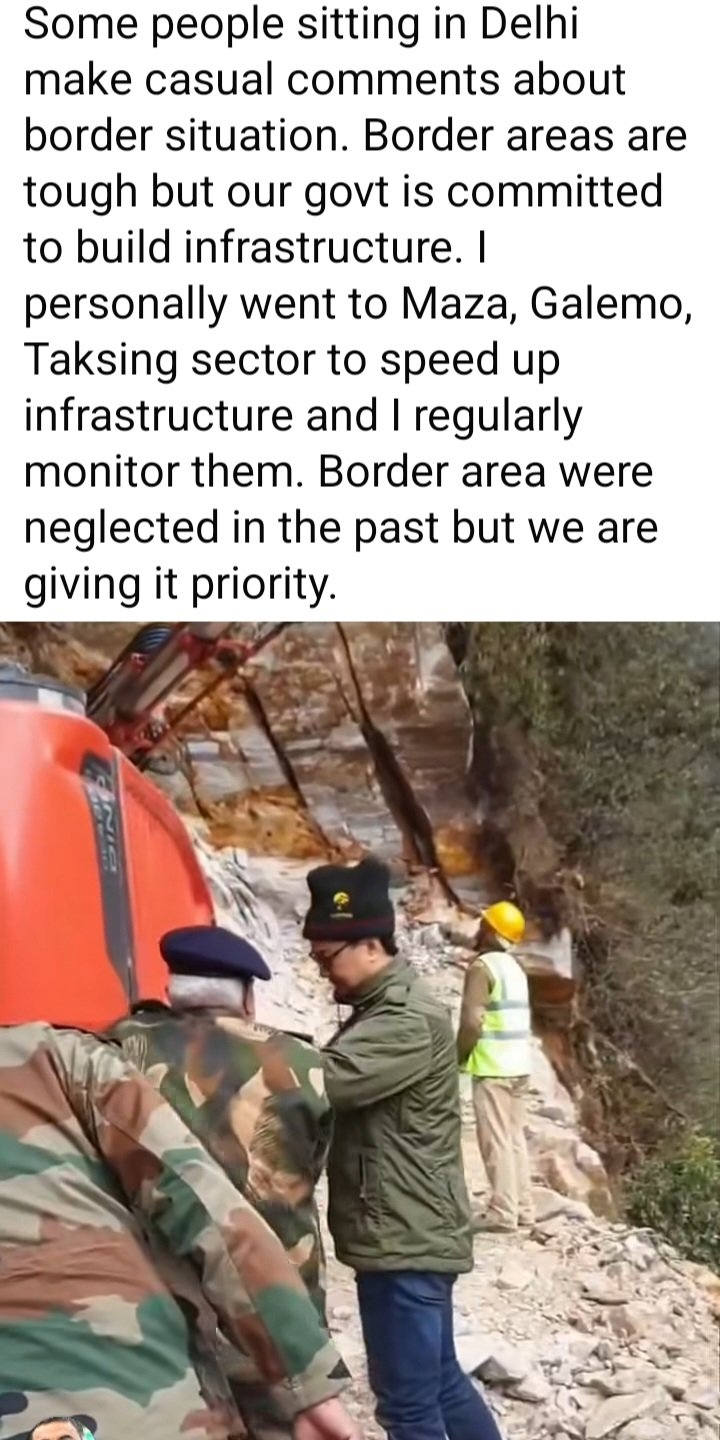
In a video from a remote border area, Rijiju pointed to the ongoing construction of roads by the Border Roads Organisation and said the India-China boundary in forward areas of Arunachal Pradesh has not been formally and legally demarcated, resulting in competing claims.
He said the Army, BRO and security personnel are deployed along the frontier and strongly protecting it. Claims that Chinese forces have moved 50–60 kilometres inside Indian territory, he said, are not true.
Rijiju also underlined the transformation of India's border infrastructure since 2014, contrasting it with the earlier policy of the Congress regimes holding back infrastructure development along sensitive border areas.
He said India has since accelerated road and other infrastructure construction even as China has developed extensive infrastructure on its side.
Importantly, Rijiju cautioned that allegations suggesting that Indian security forces have allowed major territorial inroads can undermine the morale of personnel guarding the frontier.
The political disagreement, therefore, is not simply about whether the border is vulnerable.
It is also about how such vulnerabilities should be discussed without either ignoring legitimate concerns or weakening public confidence in those guarding the country.
Then came a four-year-old's innocent message
Amid this politically charged debate, a completely different video from Arunachal Pradesh has captured the country's imagination.
A four-year-old Arunachali girl appears in a video in which she is reportedly asked to say something Chinese. Her innocent response is that she is in India, she likes India, and she does not like being asked to say that she is Chinese.
The child's simple assertion of belonging has struck an emotional chord far beyond Arunachal Pradesh. The video has spread rapidly across social media, with users sharing, remixing and reproducing it in reels and AI-generated content.
In the race for views and monetisation, the original innocence of the moment risks getting buried beneath countless derivative videos.
Yet the little girl herself has emerged as an unlikely symbol of something much larger: the emotional connection people living on India's remote frontiers have with the country.
For millions watching the video, her message requires no political speech, no military briefing and no parliamentary argument.
She simply says she is Indian.
That innocence perhaps explains why the video has resonated so deeply.
The Arunachal border debate will continue to involve maps, claims, counterclaims, roads, patrols and military preparedness.
But the little girl's message brings the issue down to its most basic human dimension: the people who live on India's frontier are not merely lines on a map. Their land, homes, identity and sense of belonging matter.
Border security demands vigilance. Border development demands roads and connectivity. And territorial integrity ultimately requires both a strong security establishment and the confidence of the people living closest to the frontier.
Whatever the political differences, one point should remain beyond dispute: India must protect its territory and its frontier communities with vigilance, preparedness and resolve.
#ArunachalPradesh #IndiaChinaBorder #BorderSecurity #JaiHind