
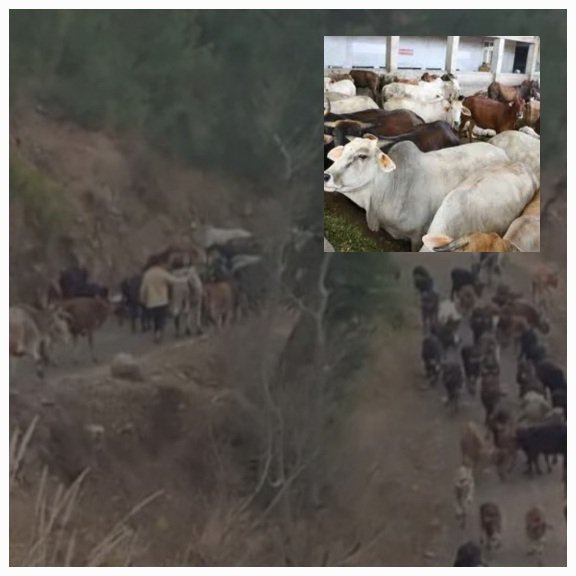
Stray Cattle Menace in Apple Orchards and other crop fields Across Himachal, Exposes Gaps in Enforcement and Animal Welfare. Here are some encouraging stories/ solution on how to manage the menace
SHIMLA/TIKKAR/CHOPAL: EVERY few days, the same distressing story come  to light across Himachal Pradesh's apple-growing villages.
Stray and abandoned cattle wander into orchards under the cover of darkness, damaging apple trees, destroying crops and leaving worried farmers counting their losses.
What was once an occasional nuisance has now become a full-blown rural crisis stretching from one village to another.
From Rohru and Jubbal in Shimla district to other apple belts of the state, villagers say they are spending sleepless nights guarding orchards that represent their only source of livelihood.
Small groups of residents regularly drive away stray cattle from apple orchards and crop fields, only to find the same animals returning within a day or two. The problem is no longer confined to agriculture alone; it has become a social, economic and environmental challenge.
The irony is hard to miss. Himachal Pradesh has a dedicated statutory body, the Himachal Pradesh Gau Seva Aayog, entrusted with the protection, preservation and welfare of cattle.
The Aayog supports gaushalas, gau-sadans, cow sanctuaries and Gau Vigyan Kendras for managing abandoned and non-productive cattle.
Under the state's Gaupal Yojana, registered gaushalas receive financial assistance for maintaining abandoned cattle. The incentive, which stood at ₹700 per animal per month, was increased to ₹1,200 from August 2025.
According to official figures, as of July 2025, Himachal Pradesh had 276 Gau-Sadans and Gau-Abhyaranyas sheltering 21,306 abandoned cattle.
The Aayog works with Panchayats, the Animal Husbandry Department and the Police to identify and rehabilitate abandoned cattle, provide support to gaushalas, and monitor cases of illegal abandonment and cattle smuggling.
Yet, despite this elaborate framework, stray cattle continue to roam roadsides, forests and agricultural fields across the state.
Ask farmers and they argue that cow sanctuaries and gau-sadans remain too few and too far between to effectively tackle the growing number of abandoned animals in the apple belt.
In many areas, villagers routinely encounter cattle wandering along highways, village roads and forest edges before they eventually stray into orchards and standing crops.
The root of the problem lies in a disturbing social trend. When cattle cease to be economically productive, many owners quietly abandon them instead of handing them over to authorised shelters.
These animals are often driven far away from their native villages, transferring the burden to neighbouring communities.
Farmers say this reflects an alarming erosion of compassion towards livestock that once served households through milk production, farming operations and other rural needs.
The state already possesses the legal and administrative mechanisms required to address the issue.
The Panchayati Raj framework empowers local bodies to identify owners, impose penalties and take action against those abandoning cattle.
However, villagers and activists allege that enforcement remains weak. Lack of coordination among government departments, Panchayati Raj Institutions, local bodies, police and animal welfare agencies has allowed the problem to persist despite the availability of funds, schemes and statutory powers.
The consequences extend beyond damaged orchards and crop losses. Stray cattle increasingly move through forests, grasslands and fragile mountain ecosystems, causing damage to natural vegetation.
The growing presence of abandoned livestock in ecologically sensitive areas adds further stress to already fragile Himalayan landscapes.
Yet there are very few success stories in apple and within Himachal Pradesh that demonstrate the problem can be managed effectively when communities adopt a professional yet compassionate approach.
Some gau-sadans have evolved into self-sustaining models by combining animal welfare with sound management practices.
There are motivated volunteers who have become role models for others. In Chopal Milki Ram is single handedly managing cow sadan of 400 cows.
Another example is gau sadan run by Gau sanrakshan Seva Samiti at Sanora in Rajgarh.
In Sunni Basantpur, gau sadan was constructed at tge cost of Rs 2.35 crore has become a sustaining centre. Milk from productive cows is sold in nearby urban centres, while organic manure is supplied to local farmers.
The income generated is ploughed back into maintaining the shelters but they need more sustained support.
Milki Ram faces the pinch as local wealthier section in Chopal don't come forward to assist the cow sadan as there is paucity of funds and feed mainly in winter months.
These examples are encouraging and show that with community ownership, accountability and sustainable business practices, cow shelters can become viable institutions rather than merely holding centres for abandoned cattle.
The way forward lies in treating stray cattle not merely as an agricultural problem but as a governance, animal welfare and social responsibility issue.
Every abandoned animal should be tagged and traced back to its owner, with Panchayats empowered and encouraged to impose penalties under existing laws.
More cow sanctuaries and gau-sadans need to be established in vulnerable apple-growing regions, while the financial support already provided by the government must be linked to measurable outcomes in cattle rehabilitation.
Village-level committees, Panchayati Raj Institutions, the Animal Husbandry Department, Police and the Gau Seva Aayog must work in tandem rather than in silos.
The successful Sunni and Chopal models offer a practical roadmap for the future. Replicating such community-managed, financially sustainable cattle shelters across Himachal's apple belt could help transform abandoned cattle from a liability into an asset through organised dairy production, organic manure marketing and rural employment generation.
Unless accountability is fixed and coordination strengthened, stray cattle will continue to roam roads, forests and orchards, threatening farmers' livelihoods, public safety and the fragile Himalayan ecosystem.
The challenge facing Himachal is not the absence of laws, institutions or schemes, but the collective will to implement them effectively on the ground. (WITH INPUTS FROM HIMBUMAIL REPORTER)
#HimachalPradesh #AppleOrchards #StrayCattle #RuralGovernance #AnimalWelfare