
Supreme Court Examination Reform Case: Centre Seeks UDF Inputs on Leak-Proof National Examination System
New Delhi, August 26, 2026:
With the Supreme Court monitoring the Centre’s response on systemic reforms in the country’s examination system and directing the government to file its reply on the steps being taken to strengthen examination integrity, the Centre has sought inputs from the United Doctors Front (UDF), one of India’s leading doctors’ associations, on comprehensive examination reforms.
The UDF has now been invited to place its recommendations before the High Power Task Force (HPTF) on Examination Reforms on August 27 at 11 am at the National Recruitment Agency (NRA), New Delhi. The meeting will be chaired by Amrit Lal Meena, former Chief Secretary and Member of the High Power Task Force.
The development assumes significance as the UDF’s petition seeking structural reforms in the examination system is also pending before the Supreme Court.
The apex court, in its last hearing, directed the Centre to place on record its response on the measures being taken to institutionalise examination reforms and strengthen the system against paper leaks, manipulation and other security failures.
Against this backdrop, the invitation to the UDF to present its recommendations before the Prime Minister-constituted task force is being viewed as an opportunity to bring the concerns raised before the Supreme Court into the broader policy process.
The UDF is expected to present a detailed blueprint covering question-paper security, secure printing, transportation and storage, cybersecurity, computer-based testing, examination-centre security, chain of custody, digital forensics, pre- and post-examination safeguards and fixing of institutional accountability.
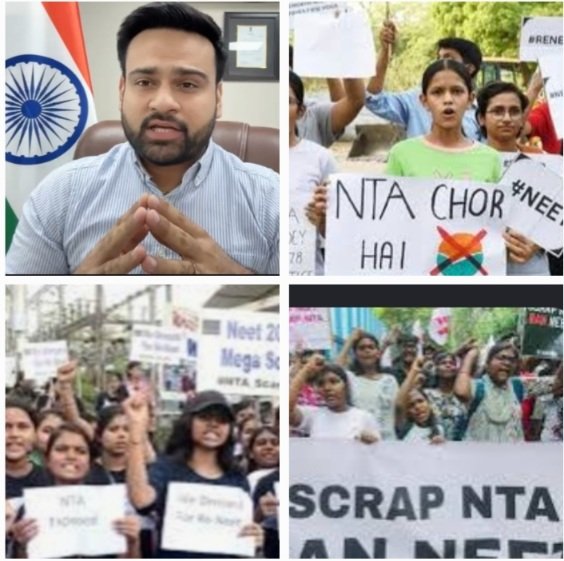
Its principal demand is for replacing the existing National Testing Agency framework with a Statutory National Examination Authority through an Act of Parliament.
UDF Chairperson Dr. Lakshya Mittal said the country cannot afford an examination system that relies on ad-hoc fixes after every controversy.
“India’s examination system cannot continue to depend upon ad-hoc arrangements and corrective measures after every controversy. The future of crores of students and young Indians requires a permanent, professionally staffed, technologically secure and accountable examination institution,” he said.
The UDF will also propose permanent professional manpower for examination management, independent security audits, certified examination centres, robust cybersecurity and digital-forensic capabilities, institutionalised chain-of-custody mechanisms and time-bound implementation of examination reform recommendations.
The association has consistently argued that examination security must be treated as an end-to-end process rather than being confined to preventing malpractice at examination centres.
According to the UDF, vulnerabilities can arise at multiple stages—from question-paper creation and printing to storage, transportation, digital systems, centre management and post-examination processing.
“Our objective is not merely to secure the next examination. We want to help build an examination system in which paper leaks become structurally difficult, responsibility is clearly fixed, technology is secure and students can have complete faith in the process,” Dr. Mittal said.
The August 27 meeting is therefore significant not merely as another consultation exercise, but as part of a larger examination-reform process unfolding alongside judicial scrutiny.
With the Supreme Court awaiting the Centre’s response, the UDF is expected to push for reforms that are statutory, permanent and accountable rather than crisis-driven and temporary.
“For every student who studies hard, the examination system must be worthy of their trust,” Dr. Mittal said.
#ExaminationReforms #SupremeCourt #PaperLeak #NTA