
Nadda 'Hijacks' Highland Health Launch for BJP, Freezes Out Sukhu Govt
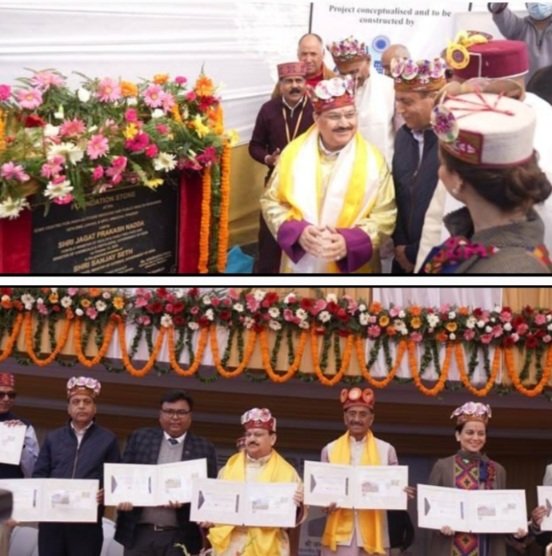
KEYLONG/SHIMLA — A high-profile ceremony here this district headquarters of tribal Lahaul and Spiti marked the foundation-stone laying of the Indian Council of Medical Research (ICMR) Centre for High Altitude Medicine and Public Health Research today.
But the major healthcare research centre quickly turned into a slugfest, transforming into a partisan stage that entirely sidelined the state’s elected government.
Union Health Minister J.P. Nadda and Union Minister of State for Defence Sanjay Seth led the Bhumi Pujan for the long-awaited permanent facility.
However, the dais was conspicuously dominated by Bharatiya Janata Party (BJP) figures—including Mandi MP Kangana Ranaut, Leader of Opposition Jai Ram Thakur, and former local MLA Ravi Thakur—while Himachal Pradesh Chief Minister Sukhvinder Singh Sukhu, the State Health Minister, and the sitting local Congress MLA Anuradha Rana were bypassed as they were conspicuousby their absence.
It has triggered accusations of undermining cooperative federalism during a vital public health rollout.
Political optics and posturing aside, the permanent institute revives a project of urgent necessity that had languished in semi-dormancy for nearly a decade since ICMR first established a temporary field station at Keylong.
Designed as a year-round, cutting-edge hub, the facility unites ICMR, the Armed Forces Medical Services (AFMS), and AIIMS Bilaspur to build India’s own empirical scientific database on extreme mountain environments.
The collaborative research mandate directly addresses high-altitude physiology, low oxygen levels, severe cold, and acclimatization protocols.
For armed forces personnel stationed in harsh forward border posts including Siachin glacier, the highest battle ground in the world in the Himalayas, these studies aim to translate laboratory findings into operational triage against conditions like pulmonary and cerebral edema, said ICMR experts.
Simultaneously, the center will tackle critical civilian issues, including tribal maternal-neonatal health, child growth metrics, and the deployment of drone-assisted medicine delivery and artificial intelligence in isolated snowbound valleys.
Crucially, the center steps into an unaddressed public health crisis triggered by surging mountain tourism.
With the influx of both domestic and international travelers ascending rapidly to high elevations across Himachal Pradesh and neighboring Himalayan belts, acute mountain sickness and severe altitude-related complications have surged.
In the complete absence of systematic mortality tracking or baseline health registries, the research center is set to provide standardized clinical evidence to curb preventable tourist fatalities.
On the other it will improve healthcare access for border communities across Ladakh, Uttarakhand, Sikkim, and Arunachal Pradesh as well.
Addressing the gathering Union Health Minister Shri Jagat Prakash Nadda said the dedicated research centre will strengthen preventive healthcare and address unique health challenges of Himalayan communities.
"ICMR, Armed Forces Medical Services and AIIMS Bilaspur to join hands for high-altitude health research."
Dr. Rajiv Bahl, Secretary, Department of Health Research and Director General, ICMR said Keylong will be a place where the laboratory and the community meet, where local people are partners in research and where the goal is better health, not just research papers.
Air Marshal Sandeep Thareja, Director General Armed Forces Medical Services (DGFMS) said : "Combining the AFMS field experience with ICMR’s scientific expertise would help turn research findings into practical protocols for acclimatisation, early detection and treatment."
Senior officers of the Armed Forces Medical Services and the Indian Air Force were also present.
#HighAltitudeMedicine #Keylong #HimalayanHealthcare #ICMR