
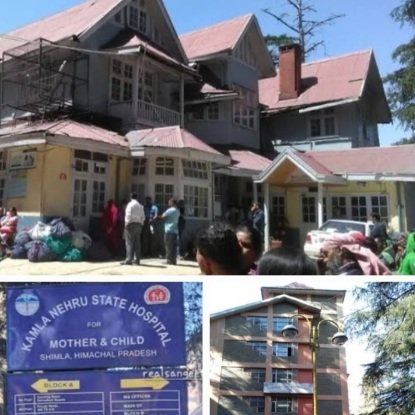
KNH shift to IGMC faces a reality check: Technical committee flags space crunch, overcrowding and operational hurdles
SHIMLA: The proposed shifting of the Gynaecology and other services of Kamla Nehru Hospital (KNH) to IGMC Shimla has entered a crucial phase, with the report of the government-appointed technical committee expected to be examined by the state government before it takes its next decision.
The report assumes significance because it has reportedly substantiated several concerns repeatedly raised by KNH doctors, SAMDCOT, residents and women’s organisations—that shifting a full-fledged, state-level mother-and-child hospital into an already crowded IGMC could create more problems than it solves.
As a matter of fact, across the world, obstetrics and gynaecology are recognised as a single, integrated medical speciality because the health of women cannot be divided between two disconnected systems.
From high-risk pregnancies and childbirth emergencies to gynaecological surgery, reproductive health and post-operative care, the two disciplines require seamless coordination, round-the-clock specialist support, operating theatres, anaesthesia, blood-bank services, diagnostics and critical care.
Established healthcare standards therefore favour integrated, multidisciplinary care rather than fragmenting essential services.
If the state government has any regard for patient safety and medical wisdom, Obstetrics and Gynaecology at KNH must function as one full-fledged speciality under one roof—not be split between KNH and IGMC, a move that could disrupt continuity of care and put mothers and patients at avoidable risk.
The technical committee has reportedly found serious space constraints and overcrowding at IGMC, raising questions over the feasibility of accommodating KNH departments and their patients without putting additional pressure on the existing healthcare infrastructure.
The report is now expected to be placed before Chief Minister Sukhvinder Singh Sukhu, the Health Minister, senior Health Department officials, advisers and other stakeholders for detailed examination. Only after the report is considered at the government level will the administration decide its next course of action.
Technical report vindicates what KNH stakeholders have been saying
For years, doctors and local stakeholders have argued that KNH cannot be treated as merely another hospital department that can be shifted from one campus to another.
KNH is a specialised mother-and-child hospital with an established ecosystem for obstetrics, gynaecology, neonatal and paediatric care. Any disruption in this integrated system could have direct consequences for women and newborns.
The technical committee’s reported findings on space and overcrowding at IGMC have now given official weight to those concerns.
The question confronting the government is straightforward: If IGMC itself is struggling for space, where will the additional infrastructure required to absorb KNH services come from?
80,000 women depend on the hospital every year
The scale of KNH’s role makes the proposed shift even more sensitive.
The hospital reportedly caters to around 80,000 women every year for treatment and childbirth-related services. Parking and accommodation of staff are already challenging at IGMC, while adding KNH departments would bring thousands more patients, attendants and healthcare workers into an already congested campus.
A technical assessment has reportedly also pointed to difficulties in accommodating the proposed departments without affecting the smooth functioning of the existing services.
This is why the issue has moved beyond an administrative decision about buildings and departments.
It is fundamentally a question of whether maternal and neonatal healthcare can be safely reorganised without weakening an established specialised institution.
Women’s organisation already in High Court
The government’s proposed move has also been challenged before the Himachal Pradesh High Court by a women’s organisation, which has sought a stay on shifting the Gynaecology services from KNH to IGMC.
The petition reflects the wider apprehension among women’s groups and residents that transferring the Gynaecology wing to an already congested IGMC could cause hardship to women patients and adversely affect the specialised mother-and-child healthcare system at KNH.
The matter remains pending before the High Court.
The technical committee report therefore acquires an additional significance: the government will now have to examine the technical findings while the judicial proceedings over the proposed shifting are still underway.
KNH’s location has a medical advantage that cannot be ignored
There is also a geographical and climatic dimension to the controversy that has received inadequate attention.
KNH is located on the southern, sunnier face of Shimla. Its location provides comparatively better exposure to sunlight and warmth, an important environmental advantage for mothers recovering after childbirth and vulnerable newborns.
IGMC, on the other hand, is located on the northern side of the city, where winter conditions are considerably colder and the campus receives less direct sunlight.
For ordinary hospital services, such differences might appear secondary. But for gynaecology, obstetrics, premature babies and neonatal care, the physical environment, warmth, sunlight, accessibility, patient movement and availability of adequate space are all relevant to patient comfort and care.
‘A medical disaster’ if convenience overrides clinical realities
Those opposing the move have repeatedly warned that shifting a full-fledged mother-and-child hospital into an already crowded tertiary-care institution could prove to be a medical disaster if infrastructure and patient-care requirements are not adequately assessed.
The technical committee appears to have done precisely what the stakeholders had been demanding: examined the proposal from the standpoint of available infrastructure and practical feasibility rather than administrative convenience alone.
Its findings will now have to be weighed by the government before proceeding any further.
Government faces a crucial decision
The state government is now caught between its original proposal to reorganise KNH services and a technical assessment that reportedly raises serious questions about the capacity of IGMC to absorb them.
The report will be examined by the Chief Minister, Health Minister, Health Department officials, advisers and other concerned stakeholders, following which the government will be required to formulate its response.
With the matter already before the High Court, any decision will also have to withstand judicial scrutiny.
For KNH’s supporters, the issue is no longer about resisting change for the sake of resistance. It is about ensuring that a specialised institution serving mothers and children is not dismantled or shifted without establishing that the receiving institution has the space, environment and infrastructure to safely take over its workload.
The technical committee’s report has now put that question squarely before the government.
The government wanted to shift KNH. The technical assessment has now asked the more fundamental question—does IGMC have the capacity to receive it?
Himbumail.com Series
The KNH controversy has entered its decisive phase. The technical committee has reportedly backed several concerns raised by doctors, SAMDCOT, residents and women’s organisations.
The High Court challenge is pending. It remains to be seen whether the government would drop the proposal and instead do something to strengthen the KNH, making all facilities available at the hospital as the state government has already spent over Rs 20 Crore on the upgrade of KNH in the recent past.
At stake are the health issues of mothers, newborns and women patients. No government can ignore it.
#SaveKNH #KNHShimla #IGMC #HimachalHealth #MotherAndChildCare