
UNGUARDED CURVES, DEADLY POLES, AND LEGISLATIVE SILENCE: HIMACHAL’S ROADS BECOME A GRAVEYARD FOR ITS YOUTH. Mr GADKARI HILL STATES NEED SEPERATE BUDGET FOR CRASH BARRIERS TO SAVE PRECIOUS YOUNG LIVES
SHIMLA/DHARAMSHALA / MANDI:
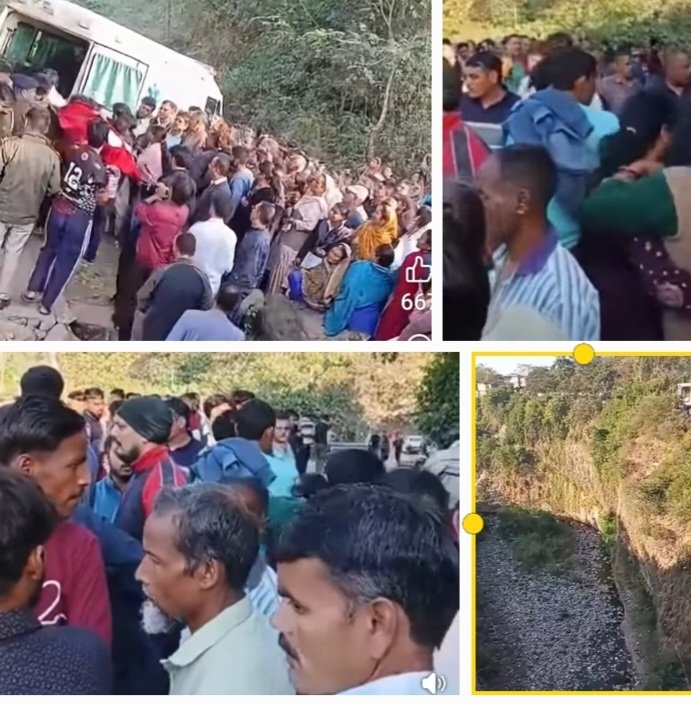
Six young men died near Lad Bharol Bazaar in Mandi district after their car missed a sharp, unguarded curve and plunged two hundred feet into a deep gorge.
The victims—Ayush Rai, Anuj Kumar, and Yash Rai of Simas, Pankaj Kumar and Arnav Thakur of Gawala, and Aditya Kumar of Balotu—lay undiscovered in the ravine for nearly fifteen hours while their families searched in vain.
No hearths were lit in those shattered villages as mothers wailed in empty homes.
The six youngsters, four of them minors, were returning from a birthday function when the driver lost control on a narrow, unprotected bend. Grieving families say one steel crash barrier at that blind curve would have stopped the car and saved their sons.
Shockingly, while the Himachal Pradesh Vidhan Sabha winter session is underway right now at Tapovan in Dharamshala, elected lawmakers have failed to debate this killer road crisis. Not a word was uttered in Vidhan sabha by the MLAs.
All they did was that they were busy debating why Sundar Thakur was not made Minister or they were staging protest washing dirty linen out the vidhan sabha to grabe cheap publicity eyeing next elections.
Sitting MLAs offered nothing more than a passing condolence mention before adjourning for the day, refusing to hold a single substantive discussion on why young blood stains the state's highways. While ruling and opposition legislators trade political barbs inside the House, public anger is boiling over their glaring insensitivity toward the daily slaughter of Himachal's youth.
Two other recent horrors prove that the state machinery has learned nothing from this carnage. In one wreck, a jubilant young athlete from Hamirpur was returning home after winning a tournament in Kupvi when his head struck a useless pole planted right on the road edge, killing him instantly while his mother sits inconsolable back home. In another crash, a Fortuner carrying students from Devat Government Senior Secondary School toward Shantha and Duina missed an unguarded bend, plunged down a steep slope, killed two schoolchildren, and left five injured.
Across the hills, weeping mothers are burying their children while departments hide behind hollow excuses. Missing crash barriers, absent warning signs, and encroaching electricity and telecom poles have turned daily travel into a deadly gamble.
Whether it is schoolchildren heading home from Dewat, a young champion returning from Kupvi, or wedding guests near Lad Bharol, the pattern of criminal engineering neglect never changes.
Himachal Pradesh has over forty-two thousand kilometres of mountain roads, and not a single district is free from sheer cliffs and blind bends.
Rural panchayat tracks, ambulance roads, and Pradhan Mantri Gramin Sadak Yojana routes all lack basic safety railings and warning boards.
Even major highways run by the Public Works Department, the National Highways Authority of India, and the Border Roads Organisation leave deadly drops wide open while power and telecom agencies erect poles like guillotines along narrow shoulders.
Official data from the National Crime Records Bureau exposes the true scale of this daily bloodshed across the hills and the nation.
According to the National Crime Records Bureau's Accidental Deaths and Suicides in India reports, road accidents kill around one thousand people in Himachal Pradesh every year—claiming 1,032 lives in 2,408 crashes in 2021, 885 lives in 2,255 crashes in 2023, and 806 lives in 2,107 crashes in 2024 alongside 3,226 injured.
State transport records further reveal that run-off-road crashes—where vehicles veer off unprotected mountain edges—account for nearly forty percent of all road fatalities in Himachal, pushing the state's accident severity rate of nearly 40 deaths per 100 crashes far above the national average.
National Crime Records Bureau figures also prove that these crashes are wiping out India's youngest and most productive generations.
Across India, road accidents killed 1,75,142 people and injured 4,48,365 in 2024 alone, with overspeeding accounting for 61.2 percent of deaths and dangerous or careless driving causing another 26 percent.
Crucially, the National Crime Records Bureau data confirms that young adults in their prime working years bear the heaviest brunt of accidental deaths.
When one wreck wipes out six youths in three neighbouring villages or kills schoolchildren on their way home, it leaves aging parents with no support and inflicts a lasting demographic and social wound on rural communities.
This deadly crisis extends far beyond Himachal, claiming thousands of lives across the entire Himalayan and north-eastern belt.
In neighbouring Uttarakhand, road crashes claim well over one thousand lives every single year—killing 1,042 people in 2022, 1,054 in 2023, 1,090 in 2024, and surging to 1,242 deaths in 2025.
In Assam, a horrific collision near Kaziranga National Park on National Highway-715 killed at least 23 passengers—including several college students—and injured 20 others.
From Jammu and Kashmir to the Northeast, unguarded highways and lax enforcement are turning routine journeys into mass funerals.
Police often blame overspeeding, rash driving, and youthful thrill-seeking for these wrecks.
Yet road safety experts argue that human error does not excuse lethal road design.
Field findings gathered by HimbuMail confirm that the vast majority of fatal crashes occur at narrow curves, blind bends, and obstructed road edges where departments spend crores on tarring roads so vehicles go faster, yet leave cliff edges completely bare and dead poles standing.
Top political and engineering leaders can no longer pass the buck while young blood stains the mountains.
Union Road Transport and Highways Minister Nitin Gadkari, PWD Minister's of all hill states including Vikramaditya Singh, the PWD Engineer-in-Chiefs of all states , the Chairman of the National Highways Authority of India, and the Director General of the Border Roads Organisation must sit together immediately to end this slaughter.
They must carve out a separate, ring-fenced budget exclusively for crash barriers and make steel guardrails and warning signs mandatory before any mountain road is opened to traffic.
Chief Minister Sukhvinder Singh Sukhu's government and every MLA sitting in Tapovan must wake up from their legislative slumber right now.
The House must break its silence, declare a road safety emergency, order an inch-by-inch audit of every village track and highway, and uproot every hazardous roadside pole.
Unless the Centre and mountain states enforce a strict, zero-tolerance policy on unprotected cliffs and blind bends, our highways will keep burying the nation's youth.
#HimachalRoadSafety #DeathTrapsInHills #WakeUpVidhanSabha #SaveHimalayanYouth #CrashBarriersSaveLives