
Sukhu Opens New Front in Hydro Power Row, Orders Takeover of Three SJVN Projects; Legal Battle Looms Ahead
SHIMLA, JULY 8: In a move that could trigger one of the biggest Centre-State disputes over hydropower assets in recent years, the Himachal Pradesh government has initiated the process to take back the 382 MW Sunni Dam, 210 MW Luhri Stage-I and 66 MW Dhaulasidh hydroelectric projects from SJVN.
Chief Minister Sukhvinder Singh Sukhu today declared that the state's natural resources belonged to its people and described the agreements signed during the previous BJP government as a "sellout" of Himachal Pradesh's interests.
"Our government is moving ahead to take back the Sunni, Luhri and Dhaulasidh power projects. Himachal's natural wealth is the property of its people and only the hardworking and honest people of the state have the right over it.
Protecting the state's interests, dignity and rights remains our highest priority," the Chief Minister said while reiterating his government's commitment to reclaiming what it calls the state's rightful share in hydropower resources.
The announcement signals the beginning of what is expected to be a prolonged legal and contractual battle between the Congress-led state government and SJVN, a Navratna public sector undertaking jointly owned by the Centre and the Himachal Pradesh government.
Legal experts believe SJVN may challenge any unilateral move to terminate or alter agreements, particularly after the company has invested heavily in project development and construction.
The timing of the announcement is politically significant. With Assembly elections due in Himachal Pradesh next year, the Sukhu government has once again placed the issue of "Himachal's rights over its natural resources" at the centre of its political narrative.
Since assuming office, the government has repeatedly argued that previous agreements signed for hydropower projects disproportionately favoured central public sector companies at the cost of the hill state's long-term revenues.
The three projects together represent an installed capacity of 658 MW and form a major component of SJVN's future hydropower portfolio in Himachal Pradesh.
Ironically, only days ago SJVN signed long-term Power Purchase Agreements with Gujarat Urja Vikas Nigam Limited (GUVNL) for sale of electricity from these three upcoming projects, underscoring the company's confidence that the projects would move ahead as planned.
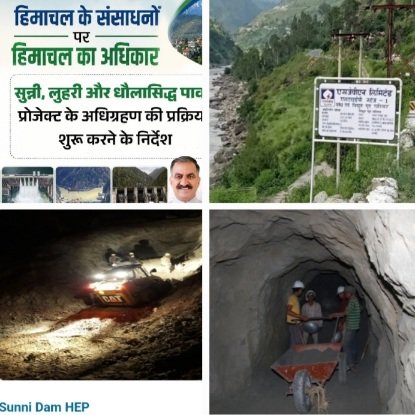
The 382 MW Sunni Dam Hydro Electric Project, located on the Satluj River across Shimla and Mandi districts near Khaira village, is presently the most advanced among the three. Designed as a run-of-the-river project, it is expected to generate around 1,382 million units of electricity annually.
Construction is already underway after award of the main civil works in January 2023.
The diversion tunnel has been completed, the river was diverted in January 2024 and excavation for the dam and underground powerhouse continues. The project carries an approved cost of about Rs 2,614.51 crore.
The 210 MW Luhri Stage-I Hydro Electric Project, also on the Satluj River, forms part of the larger Luhri hydropower cascade.
It is one of SJVN's flagship green energy projects under development and has received major statutory clearances besides investment approvals.
The project is intended to strengthen power generation from the Satluj basin and remains a key component of SJVN's expansion strategy.
The 66 MW Dhaulasidh Hydro Electric Project, situated on the Beas River in Hamirpur and Kangra districts, is designed as a run-of-the-river scheme with peaking capability.
The project is expected to generate around 304 million units of electricity annually. Investment approval of nearly Rs 688 crore was accorded in 2020, financial closure was achieved in 2022 and construction activities have progressed following environmental and forest clearances.
The Sukhu government has consistently maintained that Himachal Pradesh should receive a substantially larger economic return from projects built on its rivers.
It argues that hydropower constitutes the backbone of the state's economy and that future generations should benefit from the state's natural resources instead of allowing outside agencies to reap the larger financial gains.
However, SJVN is expected to defend the allotments vigorously. The company has already secured financing, statutory approvals, engineering contracts and long-term power sale agreements for these projects.
Any attempt to withdraw or renegotiate the allotments could lead to arbitration, litigation and claims involving contractual obligations, investments already made and compensation for delays.
The unfolding dispute is therefore likely to extend beyond political rhetoric into courtrooms, where contractual rights, investment commitments and the constitutional powers of the state over its water resources could all come under judicial scrutiny.
With the election season approaching, the hydropower issue is fast emerging as one of the defining political and economic battles in Himachal Pradesh.
Whether or not the government's promise to reclaim these projects translates into legal success or prolonged litigation.
But CM Sukhu’s move may determine not only the future of three major hydroelectric projects but also the broader debate over ownership and control of the Himalayan state's natural resources as the water falls in concurrent list meaning Union government has greater control over water resources of the country.
As a matter of fact, Water is primarily a State subject under Entry 17 of the State List of the Constitution, giving states legislative powers over water, irrigation, canals, drainage and water storage.
However, this authority is subject to Entry 56 of the Union List, under which Parliament can regulate and develop inter-State rivers and river valleys in the public interest through a law.
The constitutional balance between these provisions is expected to be central to any legal dispute arising from the Himachal Pradesh government's move to reclaim the Sunni, Luhri and Dhaulasidh hydropower projects.
Now the state government has yet to start the legal process to take back the project. How SJVN will respond is yet to be seen. But Sukhu’s move is full of thorns and legal hassles.
#HimachalPradesh #Hydropower #SJVN #SukhvinderSinghSukhu