
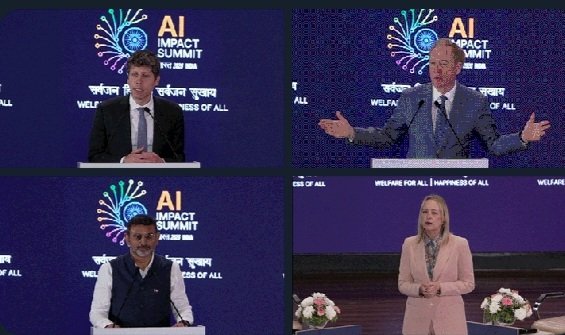
AI Impact Summit and how India is changing. What Altman, Brad Smith Say about AI
New Delhi:
Global technology leaders, policymakers and development voices converged at the AI Impact Summit 2026 in India.
They say artificial intelligence must be democratic, inclusive and human-centred if it is to become a true engine of global progress—especially for the Global South.
The summit was inaugurated by Prime Minister Narendra Modi, who underlined that AI should not become an elite privilege but a tool for inclusion and empowerment.
“AI must work for people, not the other way around,” the Prime Minister said, stressing its potential to transform lives across developing economies.
On the sidelines of the summit, Prime Minister Modi held talks with Guy Parmelin, President of the Swiss Confederation.
The two leaders reaffirmed the strong and multifaceted India–Switzerland partnership, reviewing cooperation across trade and investment, science and technology, innovation, skilling, cultural exchanges and people-to-people ties, while also exchanging views on regional and global issues of shared concern.
The intellectual core of the summit was shaped by keynote addresses from global technology and development leaders, who highlighted both the unprecedented pace of AI advancement and the moral choices that will define its impact.
Sam Altman, CEO of OpenAI, warned that the world may be approaching a historic inflection point.
“On our current trajectory, we may be only a couple of years away from early versions of true super-intelligence,” he said, suggesting that by the end of 2028, more intellectual capacity could reside inside data centres than outside them.
Emphasising openness and resilience, Altman argued that “democratization of AI is the only fair and safe path forward” and the best way to ensure that humanity flourishes.
Echoing concerns about inequality, Brad Smith, Vice Chair and President of Microsoft, framed AI as a decisive force in either narrowing or widening the global economic divide.
He stressed that infrastructure, skilling and linguistic diversity are critical if AI is to genuinely serve the Global South.8 “The real question,” he said, “is whether we use AI to do better.”
From a development lens, Ankur Vora, President of Africa and India Offices at the Gates Foundation, underlined AI’s potential to accelerate outcomes in health, education and agriculture. Rejecting technological determinism, he said the impact of AI is ultimately a choice.
Announcing new philanthropic initiatives, Vora noted that the true test of AI will be whether it delivers tangible improvements for communities that have historically been left behind.
Calling for large-scale reinvention, Julie Sweet, Chair and CEO of Accenture, described AI as the only viable engine for future global growth.
However, she cautioned that prosperity will depend on leadership, global standards and workforce transformation, with humans remaining firmly in the lead.
Taken together, the summit captured the defining tension of the AI era—extraordinary technological acceleration alongside an urgent demand for responsibility, inclusion and democratic governance.
AI must not deepen divides or concentrate power, but expand opportunity and be shaped by human values and purposeful leadership.