Statewide Model Emerges as Gosadans Turn Apple Twigs into Cow Feed.
Farmers need Cheap Shredders to make it a viable alternative
SHIMLA/ CHOPAL/MANALI:
What began as a local experiment in Chopal and Manali is now being seen as a model that can be extended to all Gow Sadans across Himachal Pradesh.
Experts and farmers say the initiative of converting pruned apple twigs into cow fodder and manure has the potential to transform orchard waste management statewide.
They are also demanding subsidies for shredder machines so that small and marginal farmers can afford them and process twigs within their own orchards instead of burning them.
A silent shift is taking place in Himachal’s apple heartland, where the familiar winter ritual of burning pruned apple branches is slowly being replaced by a cleaner, smarter alternative.
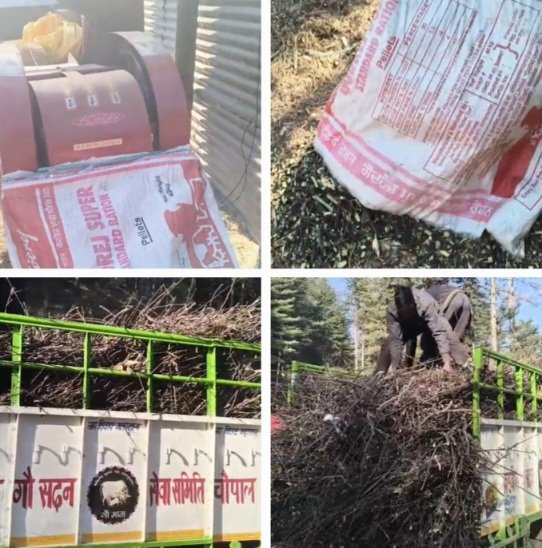
At Chopal Gow Sadan and Manali Gosadan, orchard waste is now being converted into cow fodder and organic manure, offering a practical solution to the annual pollution crisis.
Every winter, apple growers prune their orchards to improve tree health and fruit quality.
The exercise generates huge quantities of dry branches which, for years, were set on fire to clear orchard floors.
The smoke would hang over entire valleys, turning towns and villages into virtual gas chambers.
Residents complained of burning eyes, breathlessness and worsening asthma, while the risk of fires spreading into nearby forests remained a constant threat.
This season, the picture is changing. At the Gosadans, pruned twigs are being collected and fed into shredding machines that convert them into small, chewable particles.
Cows readily consume this fodder, caretakers say, as apple twigs carry a natural sweetness that makes them more palatable than ordinary dry grass.
The shredded waste is also mixed with other feed and manure, creating a low-cost, sustainable alternative to commercial fodder.
Officials managing the Gosadans stress one important precaution. Only those twigs which have not been sprayed with harmful pesticides or insecticides are accepted.
Chemical residues, they warn, can seriously affect cattle health. Farmers are therefore being advised to separate untreated branches or ensure they are safe before supplying them for shredding.
The environmental impact of this shift is already visible. With fewer orchard fires, smoke levels have reduced in parts of Chopal and Manali.
Forest officials say this also lowers the risk of accidental wildfires during dry months, which every year destroy patches of forest and threaten wildlife habitats across Himachal.
Apart from fodder, the shredded apple wood is finding multiple uses. Farmers are using it as mulch in orchards to retain moisture and improve soil fertility. Some are spreading it on pathways and slippery roads as a natural anti-skid layer during winter. Others are composting it to enrich their fields, proving that what was once treated as waste has real economic and environmental value.
President Integrated Mountain Initiative, Ramesh Negi, (CS Retd), termed the initiative a “game changer” for apple-growing regions.
“No burning, no pollution,” he said, expressing happiness that the idea is gaining popularity. He added that such simple solutions can drastically improve air quality if adopted across the apple belt.
President of Save Lahaul-Spiti Society BS Rana confirmed that similar efforts have been underway at Manali Gosadan for some time. He said the model proves that sustainable waste management is possible even in remote hill areas.
On the question of carbon credits, he explained that while the process exists under international mechanisms, it is lengthy and mostly applies to new plantations. However, he added, the climate benefits at the local level are undeniable.
Farmers’ groups and environmentalists are now urging the state government to replicate this initiative in all Gow Sadans of Himachal Pradesh.
They say subsidising shredders will allow small and marginal growers to process twigs on their own farms, convert them into compost and manure, and completely eliminate the need for burning.
For now, the Chopal-Manali experiment stands out as a hopeful example. As winter sets in and pruning season peaks, these Gosadans are showing that Himachal’s apple waste can be turned into a resource rather than a threat.
READERS RESPONSES:
1. The initiative is good, but there are serious doubts about using shredded pruned material as cow feed. Orchards are sprayed 8–10 times a year, and these chemicals are absorbed by plants. Using such waste as fodder may harm cattle.
It is an excellent option for manure and will help reduce pollution. However, using it as feed needs proper scientific testing. Even months after spraying, pruned wood shows blue and green flames when burnt, indicating chemical residues.
Before promoting this practice for animals, detailed research on pesticide residues and their effects is essential.
-RAMESH MEHTA, (APPLE FARMER, ExSERVICEMAN, CHOPAL)