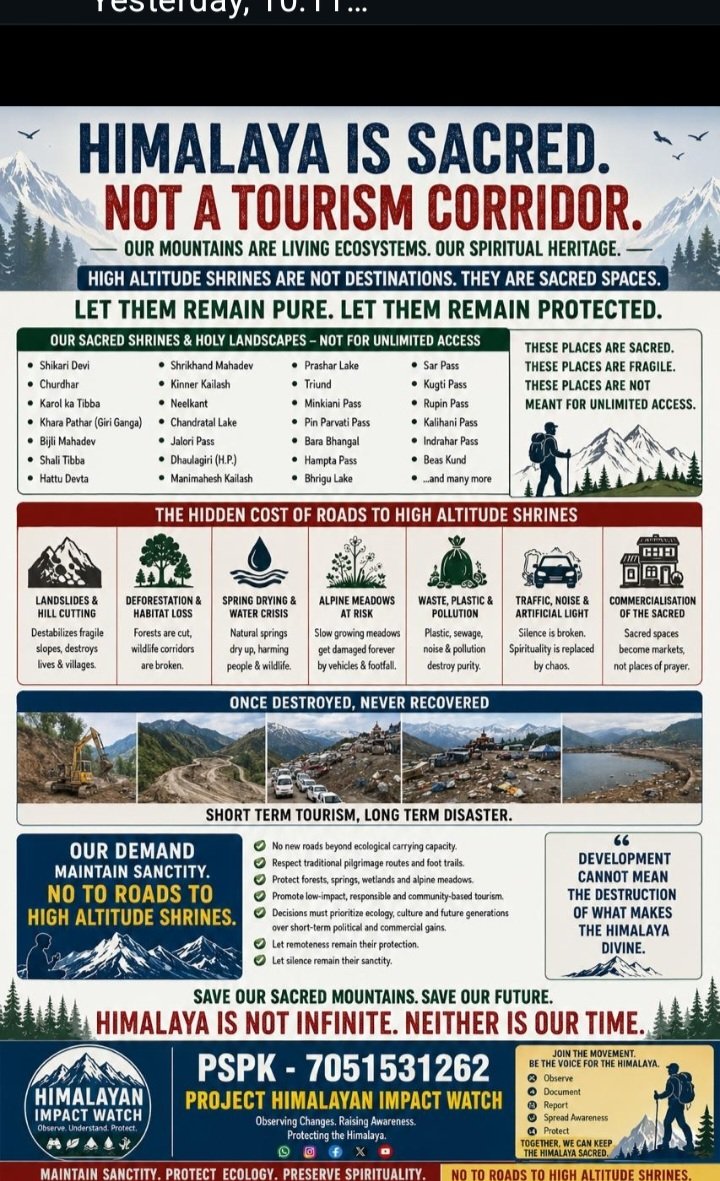

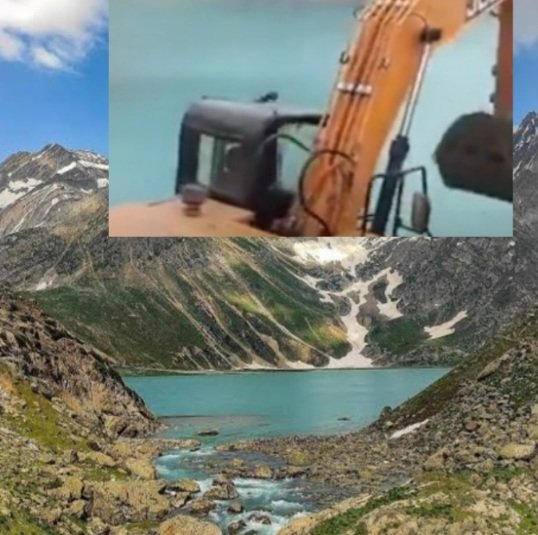
Bulldozing the Sacred: Kashmir’s Fragile Sheshnag Lake Faces Ecological Peril Amid Unchecked Road Work. Dr Karan Singh, Mufti Join Hands Slamming Omar Abdullah Government.
SRINAGAR: Heavy earth-moving machinery roaring along the banks of the sacred high-altitude Sheshnag Lake has ignited a fierce political and environmental storm across Jammu and Kashmir, raising alarms over an impending ecological catastrophe in the high-altitude Himalayas.
Critics, scientists, and political heavyweights have united in condemning the Border Roads Organisation’s (BRO) ongoing excavation and track-widening activities, warning that the administration is inviting a man-made disaster in the name of pilgrimage infrastructure at an high-altitude lake Sheshnag located at 3590 m in a fragile ecosystem.
A rare consensus has emerged across Kashmir’s fractured political spectrum as leaders from the Dogra dynasty to the Peoples Democratic Party (PDP) demand an immediate halt to the project.
Veteran Congress leader and former Sadr-e-Riyasat Dr. Karan Singh strongly opposed the deployment of excavators along the Pahalgam-Amarnath axis, stating that authorities need not convert every sacred pilgrim trail into a motorable highway for tourist convenience.
Echoing his father's warning, Dogra scion Vikramaditya Singh termed the felling of protected Chinar and Chestnut trees alongside construction near Sheshnag "deeply concerning," urging the government to enforce strict monitoring before the region suffers irreversible damage.
The Omar Abdullah-led administration is facing blistering criticism over a cabinet clearance that paved the way for heavy machinery in this eco-sensitive zone.
PDP chief Mehbooba Mufti revealed that the cabinet cleared the Sheshnag road project on January 23, 2026, by extending a Memorandum of Understanding (MoU) with BRO’s Project Beacon.
Demanding the immediate cancellation and public disclosure of the agreement, Mufti accused the government of launching an "assault on our fragile ecology" without an environmental impact assessment, warning that destroying the lake’s delicate ecosystem threatens the very survival of the Amarnath Yatra.
Scientific warnings underscore the grave danger of tampering with Sheshnag, which is officially classified among Jammu and Kashmir’s 14 high-risk glacial lakes.
Prominent environmental activist Dr. Raja Muzaffar Bhat warned that excavating and digging a circumambulation path around a volatile glacial waterbody risks triggering a catastrophic Glacial Lake Outburst Flood (GLOF).
Bhat demanded that J&K Environment and Forest Minister Altaf Kaloo immediately convene a joint press conference featuring top glaciologist Prof. Shakil Ahmad Romshoo, J&K Pollution Control Committee Chairman Vasu Yadav, and Chief Wildlife Warden Sarvesh Rai to present transparent, science-backed facts rather than political assurances.
The reckless push for high-altitude concretization ignores the grim lessons of recent Himalayan tragedies, including the devastating August 2026 floods in central Nepal.
The transboundary catastrophe in Nepal’s Rasuwa district and Gyirong along the Nepal-China border—triggered by high-altitude glacial and rock-ice instability—claimed well over a thousand lives and obliterated highways, bridges, and hydropower infrastructure.
Environmentalists point out that with climate change rapidly destabilizing Himalayan permafrost and triggering extreme disasters from Uttarakhand to Nepal, carving up alpine habitats with JCBs is a recipe for carnage.
Despite mounting statewide outrage from civil society, NGOs, and citizens, official accountability remains conspicuously absent.
While the BRO maintains that work is confined to safety upgrades on existing tracks, the lack of an independent scientific audit has only deepened public distrust.
Unless the J&K government revokes the clearance and halts the excavation immediately, Kashmir’s pristine alpine heritage risks becoming the next casualty of short-sighted Himalayan over-development.
#SaveSheshnag #KashmirEcology #HimalayanCrisis #StopGLOF #ProtectKashmir