Saat Modh Highway Plan Sparks Fury: Civil Society Warns of Elephant-Human Conflict and ‘Green Destruction’
DEHRADUN/RISHIKESH, AUGUST 14: The widening of the Saat Modh road in Rishikesh has triggered a sharp backlash from environmentalists, civil society leaders, activists and local residents, who have accused the government and the National Highways Authority of India (NHAI) of pushing a reckless highway construction model that could destroy a crucial elephant habitat and intensify human-wildlife conflict.
The civil society leaders have issued a clarion call to save Saat Modh, saying they will tie rakhis to trees on Raksha Bandhan as a pledge to protect the forest.
On Himalaya Day, they will organise “Ye Kaisa Himalaya Diwas” as a mark of protest and to “wake up” Union Road Transport and Highways Minister Nitin Gadkari and Uttarakhand Chief Minister Pushkar Singh Dhami from what they described as a “stupor and development delirium”.
They assert that the race for so-called super highways cannot be allowed to turn the green gateway to Rishikesh into a corridor of ecological destruction.
‘Where will the elephants go?’
Environmentalist Himanshu Arora said the simultaneous widening of the Rishikesh-Saat Modh road and Thano road would effectively squeeze elephants between expanding concrete corridors.
“We are continuously destroying the natural habitat of wildlife. On one side, the Saat Modh road is being expanded to four or six lanes, and on the other, the Thano road is being widened. This is like enclosing elephants in a concrete trap,” he said.
“If we take away their habitat and walking paths, where will the animals go? They will be forced towards human settlements, and that will escalate human-wildlife conflict to dangerous levels,” Arora said.
He said the issue was not simply about cutting trees.
“We are destroying an entire living ecosystem and then expecting wildlife to adjust to our concrete development.”
‘Dehradun cannot be reduced to a concrete jungle’
Anoop Nautiyal cited RTI information to highlight the scale of forest loss in Dehradun.
“In the last 25 years, since the formation of Uttarakhand, 47 per cent of the total deforestation in the state has occurred in Dehradun district alone,” he said.
“If trees and forests have been cut on such a massive scale in just 25 years, the remaining forests too will disappear if this model continues. Dehradun will ultimately be reduced to a concrete jungle,” Nautiyal said.
He described the development model as environmental destruction masquerading as progress.
‘Saat Modh is an elephant corridor’
Rishikesh-based environmental activist Shaify said there was no justification for destroying the forest when the existing road did not face overwhelming traffic pressure.
“We will not accept the cutting of forests and trees at any cost. The Saat Modh road does not have such significant traffic pressure that its widening should come at the cost of an important elephant corridor,” she said.
She warned that the construction process itself could drive elephants and other wildlife out of the area.
“If construction continues for four or five years, noise, machinery and constant disturbance will force elephants and other animals to leave their habitat. Where will they go? They will move towards human habitation,” she said.
Pointing to the recent reported death of a man in an elephant attack in Doiwala, she said such incidents should be treated as a warning rather than merely as wildlife encounters.
“Instead of destroying more elephant habitat, we should be asking why elephants are being pushed out in the first place,” she said.
‘Why another highway when one already exists?’
Civil society leader Shilpi questioned the rationale behind constructing another major highway corridor.
“When the Nepali Farm-Dehradun four-lane highway already exists and is in good condition, why is NHAI building another NH-7 highway parallel to it?” she asked.
“This is a blatant waste of public money and an enormous environmental cost. Before cutting a single more tree, the authorities must explain the necessity of another highway and demonstrate that alternatives have been fully examined,” she said.
Where is NHAI’s compensatory afforestation plan?
The civil society leaders also put a direct question to NHAI and the government:
If NHAI is going to cut hundreds or thousands of trees for the project, what exactly is its compensatory afforestation plan?
They demanded that the authorities publicly disclose the number and species of trees proposed to be felled, the total forest area to be diverted, the location of compensatory plantations, the land identified for them, the plantation schedule, the agency responsible for maintaining them and the mechanism for ensuring their survival.
“Planting saplings somewhere else cannot compensate overnight for the destruction of a mature forest,” the civil society leaders said.
They also questioned whether any compensatory afforestation proposal takes into account the loss of elephant habitat and displacement of wildlife.
“A mature forest is not simply a collection of tree trunks. It provides food, water, shelter, breeding grounds and movement corridors for elephants and hundreds of other species. How will planting saplings elsewhere compensate for the displacement of an elephant herd?” they asked.
They demanded that the government explain how the ecological loss would be assessed—not merely in terms of the number of trees cut, but in terms of habitat fragmentation, wildlife movement, elephant corridors and increased human-wildlife conflict.
Night closure offered as an alternative
Omni proposed what the civil society leaders described as an immediate and practical alternative.
“This is an extremely sensitive wildlife route. The Saat Modh route can be closed to traffic from 8 pm to 6 am. Wildlife will then have a safe window to move, while night traffic can easily be diverted through the Nepali Farm-Dehradun four-lane highway,” he said.
He pointed out that the Rishikesh-Dehradun route had historically been closed at night.
“This is not an impossible solution. It requires political will and compassion for wildlife,” he said.
‘Wider highways do not automatically mean safer highways’
Nitin challenged the argument that eliminating bends and widening the road would automatically prevent accidents.
“If the administration believes that eliminating Saat Modh and straightening the road will prevent accidents, it is completely wrong. Four-lane and six-lane highways also witness fatal accidents,” he said.
According to him, widening roads can encourage higher speeds.
“Instead of automatically making roads safer, wider highways can lead to higher vehicle speeds, and speed itself becomes a major factor in fatal crashes,” he said.
‘This is construction mania, not sustainable development’
The civil society leaders said they were not opposed to roads or connectivity but objected to a development model in which forests are treated as vacant land for infrastructure.
“The question is not whether development is needed. The question is whether every road has to become a four-lane or six-lane super highway by destroying forests and ecological corridors,” they said.
They accused NHAI and the political leadership of becoming disconnected from the ecological consequences of their infrastructure push.
“NHAI and those driving this construction mania must listen to voices of sanity, science, commonsense and compassion. Elephants cannot come to a press conference and defend their habitat. We have to speak for them,” the civil society leaders said.
They warned that the green landscape around Rishikesh could be sacrificed in the name of speed and connectivity.
“Once an old forest is cut and an elephant corridor is fragmented, no amount of rhetoric about development can restore what has been lost,” they said.
Protest calendar announced
The campaign will continue over the coming weeks.
A special awareness and patriotic programme will be held at Saat Modh on August 15, along with a bike rally.
On Raksha Bandhan, activists will tie rakhis to trees and take a pledge to protect the forest.
On September 9, Himalaya Day will be observed through “Ye Kaisa Himalaya Diwas”, which the organisers said would question policies that are destroying the Himalayan environment.
Regular protests and awareness campaigns will continue every Sunday at Saat Modh.
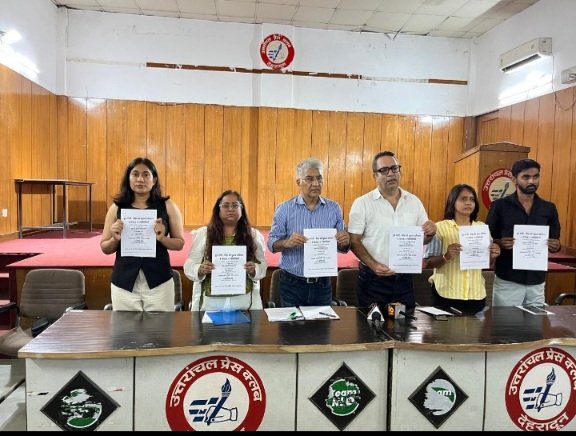
Jaya Singh, Ira Chauhan, Ruchi Singh, Anish Lal, Sanjay, Vasu Khanna, Shilpi and Kanish were among those present at the press conference.
The civil society leaders demanded immediate withdrawal of the proposed widening plan and warned that the movement would be intensified if tree felling proceeds.
Their central question now hangs over the entire project: if the price of a new highway is mature forests, an elephant corridor and increased human-wildlife conflict, can it really be called development?
#SaveSaatMorh #SaveElephants #GreenRishikesh #StopTreeFelling