

Three Years, 90% Survival: Dehradun’s Miyawaki Forest Offers a Green Blueprint for the urban areas in the hills and towns and cities in India
DEHRADUN, AUGUST 20: While much-hyped Van Mahotsav plantation drives across Uttarakhand, Himachal Pradesh and other parts of the country often leave the actual survival of planted trees uncertain, a three-year-old urban forestry experiment in Dehradun has produced a strikingly different result — more than 90 per cent survival of over 300 saplings.
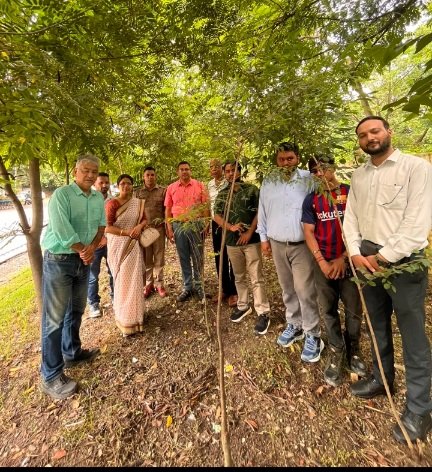
The Miyawaki plantation, established on August 20, 2023, along the Vasant Vihar–Panditwari Main Road near Major Vivek Gupta Chowk, has emerged as a shining example of how sustained maintenance, community participation and scientific plantation practices can turn a modest urban patch into a thriving green space.
The survival assessment was shared on the third anniversary of the project after the team reviewed the plantation site. The finding is particularly significant in a region where plantation numbers are frequently highlighted, while post-plantation survival often receives far less attention.
The initiative was undertaken jointly by the Research Wing of the Uttarakhand Forest Department, Vasant Vihar Doon Valley Officers Cooperative Housing Society, SDC Foundation and SGI Foundation. More than 300 native and locally suitable species, including amaltas, neem, bhimal, tejpatta, moringa, parijaat and kachnaar, were planted.
Unlike conventional plantation drives that may end soon after saplings are planted, SDC Foundation and SGI Foundation committed themselves to maintaining the site for three years. Regular watering, monitoring, protection and care through both dry and wet periods have been credited with helping the plantation achieve its exceptional survival rate.
The experiment drew inspiration from successful Miyawaki initiatives in Uttarakhand, particularly the work undertaken at Kalsi by senior IFS officer Sanjiv Chaturvedi and his team.
Speaking at the third-anniversary programme, Chaturvedi said the Miyawaki technique should not be reduced to merely a method of planting more trees. It can be used to restore local ecosystems, strengthen biodiversity and create functional green spaces even where urban land is limited.
He stressed the importance of native species, proper soil preparation, suitable planting density and sustained maintenance, saying such local interventions need to be amplified to help moderate increasingly severe urban heat and changing microclimates.
“The Miyawaki technique should not be viewed simply as a method of planting trees, but as an effective way of restoring local ecosystems and enhancing biodiversity in limited urban spaces,” Chaturvedi said.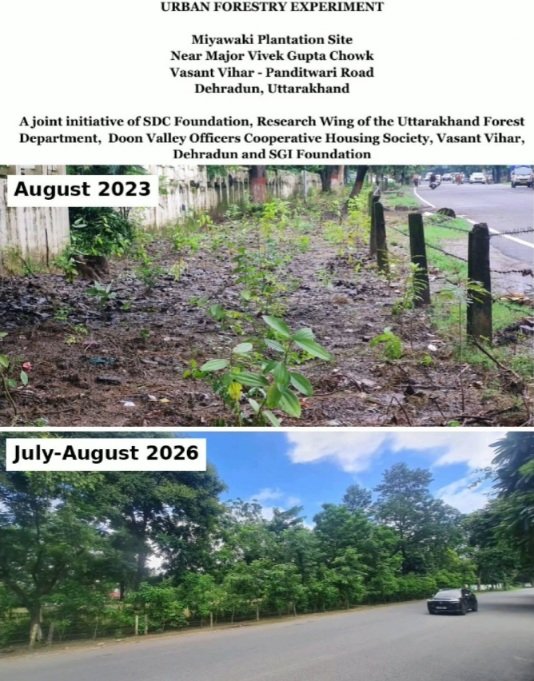
SDC Foundation's Anoop Nautiyal described the completion of three years as an important milestone, saying the project demonstrated that meaningful green spaces can be created within cities when government institutions, communities and civil society organisations work together.
SGI Foundation's Prerna Raturi said the experience showed why plantation programmes must move beyond one-day plantation drives and evolve into long-term, community-led environmental initiatives.
Pyare Lal, Miyawaki Project Lead at SDC Foundation, said the plantation had changed considerably over the past three years and now functions as an established urban green space. He attributed the over 90 per cent survival rate to continuous maintenance, monitoring and community support.
The proceedings were conducted by Dinesh Semwal of SDC Foundation. Forest Department Statistical Officer Akriti, environmentalist Rakesh Kapoor of Vasant Vihar, Akshit Kukreti of Himmothan, Narendra Chauhan of the Forest Department, Praveen Upreti, Sunit Verma, Kanish Das, Subhash of SDC Foundation and Utkarsh Rana of SGI Foundation were among those present.
A lesson beyond Dehradun
The significance of the experiment extends well beyond one roadside plantation. For the Himalayan states, where fragile slopes, shrinking green spaces, rising temperatures and rapid urbanisation are creating new ecological pressures, the Dehradun model offers a simple but important lesson: the success of afforestation should be measured not by how many saplings are planted, but by how many survive and become functioning ecosystems.
The reported 90-plus per cent survival rate makes the Vasant Vihar plantation a potentially replicable model for urban greening across Uttarakhand, Himachal Pradesh and other Himalayan regions — particularly if plantation is followed by scientifically planned maintenance and community ownership.
At a time when governments routinely announce ambitious plantation targets during Van Mahotsav, this three-year experiment provides a useful benchmark.
A plantation that survives the first summer, the monsoon and successive dry seasons is ultimately a far stronger measure of environmental success than the number of saplings recorded on planting day.
What is Miyawaki?
The Miyawaki method is an intensive afforestation technique developed by Japanese botanist Akira Miyawaki. It typically uses closely planted, locally appropriate native species with careful soil preparation and sustained early-stage maintenance to accelerate the development of dense, diverse urban forests.