Jetha Mangalvaar: From the Himalayas to Sri Lanka, the Enduring Legacy of Lord Hanuman
Shimla June 2: On the auspicious occasion of Jetha Mangalvaar, a day revered by millions of devotees of Lord Hanuman across India, the immortal tale of the Sankatmochan continues to bridge faith, mythology, and geography—from the lofty Himalayas to the lush coastal hills of Sri Lanka.
Among the many sites associated with the Ramayana, the forested Rumassala hills near Galle in southern Sri Lanka occupy a special place in popular belief.
Overlooking the blue waters of the Indian Ocean and adjoining the famous Jungle Beach and Galle Harbour, Rumassala today is a protected biodiversity sanctuary and a major tourist attraction.
Yet for devotees, it is much more than a scenic destination.
Local tradition holds that this hill is linked to one of Lord Hanuman's most celebrated exploits.
According to the Ramayana, when Lakshman was grievously injured during the war in Lanka, Hanuman was sent to fetch the life-saving Sanjeevani Booti.
Unable to identify the medicinal herb, he is said to have lifted an entire mountain and carried it through the skies.
Some Sri Lankan legends claim that a fragment of that mountain fell at Rumassala, explaining the area's unique flora and unusual geological features.
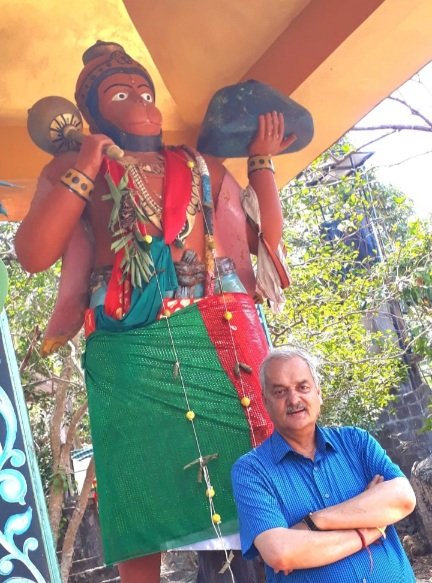
A towering multi-coloured statue of Hanuman, carrying the mountain in his hand, now stands as a symbol of that enduring faith.
The belief, however, exists alongside another widely accepted tradition in India that places the Sanjeevani-bearing mountain in the Himalayan region of present-day Uttarakhand near Gangotri and the Dronagiri ranges.
The differing narratives reflect the rich tapestry of folklore that has evolved around one of Hinduism's most beloved deities.
For devotees, Hanuman is no ordinary hero. He is one of the seven Chiranjeevis—the immortals believed to remain alive through the ages.
Revered as the embodiment of strength, devotion, courage and selfless service, Hanuman occupies a unique place in Hindu tradition.
From helping Lord Rama locate Sita, leaping across the ocean to Lanka, burning Ravana's capital, and carrying the Sanjeevani mountain, his exploits form some of the most dramatic episodes of the Ramayana.
Sri Lanka itself preserves several locations linked to the epic. Near Nuwara Eliya lies the revered Seetha Amman Temple, which many devotees identify with the legendary Ashoka Vatika where Sita was held captive by Ravana.
The site, nestled amidst tea gardens and mist-covered hills, attracts pilgrims from India and across the world.
Temples dedicated to Rama, Sita and Hanuman have become important centres of worship, reflecting the deep cultural and religious ties between India and Sri Lanka.
Today, as devotees observe Jetha Mangalvaar with prayers and fasting, the story of Hanuman continues to transcend borders and generations.
Whether in the Himalayan valleys where the search for Sanjeevani is believed to have begun, or on the coastal hills of Rumassala where legends say a fragment of the sacred mountain landed, Lord Hanuman remains the same: The unwavering symbol of devotion, courage in adversity, and service to humanity.
For millions, Hanuman is not merely a character from an ancient epic. He remains the eternal protector—the Sankatmochan—whose presence is believed to guide and safeguard mankind even in the present age.