 NEW DELHI/SHIMLA: Western. Media described it as one of the leading success stories of 21st century.
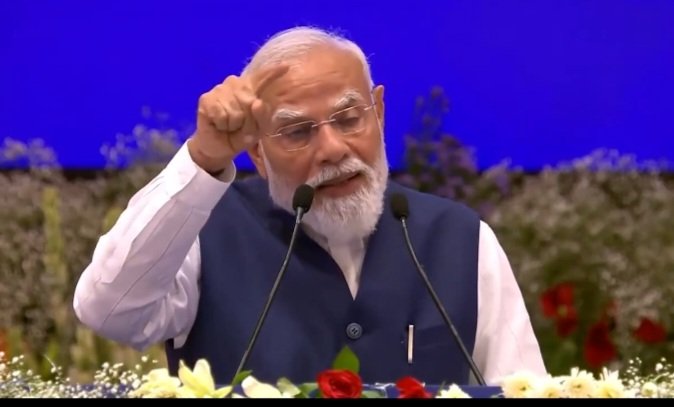
Prime Minister Narendra Modi has achieved a historic political milestone, surpassing Jawaharlal Nehru to become India's longest-serving elected Prime Minister.
Having completed more than 4,399 consecutive days in office, Modi's record-breaking tenure has drawn congratulations from world leaders and renewed debate over a legacy that has transformed India's political, economic and diplomatic landscape.
The achievement marks the culmination of an extraordinary journey that began in the small town of Vadnagar in Gujarat.
Born into a modest family, Modi famously helped his father sell tea at a railway station before joining the Rashtriya Swayamsevak Sangh (RSS) as a young activist.
Rising steadily through the ranks of the Bharatiya Janata Party (BJP), he became Gujarat's Chief Minister in 2001 and built a reputation as a pro-development administrator.
After a vigorous 2014 election campaign centered on economic revival, governance reforms and development, Modi led the BJP to its first-ever outright majority in the Lok Sabha.
He was sworn in as Prime Minister on May 26, 2014, ending three decades of coalition-era politics and ushering in a new phase of centralized leadership in New Delhi.
Over the next decade, Modi's government launched some of the most ambitious programmes in independent India's history.
Flagship initiatives such as the Swachh Bharat Mission, Jan Dhan Yojana, Digital India, Ujjwala Yojana, Ayushman Bharat, PM Awas Yojana and Skill India sought to improve sanitation, expand financial inclusion, strengthen healthcare access and modernize public service delivery.
The government's push for digital governance helped create one of the world's largest digital payment ecosystems through UPI and direct benefit transfers, reducing leakages and bringing millions into the formal economy.
Supporters credit Modi with steering India toward becoming one of the world's fastest-growing major economies.
The introduction of Make in India and later Atmanirbhar Bharat sought to position the country as a global manufacturing hub, attract investment and reduce dependence on imports.
Production-linked incentive schemes boosted sectors ranging from electronics and semiconductors to renewable energy and defence manufacturing.
India's growing mobile phone manufacturing sector and expanding infrastructure network of highways, airports, railways and renewable energy projects are frequently cited as hallmarks of his administration.
On the diplomatic front, Modi sought to elevate India's global standing through an energetic foreign policy.
Early in his tenure, he hosted Chinese President Xi Jinping and deepened engagement with the United States under President Barack Obama.
Over the years, India strengthened its role in the G20, Quad, BRICS and other international forums, emerging as a leading voice of the Global South.
Even amid tensions with China along the Line of Actual Control, New Delhi pursued diplomatic engagement while strengthening border infrastructure and strategic partnerships.
National security became another defining feature of Modi's leadership. Following the 2016 Uri terror attack, India carried out surgical strikes across the Line of Control targeting terrorist launch pads.
After the Pulwama attack in 2019, Indian fighter aircraft struck terrorist infrastructure in Balakot, Pakistan, marking a significant escalation in India's counter-terrorism response.
More recently, Operation Sindoor was projected by the government as a demonstration of India's willingness to pursue terror networks beyond its borders.
These actions helped reinforce Modi's image among supporters as a strong and decisive leader on national security.
One of the most consequential decisions of his second term came in August 2019, when his government abrogated Article 370 and revoked the special status of Jammu and Kashmir.
Supporters hailed the move as a long-awaited step toward national integration and uniform governance, while critics questioned its constitutional implications and the restrictions imposed during its implementation.
The Modi years have also witnessed major political and cultural developments. The consecration of the Ram Mandir in Ayodhya in January 2024 fulfilled a decades-old promise of the BJP and the broader Hindu nationalist movement, becoming one of the most symbolic moments of his premiership.
However, Modi's tenure has also attracted sustained criticism both domestically and internationally.
Western media have described his rise from humble origins as one of the most remarkable democratic success stories of the 21st century.
At the same time, many have raised concerns over democratic institutions, media freedom, civil liberties, religious polarization and the growing concentration of political power.
Economic decisions such as the 2016 demonetisation exercise and the rollout of the Goods and Services Tax generated intense debate.
Supporters argued that the reforms expanded the tax base, promoted formalization and accelerated digital transactions. Critics countered that they imposed significant short-term hardships on businesses, workers and the informal sector.
The COVID-19 pandemic presented the greatest challenge of Modi's premiership. His government imposed one of the world's strictest lockdowns in 2020 and later oversaw one of the largest vaccination drives in history.
Yet the devastating second wave in 2021 exposed weaknesses in healthcare infrastructure and prompted criticism over preparedness and crisis management.
The government also faced one of the longest mass agitations in recent history as farmers protested against three agricultural reform laws introduced in 2020. After more than a year of demonstrations, Modi announced the repeal of the laws in November 2021.
The 2024 Lok Sabha election demonstrated both Modi's enduring appeal and the limits of BJP dominance.
While the BJP fell short of an outright majority with 240 seats, the NDA secured 293 seats, enabling Modi to return for a third consecutive term as Prime Minister with the support of coalition partners.
As tributes continue to pour in from capitals across the world, Modi's legacy remains a subject of vigorous debate.
Admirers view him as the architect of a stronger, more confident and globally influential India that embraced digital governance, infrastructure development, self-reliance and a more assertive foreign policy.
Critics argue that his tenure has tested democratic institutions and deepened political and social divisions.
What remains beyond dispute is the scale of his impact. From a tea stall in Vadnagar to the highest office in the world's largest democracy, Narendra Modi's rise is one of the most extraordinary political stories of modern times.
As India's longest-serving elected Prime Minister, he has reshaped the nation's politics, economy, diplomacy and national discourse in ways that will continue to influence the country long after his tenure ends. Modi is still alive and kicking. His well wishers want him to lead the next elections as well.