Shimla | January 13, 2026
Public Works Minister Vikramaditya Singh on Tuesday announced a fresh attempt to fix Himachal Pradesh’s damaged roads by introducing two new repair technologies on a trial basis
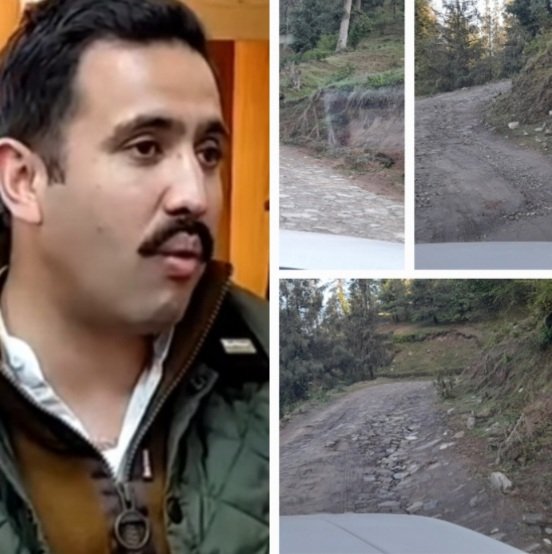
He announced the pilot project launched on the Shoghi–Mehli road in his home segment, though critics are questioning the very choice of this stretch.
“We have selected two proven technologies – Cement Grouted Bituminous Macadam (CGBM) and Stabilised Base Layer Technology – for this experiment to make roads stronger, capable of carrying heavy traffic and resistant to water damage,” Singh said.
The minister said the PWD maintains nearly 35,000 km of roads across the state but admitted that harsh weather, water-logging and weak soil repeatedly damage almost 20 per cent of the network every year, pushing up maintenance costs and forcing the department to look for a long-term solution.
Explaining the pilot project, Singh said, “After discussions with the Central Road Research Institute (CRRI), we decided to test these technologies on the Shoghi–Mehli road and if the results are encouraging, we will extend it to other stretches.”
Claiming roads built with these methods could last up to 10 years, Singh said this would reduce repeated patchwork and provide commuters with a smoother and safer driving experience.
However, experts and locals question why the pilot was not launched on the most repeatedly damaged stretches like the Dodra–Kwar road or the Deha–Chopal–Nerwa belt in Rohru and Chopal, arguing that Shoghi–Mehli is relatively stable and the minister chose it because it falls in Shimla Rural constituency which he represents, exposing the real intent behind the pilot.
Singh also did not disclose how costly these new technologies are or what the per-kilometre expenditure would be, a critical issue in a hill state like Himachal that largely survives on central funds where cost and effectiveness must go hand in hand.
Another major concern is whether PWD engineers and contractors are trained enough to implement these new technologies on the ground because experts warn that most road projects fail not in design but during execution due to poor skills, lack of modern machinery and weak quality checks.
Road specialists say CGBM involves laying a coarse bitumen layer and injecting cement slurry to fill gaps making the surface semi-rigid and stronger while stabilised base technology mixes cement, lime or chemicals with weak soil to prevent sinking and cracking, especially in hill terrain.
Experts have also slammed national bodies like the Indian Roads Congress, Central Road Research Institute and Border Roads Organisation for failing to develop any durable and eco-friendly road technology that can survive landslides, monsoon fury and fragile Himalayan slopes despite decades of research.
Calling it a “silent scam”, activists say thousands of crores of rupees are being squandered every year on repeated repairs and maintenance in Himachal, Uttarakhand, Ladakh and the Northeast with the same roads, same contractors and same bills appearing year after year without any accountability.
Experts point out that European mountain nations like Switzerland, Austria, Norway, Italy and France use geotextiles, deep drainage systems, fiber-reinforced asphalt and smart sensors to prevent damage rather than merely repairing roads after destruction.
Locals remain sceptical as Himachal has seen many such “new technologies” announced in the past only to disappear after one monsoon, making the Shoghi–Mehli road a testing ground for whether this experiment will finally deliver.
Vikramaditya proposes — will the monsoon dispose?