
Shimla, August 23:
The Himachal government is highlighting the expansion of electric-bus charging infrastructure across the State, but the larger question remains unanswered: when will Shimla itself get the modern, city-wide electric public transport system it deserves?
Deputy Chief Minister Mukesh Agnihotri, who also hopds a transport department said today that HRTC is establishing charging stations at 80 locations at a cost of Rs. 122 crore.
Of these, 34 are already operational, work at 21 locations is expected to finish within a month and work on the remaining 25 is underway.
HRTC has 297 electric buses in its fleet, with 99 charging points planned across the 80 locations. The charging stations will have 180-kilowatt CCS-2 fast chargers.
The figures may look impressive on paper. But for Shimla, the issue is not merely how many charging stations HRTC builds across Himachal.
The real question is whether the government has a clear vision for transforming public transport in its capital.
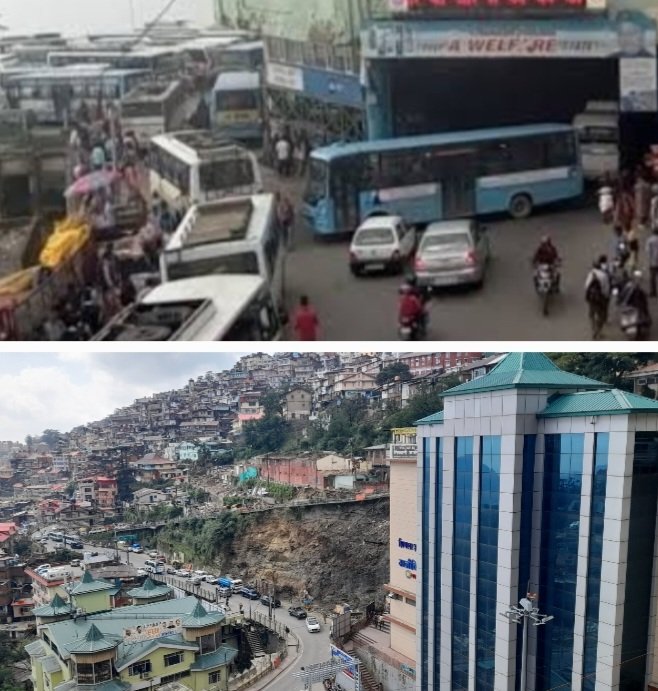
Shimla still needs a dedicated and adequate fleet of electric buses covering the city and its adjoining urban areas. HRTC's presence in local city transport remains deficient, leaving considerable space for private buses.
Many of these buses operate packed beyond capacity, with passengers often treated more like freight than people entitled to safe and dignified public transport.
The problem is compounded by the lack of visible and effective enforcement on pollution, overloading and the overall quality of urban bus operations.
A city struggling with congestion and vehicular emissions should have been the first place in the State for a planned transition to electric mobility.
Instead, the approach appears largely ad hoc—introducing a few electric buses and operating them on selected routes rather than building a comprehensive city-wide e-mobility network based on public need.
Shimla could have been Himachal's model for low-carbon urban transport: a substantial electric fleet, dependable frequency, integrated routes, charging depots, last-mile connectivity and strict regulation of private operators.
It could have demonstrated how a hill capital can reduce its carbon footprint while improving the daily travel experience of residents and tourists.
The political irony is difficult to miss. Agnihotri represents Haroli in Una, while the Chief Minister represents Nadaun.
Both the political leadership and several ministers remain deeply focused on their respective constituencies.
But Shimla is not merely another Assembly constituency. It is the State capital, the face of Himachal and the city through which the State presents itself to tourists, investors and visitors from across India and the world.
A government serious about a smoke-free and sustainable Himachal should have made Shimla the showcase for electric public transport—not left its mobility needs to political convenience and sporadic deployment of e-buses.
The government's own figures show that electric buses can work. HRTC says an electric bus can generally cover around 180 km on a single charge, while buses are already operating successfully on longer routes such as Haroli-Chandigarh and Shimla-Chandigarh-Shimla.
Then why not put the same confidence into Shimla's city transport?
The contrast becomes sharper when residents continue to face basic civic failures. Shimla is still crying for water, with residents in several areas receiving around 200 litres after a gap of three days.
A capital struggling with both water supply and urban mobility cannot claim to be building a modern smart city merely by announcing infrastructure projects.
Shimla needs more than charging points. It needs a transport policy that puts residents first, curbs pollution, reduces carbon emissions and gives commuters a safe and dignified alternative to overcrowded private buses.
The question is therefore simple: when will Shimla get its due?
When will the capital receive a city-wide electric bus fleet? When will public transport be planned around the needs of residents rather than political priorities?
And when will the government treat Shimla not as another constituency, but as the State's most important urban face?
Charging stations are welcome. Electric buses are welcome. But Shimla needs a vision—not an ad-hoc fleet.
#Shimla #ElectricBuses #HimachalPradesh #PublicTransport