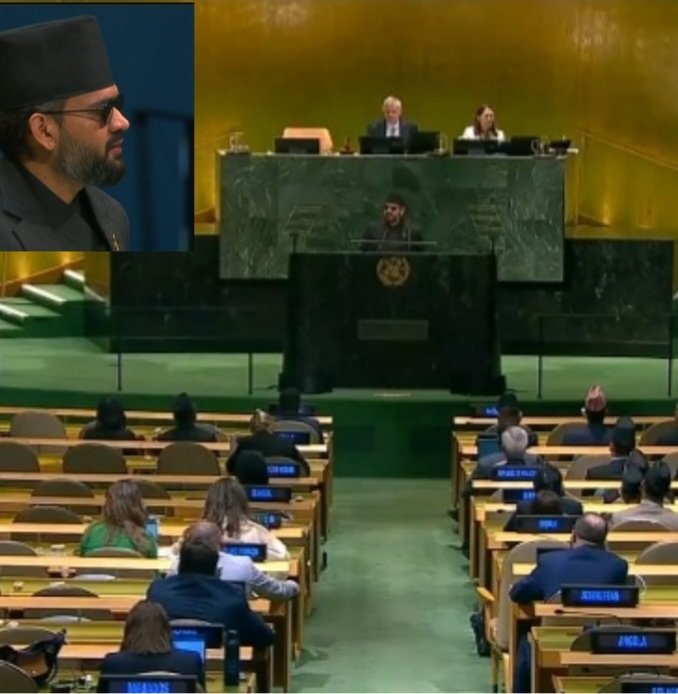
NEW DELHI/NEW YORK, Sept 25: Nepal’s devastating Bhotekoshi-Trishuli floods, which have left at least 1,400 people dead and more than 6,000 missing, moved from the Himalayan disaster zone to the centre of global diplomacy as Prime Minister Balendra Shah used his debut address to the 81st United Nations General Assembly to question whether the world is prepared to act on warnings from the Himalayas.
Shah thanked India and China for what he described as prompt and generous assistance following the disaster, along with other countries, UN agencies, humanitarian organisations and people around the world who supported Nepal.
But beneath the gratitude was a larger challenge: whether emergency solidarity can be converted into a sustained regional response to a climate crisis that is increasingly crossing national borders.
The Nepalese Prime Minister described the Bhotekoshi-Trishuli catastrophe not merely as a national tragedy but as a warning to the world.
He said Nepal contributes less than 0.1 per cent of global greenhouse-gas emissions while facing retreating glaciers, unstable mountain slopes, unpredictable rivers and increasingly destructive floods.
His most pointed intervention came when he linked climate vulnerability with the priorities of the global economic and security order.
“Inter-continental missiles arrive on time. Rifles and ammunition cross borders, clear every bottleneck, meet every deadline,” Shah said, contrasting that with the inability of a Nepali farmer to obtain fertiliser or fuel when needed. “We have built a world with flawless logistics for war and broken logistics for food.”
He then broadened the argument beyond Nepal, saying countries across South Asia were being hit by a climate crisis they did not create and by wars they did not start.
“Hit by the climate we did not warm, and hit again by the wars we did not start,” Shah said, placing climate vulnerability, food security and geopolitical instability within the same global-governance debate.
For Nepal, however, the immediate challenge is reconstruction. Shah said rapid assessments put the physical recovery requirement at roughly 10 per cent of the country’s GDP and called for adequate grant-based international support rather than leaving vulnerable countries dependent on additional debt after climate disasters.
The Himalayan question now moves beyond Kathmandu and New York. Shah proposed a Himalayan Climate Resilience Mechanism involving Nepal, India and China, with cooperation on satellite data, glacier monitoring, early-warning systems and disaster response.
The proposal would place the three Himalayan neighbours at the centre of a regional effort to deal with hazards that do not stop at international boundaries.
That puts the spotlight particularly on India and China, the two major powers sharing the Himalayan system with Nepal.
Both provided assistance after the catastrophe, but the larger question raised by Shah's speech is whether such responses can evolve into permanent mechanisms for sharing climate and disaster data, strengthening early-warning systems and coordinating cross-border relief.
The United States and other major powers face a different question: whether climate finance mechanisms can deliver resources at the speed required by countries confronting rapidly escalating disasters.
Shah argued that existing international climate-finance arrangements remain inadequate and bureaucratically difficult for vulnerable countries to access.
The disaster has already demonstrated the scale of the challenge. Nepal's official updates showed thousands rescued and continuing search operations, while later disaster assessments put the death toll above 1,400 and the number missing at several thousand.
Shah distilled Nepal's demand into six words: Relief. Rehabilitation. Reconstruction. Responsibility. Reparation. Resilience.
The first three address the immediate aftermath; the latter three seek a longer-term framework for countries repeatedly forced to rebuild infrastructure and livelihoods after climate-linked disasters.
The political significance of the speech therefore lies not only in its emotional account of Nepal's catastrophe, but in the question it leaves hanging over the UN: will the world's biggest powers treat the Himalayan disaster as another humanitarian emergency to be managed after the event, or as an early warning requiring a new system of regional climate preparedness?
For the Himalayas, that answer may matter far beyond Nepal.
#Nepal #ClimateCrisis #Himalayas #ClimateJustice