NEW DELHI/SHIMLA — The National Highways Authority of India (NHAI) has released comprehensive design guidelines for upcoming access-controlled High-Speed National Highways, establishing a uniform national framework for four- and six-lane Greenfield and Brownfield corridors under the Viksit Bharat 2047 roadmap.
While the policy aims to streamline technical standards and reduce road fatalities, the official announcement leaves a critical question unanswered: Does this standardized blueprint apply strictly to India’s flat plains, or will it be enforced in the rugged, geologically fragile mountain states?
A Uniform Blueprint for India's Highways
The newly issued guidelines seek to resolve longstanding inconsistencies in Detailed Project Reports (DPRs) by creating rigid, standardized metrics across all new high-speed corridors:
Traffic-Linked Widths: Right-of-Way (RoW) widths are strictly tied to vehicular volume. Corridors carrying up to 15,000 vehicles daily receive a 60-meter RoW, while higher-volume routes (15,000 to 40,000 vehicles) require a 70-meter RoW.
Controlled Access: Grade-separated interchanges with ramps will handle traffic from state highways, ports, airports, and logistics hubs, preventing abrupt entries onto main carriageways.
Perimeter Fencing: A mandatory 1-meter-high boundary wall along the outer edges of corridors will prevent stray cattle and unauthorized pedestrian crossings.
Advanced Signage: Protocol-driven exit and entry notifications aim to give drivers clear distance to decelerate safely.
The Mountain Ambiguity: Silence in the Standards
The official ministry release makes no explicit distinction between plain terrains and mountain geography, raising immediate concerns among civil engineers and road safety experts.
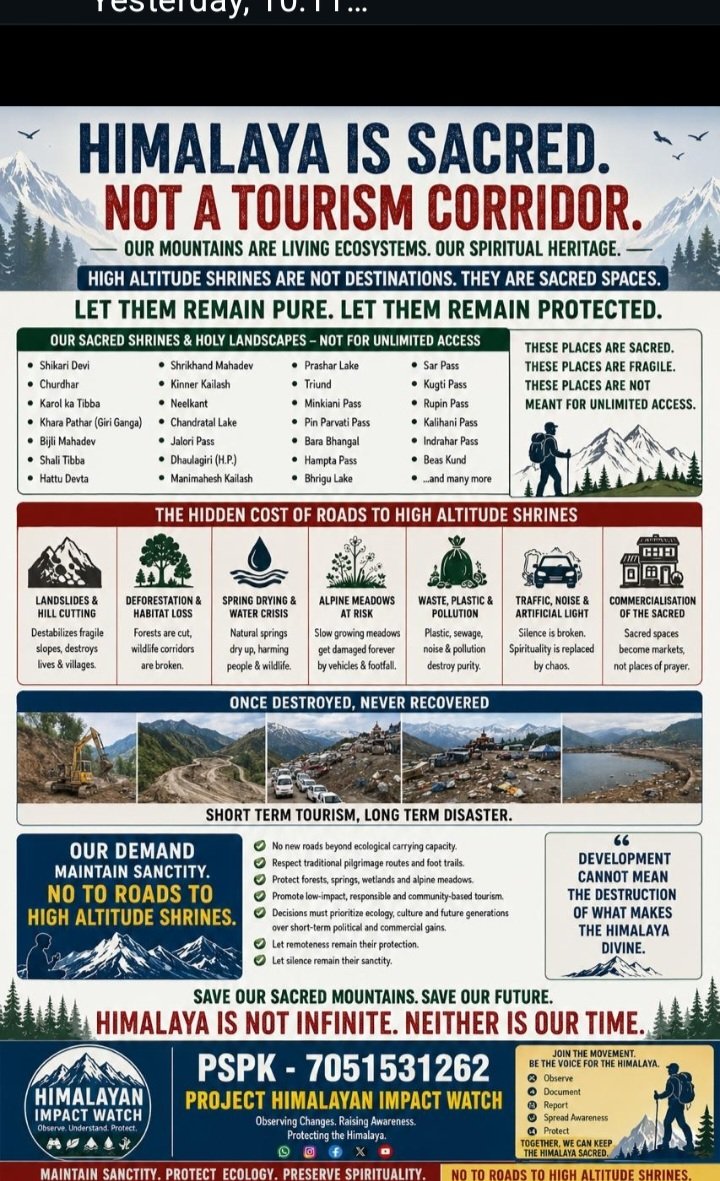
If NHAI intends to apply these uniform standards universally, mountain states—such as Himachal Pradesh, Uttarakhand, Jammu & Kashmir, and the North East—could face severe implementation hurdles:
Spatial & Topographical Friction: Squeezing a 60- to 70-meter-wide footprint through narrow Himalayan river valleys requires massive hill cutting and slope destabilization, which often triggers landslides, rockfalls, and ecological damage.
High Speeds on Steep Gradients: High-speed corridor designs inherently encourage faster travel. On long mountain down-gradients and tight hairpin bends, high speeds sharply increase the risk of brake failures and rollover collisions.
Inadequate Boundary Defenses: While a 1-meter boundary wall prevents stray cattle on flat terrain, it offers little protection against falling boulders, debris flow, or vehicles sliding off cliff edges during severe weather.
Waiting for Clarity on Hill-State Fatalities
NHAI’s initiative marks a significant step toward modernizing India’s primary transit corridors.
However, until the ministry clarifies whether hill states are included—or if a separate, terrain-sensitive framework will be issued—it remains unclear how these measures will protect lives in high-altitude zones.
Whether these standards will curb highway fatalities in the hills, or if the sheer force of mountain geography will demand a complete rethink, remains to be seen.
#NHAIGuidelines #RoadSafety #HighSpeedCorridors #ViksitBharat2047