Dehradun | February 1, 2026
The Union Budget 2026–27 has once again failed to offer any dedicated financial package or policy framework for Uttarakhand or the wider Indian Himalayan Region, even as the fragile mountain belt continues to reel under repeated climate-induced disasters and mounting ecological stress.
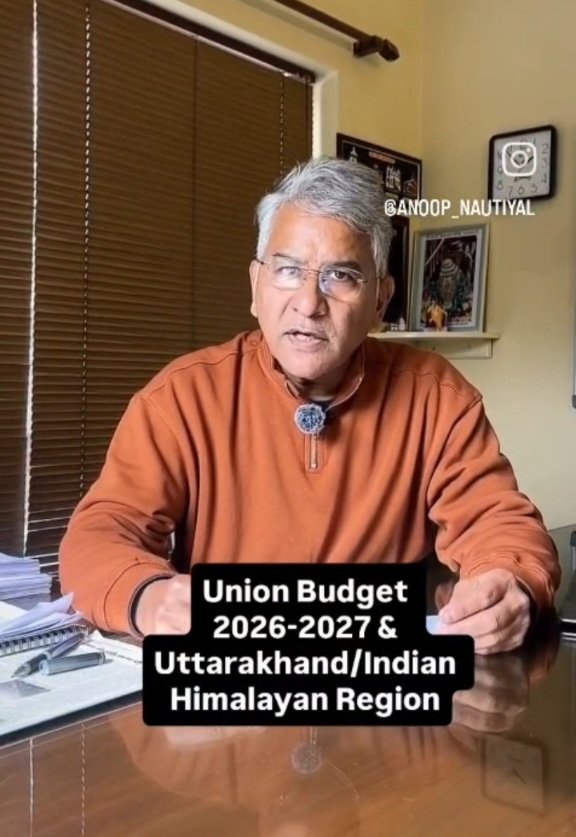
Reacting to the budget, Anoop Nautiyal, founder of Dehradun-based Social Development for Communities (SDC) Foundation, said Himalayan states—particularly Uttarakhand—have witnessed an alarming rise in cloudbursts, landslides, flash floods, forest fires, glacial instability and infrastructure damage over the past decade.
“These are no longer isolated natural events. They reflect a deepening climate crisis that disproportionately impacts fragile mountain ecosystems and communities,” Nautiyal said.
“Yet the Union Budget continues to view the Himalayas through generic national schemes on infrastructure, tourism or rural employment, without recognising the region’s unique ecological, climatic and disaster-related costs.”
He pointed out that long-standing demands from Himalayan states—including a green bonus, ecological compensation, a mountain-specific disaster risk index, and a dedicated Himalayan resilience and adaptation fund—find no mention in the Budget speech or key allocations.
The omission, Nautiyal noted, is particularly striking in light of recent statements by Uttarakhand Chief Minister Pushkar Singh Dhami, who has repeatedly highlighted the pressure of the state’s massive floating population due to the Char Dham Yatra, major religious congregations and upcoming events like the Kumbh Mela.
“While the Chief Minister has acknowledged the extraordinary burden such events place on Uttarakhand’s infrastructure and ecology, the Budget does not reflect any corresponding special assistance or financial support,” Nautiyal said.
He added that the Centre once again missed an opportunity to recognise the Himalayas as a distinct ecological and disaster-prone region.
“Himalayan states bear national costs by safeguarding water sources, biodiversity and climate stability. Yet there is no financial recognition of this role. Without green incentives, conservation-linked funding or mountain-specific disaster frameworks, we are pushing these states to the brink,” he warned.
Nautiyal also expressed concern over the continued reliance on one-size-fits-all schemes, arguing that they fail to capture the cumulative impact of climate change, unregulated tourism and aggressive infrastructure expansion in fragile mountain systems.
“As climate risks intensify, the cost of inaction will not be confined to Himalayan states alone. The entire country depends on the Himalayas for water security, climate regulation and ecological balance,” he said, adding that the Budget’s silence underscores the urgency of corrective action.
Calling for greater coordination among mountain states, Nautiyal said the time has come for Himalayan regions to speak in one voice.
“Despite political challenges, a collective Himalayan platform is essential to push for ecological compensation, disaster financing and sustainable development pathways that reflect ground realities.”
He concluded that the Union Budget 2026–27 serves as yet another reminder that national policy can no longer afford to ignore the Himalayas’ strategic environmental importance.