
Delimitation Set to Redraw Himachal’s Political Map: Lok Sabha Seats Likely to Rise to 6
Post-2027 Census Overhaul: Himachal Poised for 6 Parliamentary Seats as Demand Grows for Shimla De-reservation and Separate Tribal Seat
SHIMLA: Himachal Pradesh is on the cusp of its most sweeping electoral and political transformation in over five decades.
With the long-awaited decadal Census scheduled for 2027 and the Delimitation Commission expected to finalize new constituency boundaries by 2028, the hill state’s parliamentary tally is projected to rise from the existing four Lok Sabha seats to six.
Alongside the expansion, a major reshuffle of reserved seats—including shifting the Scheduled Caste (SC) quota from Shimla to Mandi and carving out a dedicated Scheduled Tribe (ST) constituency—has sparked intense discussion across the state’s political spectrum.
Under the Union Government’s proposed pro-rata formula, which envisages a uniform 50 per cent increase in seats across all states to raise the Lok Sabha’s strength from 543 to around 816 ahead of the 2029 General Elections, Himachal Pradesh is set to gain two new parliamentary constituencies.
In tandem, the strength of the Himachal Pradesh Legislative Assembly is expected to expand from 68 to 102 seats.
Those closely watching the delimitation exercise and constitutional experts point out that the uniform 50 per cent expansion formula has been designed to protect the federal balance.
It addresses the long-standing apprehensions of southern states and smaller hill states like Himachal Pradesh, which have successfully stabilized their population growth since the 1971 freeze and feared losing parliamentary representation if population alone were used as the yardstick.
Furthermore, experts note that in hill states, physical geography, difficult terrain, and sparse population density must be factored in alongside headcount so that remote regions receive effective representation.
At the heart of the impending shake-up is the long-standing demand for the rotation of the Scheduled Caste reserved seat.
The Shimla Lok Sabha constituency has remained reserved for the SC category for decades, fuelling a strong sentiment among voters and political leaders in the region that the seat should now be rotated and opened to the General category.
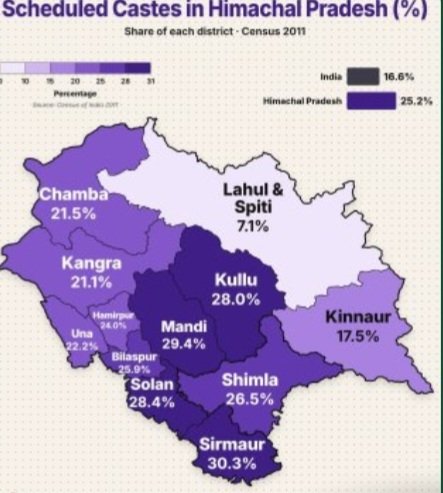
Demographic data from the Census of India 2011 strongly backs the case for shifting the SC quota to central Himachal. While India’s overall Scheduled Caste population stands at 16.6 per cent, Himachal Pradesh has a significantly higher state average of 25.2 per cent.
District-wise figures reveal that while Sirmaur (30.3 per cent), Solan (28.4 per cent), and Shimla (26.5 per cent) have high SC populations, the central cluster of Mandi (29.4 per cent) and Kullu (28.0 per cent) accounts for an equally substantial share.
Among other districts, Bilaspur has an SC population of 25.9 per cent, followed by Hamirpur at 24.0 per cent, Una at 22.2 per cent, Chamba at 21.5 per cent, Kangra at 21.1 per cent, Kinnaur at 17.5 per cent, and Lahaul and Spiti at 7.1 per cent.
"Given the rotational principle of reservation and the high concentration of the Scheduled Caste population in Mandi and Kullu—where Mandi alone stands at 29.4 per cent—there is a compelling constitutional and demographic basis to declare Shimla a General seat and shift the SC reservation to Mandi in the 2028 delimitation," say legal experts and political observers closely tracking the delimitation process.
Simultaneously, the push for reorganizing constituencies based on physical topography and tribal identity has gained momentum.
The Himachal Pradesh Tribal Mahasamuh has formally demanded the creation of a separate Scheduled Tribe (ST) parliamentary constituency by integrating the contiguous high-altitude and tribal belts of Kinnaur, Lahaul and Spiti, and the Pangi and Bharmour sub-divisions of Chamba district.
Currently, these snow-bound tribal pockets are clubbed with the sprawling Mandi parliamentary constituency, which covers nearly half of the state's geographical area. Representatives of the Tribal Mahasamuh argue that vast physical distances and harsh terrain dilute the voice of tribal voters, and carving out a dedicated ST seat using special hill-area criteria would ensure genuine representation in Parliament.
With the 33 per cent women’s reservation also slated to take effect following the 2027 Census and 2028 delimitation—which will reserve two of Himachal’s projected six Lok Sabha seats for wom- the redrawing of the electoral map is set to redefine political equations and leadership ambitions across both the ruling Congress and the opposition BJP ahead of 2029.
#HimachalPradesh #Delimitation2028 #LokSabhaElections #HimachalPolitics #Census2027