

‘Babu Palak, Not Bhed Palak’: As Ex-Mandarins Preach on Pastoralism in 2026, Himachal’s Real Shepherds Vanish Behind Dead 2019 Data and a 60% Subsidy Racket.
Biological Absurdity: State continues to allocate crores based on the 7-year-old 2019 Livestock Census
SHIMLA: Fittingly, the United Nations has declared 2026 as the International Year of Rangelands and Pastoralists.
Across the air-conditioned seminar halls of New Delhi, Chandigarh, and Shimla, retired mandarins and self-styled livestock experts are seizing the moment to deliver moving keynote addresses on “sustainable Himalayan pastoralism.”
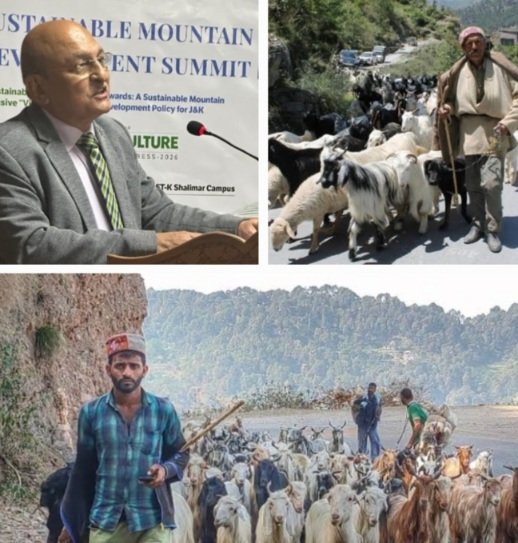
Recently, former senior IAS officer Tarun Shridhar—who previously served as Union Secretary for Animal Husbandry and held top posts as Revenue Secretary, Forest Secretary, and Animal Husbandry head in Himachal Pradesh—delivered an eloquent address at a recent Srinagar summit lamenting the marginalisation of mountain shepherds.
Dr. Tarun Shridhar spoke as the Lead Speaker for the technical session themed "Mountain Communities, Livelihoods & Natural Capital" at the Sustainable Mountain Development Summit (SMDS) 2026, held at the Shalimar Convention Centre, SKUAST-Kashmir, Srinagar.
Organized by SKUAST-K in collaboration with the Integrated Mountain Initiative (IMI), the deliberation centered on building conservation-compatible livelihoods, advancing mountain agriculture and livestock systems, and integrating local communities into sustainable value chains across the Himalayas.
Quoting George Bernard Shaw’s The Devil’s Disciple to argue that official indifference toward fellow human beings is worse than hatred, Shridhar spoke of the need for mobile veterinary care, flexible schooling, and recognition of customary rights, while noting his association with the Ghumantu Bakripalak group.
His commitment and intentions may be genuine and out of heart for the Pastoralists.
Yet, an extensive ground investigation by HimbuMail—gathering direct inputs from Gaddi bhed Palaks (shepherds) along the Kangra-Kullu-Lahaul circuit and highland graziers across the Chanshal Pass in Dodra Kawar and Kinnaur—serves as a sharp eye-opener for Mr. Shridhar and the conference circuit.
Beneath the polished seminar rhetoric lies a dying pastoral economy, a biologically dead 2019 database, and a thriving 60% subsidy racket at Pashudhan Bhawan in Boileauganj, in capital city of Shimla, reveal inputs gathered by HimbuMail.
As enraged shepherds across the state’s mountain passes put it bluntly: Sarkari tantra is not meant for ‘Bhed Palaks’ (sheep rearers), but has become a department of ‘Babu Palaks’—sustaining officials sitting in offices getting paid for paper exercises that have zero meaning on the ground".
Governing a ‘Ghost Population’: The 2019 Census Fallacy
What seminar speakers conveniently gloss over is the most glaring indictment of the Animal Husbandry Department’s functioning: its blind reliance on the 20th Livestock Census of 2019.
For the past seven years, no fresh house-to-house or pasture-to-pasture enumeration has been conducted in Himachal Pradesh to guide policy in 2026.
According to the 2019 website data still cited by officials and experts, Himachal Pradesh holds 44.11 lakh livestock, including 11.08 lakh goats (25.11%) and 7.91 lakh sheep (17.93%). Yet, the state's own recent sheep-shearing metrics quietly admit that only around 1.21 lakh sheep were shorn—exposing a massive chasm between paper numbers and living animals.
Veterinary science makes a complete mockery of using 2019 figures in 2026. While the absolute maximum lifespan of a sheep or goat is 9 to 10 years, its peak productive and migratory life in steep Himalayan terrain is just 5 to 7 years for females (after which their incisors wear down, making it impossible to graze on tough alpine pastures) and 1 to 2 years for males sold for meat.
In simple scientific terms, nearly 100% of the sheep and goats counted in the 2019 census are already dead. If former top bureaucrats who once ran the very departments of Revenue, Forests, and Animal Husbandry truly want to help the Ghumantu Bakripalaks, they must first ask why the state machinery is still allocating crores for a ghost population.
The Rohtang Fallacy and the ‘Theka’ System Reality
In his address, Mr. Shridhar cited the 9.02-km Atal Rohtang Tunnel as an example of how infrastructure benefits tourism and commerce while failing to accommodate traditional pastoral migration routes—suggesting that infrastructure planning should build "alternative passages" along roads.
However, the reality on the ground is far more drastic than a lack of roadside passages, and it should open the eyes of experts relying on outdated assumptions:
Unlike the Bakarwals of Jammu & Kashmir who still move in massive family-led caravans, the migration of Himachal’s Gaddi shepherds from Palampur, Chhota Bhangal, Bara Bhangal, and Bharmour has collapsed. Where dozens of herds once crossed the Rohtang Pass mainly from Palampur, barely less than a half dozen flocks cross it today.
The Rise of the ‘Theka’ (Contract) System: Traditional family herding has largely vanished. Today, shepherd families club their dwindling animals together and hand them over to hired caretakers (Thekadars), paying an annual per-head contract fee while the owners stay back in the valleys.
Shepherds do not want "alternative passages" alongside concrete tunnels or highways but biological corridors.
"The experts and former secretaries addressing seminars think we need passages along the Rohtang Tunnel or highways," says a seasoned Gaddi shepherd from the Palampur–Bara Bhangal route who spoke to HimbuMail. "Why would we take 500 sheep near a 9-kilometre concrete tunnel?
Our flocks don't walk on roads for convenience; they follow centuries-old mountain ridge trails because they need alpine grass, forest shrubs, medicinal herbs, and natural water springs at every halt.
We move up and down the pastures and return across the high passes in early August before the snow hits. It is ridiculous to think shepherds need roads—what we need is for the government to stop destroying our traditional grazing pastures andvforests."
The Breed & 60% Subsidy Racket?
On paper, the Animal Husbandry Department boasts of distributing high-yielding and indigenous breeds under the Krishak Bakri Palan Yojna and Krishak Bhed Palak Yojna.
Ridiculously Animal Husbandry Department demands online form submissions from nomadic shepherds to claim subsidies—ignoring the ground reality of migratory herders who spend months in high-altitude meadows without internet access or digital literacy.
The scheme guidelines propose handing out units of 11 goats (10 females + 1 male), 5 goats (4 females + 1 male), and 3 goats (2 females + 1 male) of Beetal, Sirohi, Jamunapari, and White Himalayan (Gaddi/Chegu) breeds—alongside Gaddi and Rampur Bushair sheep breeds and subsidized rams—at a 60% subsidy on a "first-come, first-serve" basis.
Furthermore, the department mandates that District Deputy Directors procure these breeds from within the state or neighboring states for F.O.R. delivery to applicants who possess an MGNREGA shed and sign a two-year undertaking.
Ground inputs gathered by HimbuMail confirm that this entire scheme is more and less a brazen racket running through the corridors of district and state offices.
Wrong Breeds for the High Passes: While breeds like Sirohi, Beetal, and Jamunapari may be suitable for stationary, stall-fed breeders in the warm, low-lying districts of Sirmaur, Solan, Bilaspur, and Una, they are completely unfit for the freezing, steep migratory treks across Rohtang, Kugti, or Chanshal passes.
In those high-altitude pastures, only hardy White Himalayan (Gaddi) goats and Rampur Bushair sheep can survive. Yet, the department pushes uniform procurement targets across the board to exhaust funds.
Genuine shepherds surviving in the last authentic pockets—such as the dry, remote corners of Dodra Kawar across the Chanshal Pass and parts of Kinnaur and Bharmour —rear flocks of 300 to 500 animals. A backyard unit of 3, 5, or 11 goats is a joke to a migratory herder. But it aims at promoting breeding, claim officials.
Because the department only cares about exhausting its annual budget online across General, SC, and ST categories, non-pastoralists and politically connected middlemen corner the 60% subsidies on paper, while the real shepherds get nothing.
The experts talk about customary rights in seminars today, but when they held the reins of Forest, Revenue, and Animal Husbandry, why wasn't this system fixed?" asks a veteran shepherd from Dodra Kawar near the Chanshal Pass.
"The Animal Husbandry Department is not meant for Bhed Palaks; it is a Babu Palak department where officers sit in comfort getting paid for meaningless paperwork. Sirohi goats may work in Una, Bilaspur, Solan, or Sirmaur, but they will die on the first climb to Chanshal. Has any officer ever walked up to Dodra Kawar or Kinnaur to count our White Himalayan goats or Rampur Bushair sheep?
They sit in Shimla, upload schemes online, and distribute 60% subsidies to fake beneficiaries who don't even own a flock."
What the Seminar Circuit Must Confront
If Mr. Tarun Shridhar and the policymakers celebrating the 2026 International Year of Rangelands and Pastoralists truly wish to end the "indifference" toward Himachal’s shepherds, token facilitation of meetings with babus will not suffice. The state must confront the hard truths on the ground:
Bury the 2019 Ghost Census: Stop quoting 7-year-old website statistics for animals that only live 5 to 7 productive years.
Conduct an immediate physical headcount at high-altitude migration checkpoints in Dodra Kawar, Kinnaur, Bharmour, and Bara Bhangal.
Dismantle the 3-to-11 Goat Subsidy Racket: Separate stationary backyard schemes in low-lying districts (Sirmaur, Solan, Bilaspur, Una) from true migratory pastoralism.
Scrap the Babu Palak paper racket and redirect highland funds directly to registered migratory flocks and Theka caretakers rearing genuine White Himalayan and Rampur Bushair stocks.
Notify Traditional Grazing Corridors: Instead of debating highway passages near the Rohtang Tunnel, legally protect the traditional shrub trails, dhars, and water halts used by the remaining shepherds before the last pockets in Dodra Kawar and Kinnaur also vanish into history.
#HimbuMail #HimachalPradesh #BabuPalakNotBhedPalak #HimalayanShepherds