

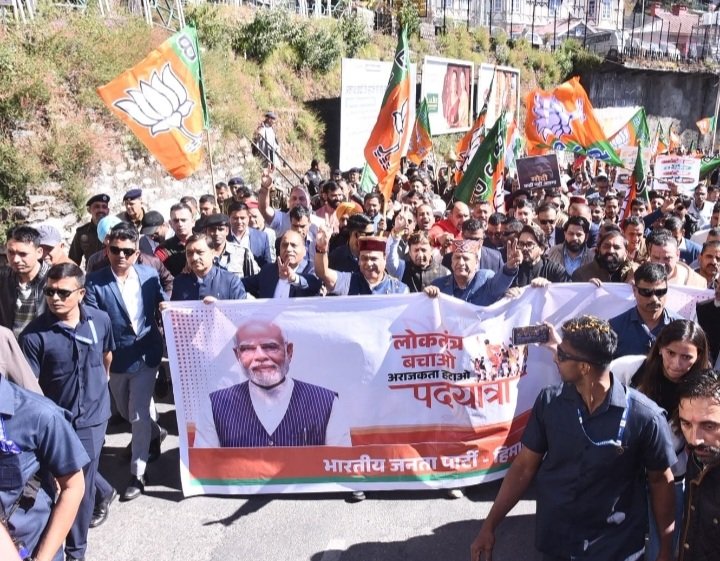
Battle Lines Drawn in the Hills: BJP Takes Aim at Sukhu Government as National Flashpoints Spill into Himachal
SHIMLA — The political tempers across the hill state is rapidly rising, transforming into a high-stakes arena as the Bharatiya Janata Party (BJP) steps up its aggressive campaign against the ruling Congress administration.
While Chief Minister Sukhvinder Singh Sukhu's government faces intense scrutiny over unfulfilled employment and financial guarantees, the political friction has transcended state borders, mirroring a fierce national showdown between the opposition INDIA bloc and the Modi-led central establishment over electoral integrity and the Special Intensive Revision (SIR) of voter rolls.
The Shimla Offensive: BJP Slams State Performance and National Double Standards
Addressing a massive BJP ‘Save Democracy, Remove Anarchy’ Padyatra rally at Chaura Maidan in Shimla, Assam Chief Minister Himanta Biswa Sarma launched a blistering attack on the state government and national Congress leadership, setting a combative tone for the upcoming electoral cycles.
Himanta Biswa Sarma, Assam Chief Minister:
“If Congress does not trust EVMs, Chief Minister Sukhu must explain why he continues to occupy the Chief Minister's chair on the basis of a mandate obtained through those very machines.
In Assam, we promised one lakh jobs and delivered more than 1.07 lakh. Congress promised five lakh jobs in Himachal Pradesh. Chief Minister Sukhu must tell the people how many young people have actually received employment.”
Echoing the aggressive posture, Leader of the Opposition and former Chief Minister Jairam Thakur accused the state leadership of administrative paralysis and deflection.
Jairam Thakur, Leader of the Opposition:
“Sukhu himself came to power by stealing votes in the name of guarantees, and today he is protesting against that very commission. He is misusing state resources to spread anarchy.)
Adding further momentum to the critique, former Union Minister and Hamirpur MP Anurag Singh Thakur challenged the empirical basis of Congress's protests against the Election Commission.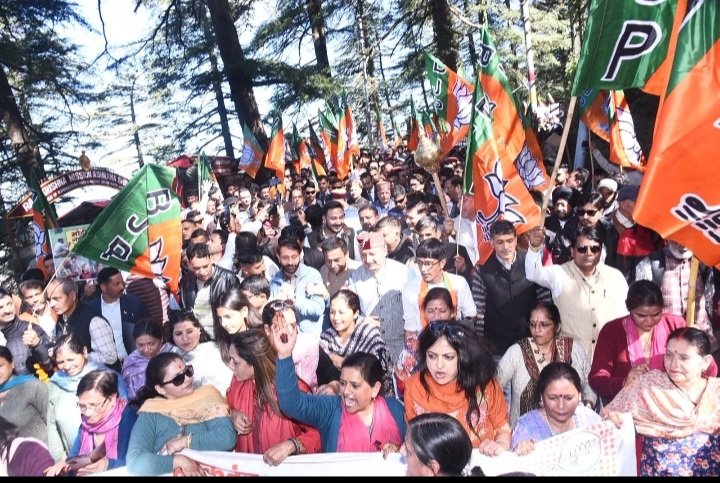
Anurag Singh Thakur, Former Union Minister & MP:
“Rahul Gandhi has been alleging vote theft for over a year continuously, but has failed to present any concrete evidence before the public. When asked for proof, they only talk about a 'feeling'. If Rahul Gandhi gets a feeling of vote theft, the people of Himachal Pradesh also have the feeling that they must vote out Congress in the next assembly elections.”
BJP State President Dr. Rajiv Bindal reinforced the narrative of local accountability, emphasizing that administrative failures cannot be masked by national rhetoric.
Dr. Rajiv Bindal, BJP State President said Congress leaders are creating a ruckus over vote theft on the streets of Delhi, while the people of Himachal Pradesh are demanding an account of four years of governance from the Congress government. Women were promised ₹1,500 per month, but even after four years, every eligible woman is awaiting thousands of rupees in dues.)
The National Echo: Ramlila Ground Showdown on SIR and Electoral Integrity
While the BJP rallied its cadre in the hills, the national capital witnessed a parallel escalation. At New Delhi's Ramlila Ground, top Congress leadership and opposition figures converged to protest against the Modi government and Chief Election Commissioner (CEC) Gyanesh Kumar over the Special Intensive Revision (SIR) of electoral rolls and alleged systemic manipulation.
Congress leaders argued that aggressive roll revisions and administrative pressures are being weaponized to disenfranchise marginalized sections and skew electoral playing fields.
The national demonstration sought to pivot public attention toward institutional independence, setting up a high-decibel ideological clash across multiple states gearing up for crucial electoral battles—including Himachal Pradesh, Uttarakhand, and Punjab.
Ground Reality: Slogans vs. Public Skepticism
As political parties aggressively queue up their pitches and cross swords from Delhi to Shimla, the broader sentiment among ordinary citizens remains heavily muted by fatigue.
Caught in the crossfire of high-octane political rallies, accusations of vote theft, and counter-claims of unfulfilled employment guarantees, the public at large views the escalating rhetoric with profound skepticism.
For the average citizen grappling with rising living costs, infrastructural gaps, and delayed developmental promises, the political noise offers little tangible relief—leaving a widespread feeling that at the end of the day, regardless of which banner flies high, grassroots realities remain largely unchanged.