

NEW DELHI/SHIMLA: A string of former top government officials, public-sector executives and regulators joining the boards or advisory board of Reliance Industries and its group companies has put the spotlight on the growing influence of India’s largest corporate groups—and the potential for conflicts of interest.
A table circulating in public domain lists several high-profile appointments involving former heads of state-owned institutions.
Among them is former SBI chairperson Arundhati Bhattacharya, who became a Reliance Industries director in October 2018 after retiring from SBI in 2017.
Former Central Vigilance Commissioner K.V. Chowdary, who had earlier headed the Central Board of Direct Taxes, joined the Reliance Industries board as an independent director in 2019, reportedly four months after retiring as CVC.
The list also includes former BPCL chairman Sarthak Behuria, who later headed Indian Oil Corporation and joined Reliance as a senior adviser in 2020, and former IOC chairman Sanjiv Singh, who joined Reliance as Group President around two months after his retirement in June 2020.
Former Petronet LNG MD and former GAIL director Prabhat Singh is listed as joining the Reliance-BP gas venture's business leadership team shortly after superannuation.
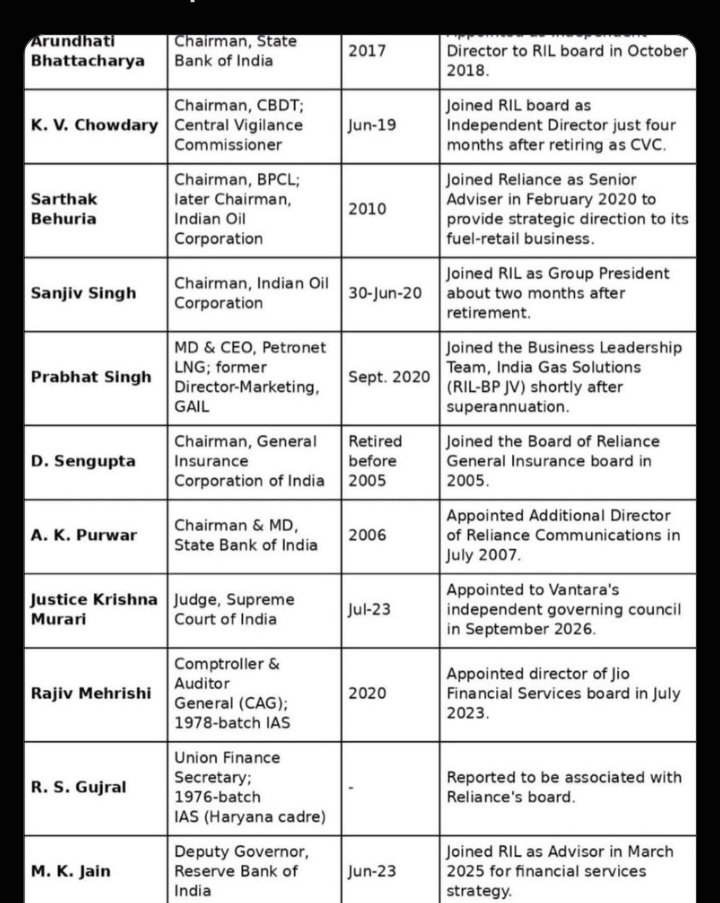
The pattern extends beyond the energy sector. Former General Insurance Corporation of India chairman D. Sengupta joined the board of Reliance General Insurance, while former SBI chairman and managing director A.K. Purwar became an additional director of Reliance Communications in 2007.
The list also names former CAG Rajiv Mehrishi, who became a director on the board of Jio Financial Services in 2023, and former RBI deputy governor M.K. Jain, who joined Reliance Industries as an adviser for financial-services strategy in 2025.
Former Union Finance Secretary R.S. Gujral is described in the table as being associated with the Reliance board.
The latest entry is former Supreme Court judge Justice Krishna Murari, who was appointed to Vantara's independent governing council in September 2026, according to the table.
Individually, such appointments can be legitimate and may bring specialised experience to private companies. But taken together, the movement of senior officials from government, regulators and public-sector enterprises into a powerful corporate group raises questions about the revolving door between public office and private business.
It also raises a larger transparency question: whether existing cooling-off periods and conflict-of-interest safeguards are sufficient when individuals who previously occupied positions of regulatory, financial or institutional authority subsequently enter corporate organisations operating in related sectors.
The appointments do not by themselves establish wrongdoing or an actual conflict of interest and is enough proof that Ambanis cultivate its powerful clique to influence power game irrespective of the ruling party.
But the concentration of former decision-makers around one corporate group provides a basis for closer public scrutiny of the rules governing post-retirement appointments, disclosures and potential conflicts.
Counterview:
There is an agreement that hiring experienced bureaucrats and PSU technocrats and judges is not, by itself, evidence of anything improper.
Their institutional knowledge, sector expertise and understanding of government systems can be valuable to private companies.
In fact, this is not a practice confined to any one corporate house. Analysts found that since 2009, at least 225 retired Central Government officials had joined the boards of private listed companies, including 155 IAS officers, 30 IRS officers, 18 IPS officers and 18 IFS officers.
There are several prominent examples. Former Economic Affairs Secretary Atanu Chakraborty became chairman of HDFC Bank after retirement.
Former Telecom Secretary Aruna Sundararajan joined L&T Infotech. Former CAG Rajiv Mehrishi has served as an independent director at Jio Financial Services, Piramal Enterprises, Dabur and Tata Power.
Former SEBI chairman M. Damodaran has served on the boards of companies including Larsen & Toubro, Hero MotoCorp, Tech Mahindra and Biocon.
The Tata example is equally relevant. Tata Power itself has had senior professionals with extensive NTPC backgrounds in its leadership and board ecosystem.
Its own records describe Narendra Nath Misra as a former NTPC Director (Operations) with 37 years of experience, while other Tata Power professionals have also moved between NTPC and the private power sector.
There are also documented examples involving Reliance and Adani.
A study reported by The Economic Times noted that Adani's listed companies had retired bureaucrats on their boards, while Reliance Industries had former bureaucrats and a former public-sector banker among its independent directors.
Therefore, if the argument is that the mere presence of former bureaucrats or PSU executives proves corporate influence or wrongdoing, that standard would have to be applied consistently across Tata, HDFC, L&T, Reliance, Adani and several other major companies.
There can certainly be a legitimate debate about cooling-off periods, conflict-of-interest safeguards and whether former officials should join companies operating in sectors they once regulated.
But selectively presenting examples from only one corporate group can create a misleading impression.
#Reliance #CorporateGovernance #ConflictOfInterest #Lobbying