
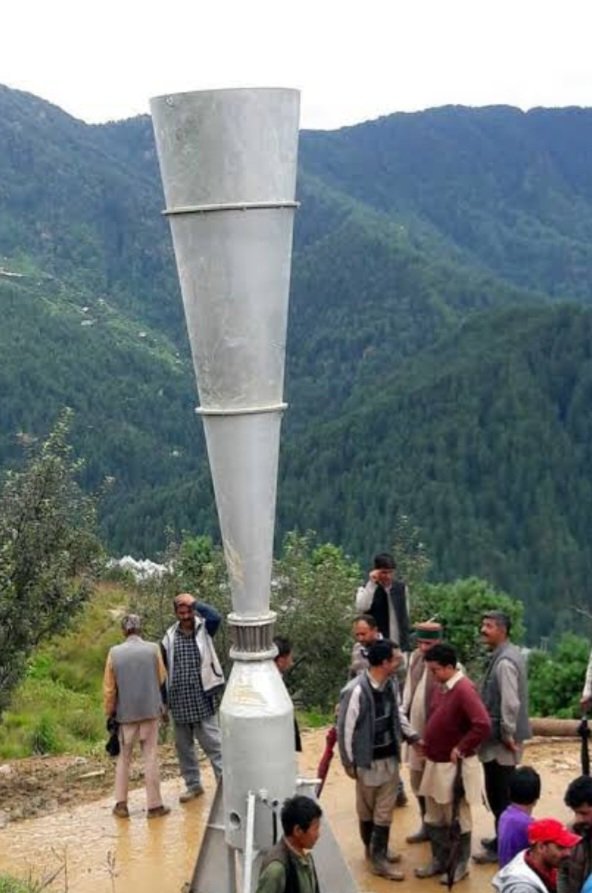
Anti-Hail Guns Come Under High Court Scanner; State, Pollution Board Asked to Explain Environmental Impact
SHIMLA: The use of anti-hail guns in Himachal Pradesh's apple belt has landed in legal trouble, with the Himachal Pradesh High Court seeking responses from the state government, the State Pollution Control Board and other agencies on their environmental, ecological and public safety implications.
A Division Bench comprising Chief Justice Gurmeet Singh Sandhawalia and Justice Bipin Chander Negi issued notices while hearing a public interest litigation triggered by a letter from a resident of Bhamnoli village in Rohru tehsil. The petitioner has sought an immediate ban or suspension on the use of anti-hail guns across the state.
The court has specifically asked whether the state government has framed any official guidelines, regulations or standard operating procedures governing the installation and operation of anti-hail guns in horticulture areas.
The matter is now listed for further hearing on July 20.
The legal challenge has brought renewed attention to anti-hail systems installed in apple-growing region of Shimla district over the year.
Defending the anti-hail gun technology, Dr. Sudarshan, Head of the Department of Aerospace Engineering at Indian Institute of Technology Bombay, told HimbuMail that a similar installation was recently set up in an industrial area near Pune after obtaining the necessary permissions from the district administration.
"We approached the Pune District Collector for permission, and he told us that we were free to carry out the installation on our own land," Dr. Sudarshan said.
He pointed out that anti-hail guns are not operated round the clock. "The system is activated only when hailstorm conditions are predicted.
It runs for a few hours during the threat period and is then shut down. It is not a 24x7 operation," he said, adding that such systems should be allowed to function as a protective measure for crops.
Dr. Sudarshan also raised concerns over the environmental impact of anti-hail nets, saying the debate should not focus solely on anti-hail guns.
"Every year, thousands of tonnes of plastic and nylon from anti-hail nets eventually become waste. Improper disposal contributes to environmental pollution, while microplastics can find their way into fruits and enter the food chain, posing potential health risks to consumers," he said.
He stressed that there is an urgent need for scientific studies to assess the long-term environmental and pollution impacts of plastic-based anti-hail nets, which are now widely used in apple-growing belt.
One such anti-hail gun was installed near Mandhol in Jubbal on a trial basis with technical assistance from IIT Bombay. Another hail suppression system was set up at Reo Ghati in Kotkhai during the BJP government when late horticulture minister Narendra Bragta was spearheading efforts to protect orchards from weather-related losses.
Many orchardists in the area have maintained that the Reo Ghati system delivered encouraging results, claiming incidents of damaging hailstorms became rare after its installation.
Farmers argue that hail suppression technology has emerged as an important tool at a time when climate change is making weather patterns increasingly unpredictable and threatening apple production.
However, concerns raised before the High Court question the environmental consequences of repeated shock-wave emissions from the guns, their impact on local ecology and wildlife, and possible risks to human health and public safety.
Experts Divided on Effectiveness of Anti-Hail Guns
The High Court's intervention has once again brought the spotlight on the scientific debate surrounding anti-hail guns and weather modification technologies.
Experts say anti-hail guns operate by generating powerful shock waves that are directed towards developing storm clouds with the aim of disrupting the formation of hailstones.
The technology has been used in several fruit-growing regions across Europe and elsewhere, particularly in areas vulnerable to frequent hailstorms.
However, meteorologists and atmospheric scientists remain divided over their effectiveness.
Several experts have argued that there is limited scientific evidence to conclusively prove that shock waves generated from ground-based anti-hail guns can significantly alter cloud microphysics or prevent hail formation.
Many weather scientists contend that hailstorms develop several kilometres above the ground and involve highly complex atmospheric processes that may not be influenced by acoustic shock waves.
On the other hand, some horticulture and agricultural experts point to field experiences from fruit-growing regions where growers have reported a reduction in hail damage following the installation of hail suppression systems.
They argue that while definitive scientific proof remains elusive, farmers often judge the technology by its practical outcomes on the ground.
The debate has also raised questions about environmental impact, noise pollution, wildlife disturbance and public safety, issues that the Himachal Pradesh High Court has now asked the state government and pollution control authorities to examine.
In Himachal Pradesh, anti-hail systems installed at Mandhol in Jubbal and Reo Ghati in Kotkhai were introduced to protect the state's apple economy from increasingly erratic weather patterns.
Many orchardists claim that damaging hail incidents became less frequent in the vicinity of these installations, although no comprehensive independent scientific assessment has yet been made public.
With the matter now before the High Court, experts believe the case could lead to a broader review of the scientific basis, regulatory framework and environmental safeguards governing the use of anti-hail technologies in the state's horticulture sector. Will IIT Bombay takes a call on this?
RESPONSES:
1. Human intervention in natural weather systems should be approached with extreme caution.
"Because I am a naturalist, I believe we cannot take the role of nature into our own hands,".
-Dr. VANEET JISHTU, FIELD BOTANIST (RETD), HIMALAYAN FOREST RESEARCH INSTITUTE, SHIMLA