
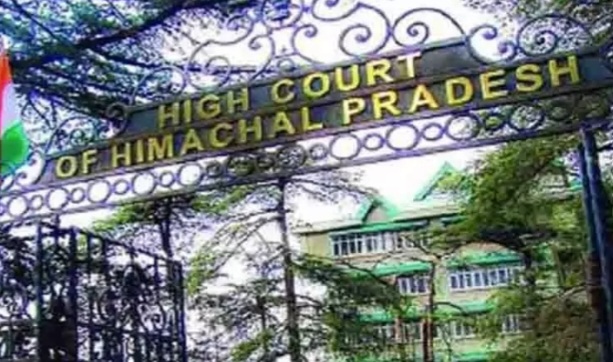
Himachal High Court Quashes Commercial Clearance for Dalhousie Hotel Project in Restricted Green Belt
SHIMLA — The Himachal Pradesh High Court has quashed an appellate administrative order permitting the conversion of residential land into a commercial hotel and guest house project in the Bakrota area of Dalhousie. The division bench ruled that the permission blatantly violated regional development regulations intended to safeguard the ecologically sensitive zone.
A division bench comprising Chief Justice G.S. Sandhawalia and Justice Bipin Chander Negi allowed a Public Interest Litigation (PIL) filed by the Upper Bakrota Residents Association. The court set aside an order dated January 3, 2020, passed by the Principal Secretary (Town and Country Planning), which had granted a Change of Land Use (CLU) to private landowner Prit Pal Singh, as well as subsequent development and construction permissions issued on February 2, 2024.
The dispute centered on a 5,594-square-meter parcel of land located at khasra No. 2134 in Mohal Bakrota. Singh had initially secured approvals in 2017 and 2018 to construct residential blocks on the plot. However, in October 2018, he sought a CLU to build a hotel and guest house.
The Deputy Commissioner-led Planning Permission Committee rejected the request in September 2019 following a joint site inspection report, which revealed that the site fell inside a designated "Restricted Area" under the Dalhousie Development Plan and harbored dozens of standing green trees.
On appeal, the Principal Secretary (Town and Country Planning) overturned the rejection on January 3, 2020, allowing the commercial conversion. The appellate authority cited that other tourism units were operating in the vicinity and that Singh was an inhabitant who had acquired the property in 1993, prior to the local enforcement of the Town and Country Planning Act, 1977.
Challenging the move, the residents association argued that the Development Plan notified in December 2004 was sacrosanct, that Bakrota was designated as a restricted zone barring commercial development, and that the appellate order lacked public interest and valid reasoning.
Singh countered that the approvals were granted under valid statutory appeal powers and contended that the PIL was filed merely to stall his project.
Dismissing the respondent's contentions, the bench characterized the appellate authority's decision as arbitrary, non-speaking, and passed with "total non-application of mind".
The court highlighted that under General Regulation 18.1.2(vi) of the Development Plan, discretionary relaxation requires demonstrable public interest or town planning considerations—neither of which were established.
The bench noted that invoking parity with existing commercial activities in the neighborhood was legally impermissible, reiterating that Article 14 of the Constitution cannot be cited in the negative to perpetuate an illegality.
The judges warned that sanctioning high-intensity commercial construction in the densely forested peak would open the floodgates to rampant degradation of Bakrota’s fragile environment.
The court clarified that while all commercial permissions stand revoked, Singh remains free to utilize the property for residential purposes in accordance with the prior sanctions granted in 2017 and 2018.