
Indigenous Seed Heroes Honoured; Experts Call for Mission-Mode State Policy to Revive Uttarakhand’s Hill Farming
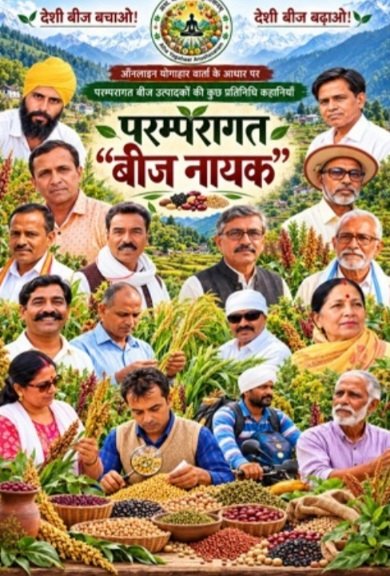
DEHRADUN, Oct 23: Marking 2,000 days of its campaign dedicated to nutrition, yoga, and sustainable agriculture, the initiative ‘Yogahaar’ released a digital booklet titled ‘Paramparagat Beej Nayak’ (Traditional Seed Heroes) during a four-day virtual conclave.
While the publication documents the achievements of 16 grassroots seed conservationists from across India, the milestone has sharpened calls for concrete policy intervention in Uttarakhand to take indigenous seeds from isolated seed banks to the fields of ordinary hill farmers.
The virtual event brought together around 80 participants, agricultural scientists, and renowned conservationists—including Uttarakhand’s Vijay Jardhari, Padma Shri awardee Nekram Sharma and Subhadra Kunwar from Himachal Pradesh, and farmers from Madhya Pradesh, Chhattisgarh, Gujarat, Maharashtra, and Uttar Pradesh.
Dr Omveer Singh, adviser to the National Dairy Development Board (NDDB), and Dr Kailash Chandra Bhatt, principal scientist at the National Bureau of Plant Genetic Resources (NBPGR), lauded the conservationists and emphasised the high nutritional value of indigenous crops.
Compiled by Dinesh Chandra Semwal and edited by Dr Vinod Kumar Bhatt, Pawan Kumar, and Ranjana Kinhikar, the booklet highlights how traditional seed keepers have safeguarded agricultural biodiversity against the aggressive expansion of multinational seed corporations.
Unlike commercial hybrid seeds that do not germinate in the subsequent season—locking farmers into an expensive cycle of annual purchases—traditional seeds can be preserved and replanted season after season.
The Grassroots Challenge: Need for a State Policy
Despite these individual conservation successes, the broader state of agriculture in the higher reaches of Uttarakhand remains grim.
Relentless distress migration in search of urban wages has left hundreds of hill villages deserted, turning once-fertile terraced fields into barren, uncultivated land.
Agricultural observers point out that celebrating seed protectors will achieve its true purpose only when these traditional seeds are actively circulated among the wider farming community. However, individual seed savers cannot bridge this gap alone.
The pressing question now is how long the Uttarakhand government will take to address this crisis seriously and roll out a dedicated policy to promote traditional seeds on a mission mode.
For indigenous seed conservation to check migration and revive the rural economy, the state must move beyond token appreciation and create an institutional framework where hill farmers are not merely encouraged to return to their fields, but are made active stakeholders with assured market linkages, sustainable income, and long-term agricultural viability.
Meanwhile, the Yogahaar conclave will continue on October 25 with the release of ‘Bharatiya Chikitsa ke Nayak’, focusing on contributions to traditional medicine, before concluding on October 26 with a roadmap session on future commitments.