
Changing Shimla, Vanishing Biodiversity Take Centre Stage at Wildlife Week
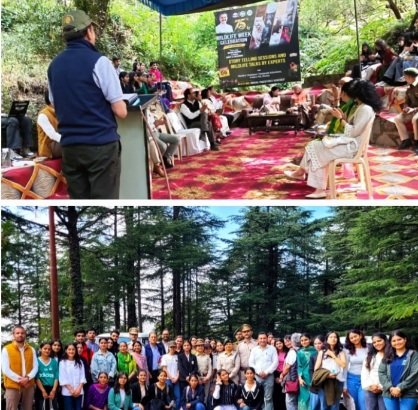
SHIMLA: The rapid transformation of Shimla’s natural and its growing impact on wildlife and biodiversity came under focus during the 75th Wildlife Week celebrations held at the Western Himalayan Temperate Arboretum, Potter’s Hill.
Organised by the Wildlife Wing of the Himachal Pradesh Forest Department, the programme used storytelling, expert talks, personal experiences and traditional ecological knowledge to examine the changing relationship between people and nature.
The discussions reflected growing concern over the replacement of forests, meadows and natural ecosystems by unplanned development. Speakers recalled a Shimla where green spaces, wildflowers, native trees and wildlife were an integral part of everyday life, while highlighting the gradual decline of natural habitats.
About 135 people, including government officials, senior citizens, local communities, industry representatives, college students, faculty members and Forest Department personnel, participated in the programme.
Chief guest Anu Nagar, Advisor (Health), Government of Himachal Pradesh, drew attention to the increasing emergence of zoonotic diseases and stressed the often-overlooked links between human health, wildlife and ecosystem health.
Retired IAS officer and theatre personality Shrinivas Joshi took participants back to an earlier Shimla through memories from his youth, offering a comparison with the city’s rapidly changing landscape and its relationship with nature.
Shimla historian Raja Bhasin warned about the adverse consequences of unplanned development on wildlife habitats. He pointed out that human activities had transformed the natural environment within a relatively short period, with consequences that could extend across generations.
Uma Mahajan of the Shimla Collective brought traditional ecological knowledge into the discussion, highlighting practices from Chamba and Kangra where local deities and traditional institutions historically played a role in conserving natural resources.
Prof Ajay Srivastava, Chairperson of the Umang Foundation, introduced participants to lesser-known plants around Shimla and underlined the ecological importance of insects, particularly their role in pollination and food production.
HP Forest Development Corporation Director Krishan Kumar shared field experiences and stressed the importance of wildlife conservation.
The programme also placed students at the centre of the conversation. Students from St Bede’s College and RKMV Shimla presented stories, poems and performances, demonstrating how storytelling can connect younger generations with nature and conservation.
Moderated by Dr Vaneet Jishtu, retired Scientist, ICFRE-Himalayan Forest Research Institute, Shimla, the programme also highlighted storytelling as an important part of Pahari culture through which memories, traditional knowledge and values have historically passed between generations.
Held amid living representatives of Himalayan flora, the programme went beyond recalling a disappearing past. It brought into focus the challenge of preserving the forests, wildlife and biodiversity that remain as Shimla continues to undergo rapid change.
#WildlifeWeek #Shimla #Biodiversity #HimachalPradesh