


Vanishing Sanctuaries: How Boundary Rationalisation Carved Up Himachal Pradesh’s Protected Forests
 SHIMLA: Over the past decade, a quiet but sweeping administrative exercise transformed the ecological geography of Himachal Pradesh.
Marketed as a benign administrative measure to settle customary forest rights and bring civic infrastructure to trapped rural settlements, the “Rationalisation of Boundaries” of the state’s Protected Area Network (PAN) has hollowed out several key wildlife reserves.
Approved under Supreme Court proceedings and executed through final notifications under Section 26A of the Wildlife (Protection) Act, 1972, the exercise formally excluded over 750 revenue villages.
Yet beneath the balance-sheet adjustments lies a stark reality: vital lower- and mid-Himalayan temperate forests were slashed by upwards of 80%, leaving behind fragmented habitat islands increasingly exposed to unchecked commercialization, hospitality expansion, and mechanized mining.
The Numbers: A Tale of Disproportionate Slashing
On paper, Himachal Pradesh maintained its overall square-kilometer ledger by adding vast tracts of high-altitude rock, snow, and alpine pasture to the protected fold. However, an analysis of individual mid-elevation sanctuaries reveals unprecedented losses of biodiverse forest canopies:
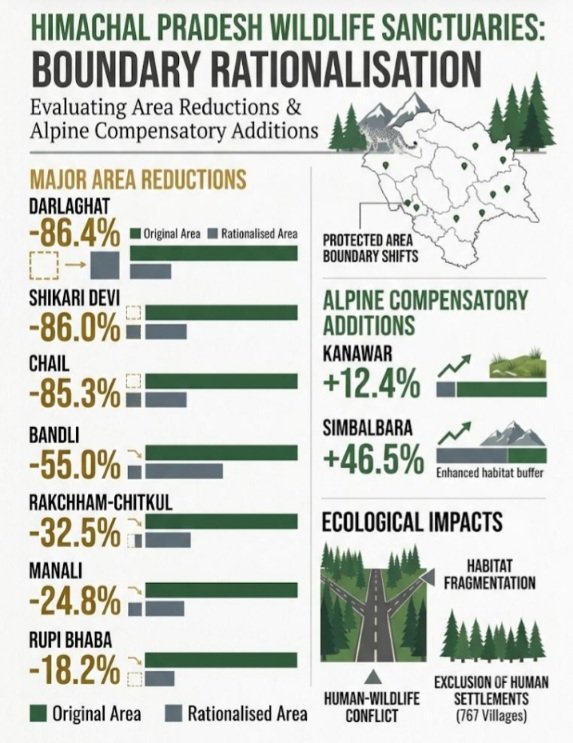
While high-altitude, unpopulated reserves such as Kanawar in Kullu doubled in paper area (expanding from 54.3 sq km to 107.3 sq km through upper alpine inclusions), the state’s dense mid-elevation oak and deodar corridors were gutted.
The Ecological Cost: Swapping Vital Canopies for Bare Rock
The fundamental flaw in treating wildlife habitat as an interchangeable acreage ledger is that snow and moraines cannot substitute for temperate oak-conifer ecosystems.
1. Habitat Fragmentation & "Islandisation":
Wildlife species do not recognize revenue boundaries. In Chail and Shikari Devi, shrinking contiguous sanctuaries into fragmented patches severed traditional migration corridors.
Animals like the Himalayan Black Bear, Leopard, Barking Deer, and endangered Western Tragopan now find their natural home ranges cut off by paved roads and concrete fencing.
2. The Commercial Real Estate & Tourism Boom:
Under Sections 18–26 of the Wildlife (Protection) Act, land conversion, commercial construction, and deforestation were legally prohibited.
The moment village revenue parcels were de-notified, the legal bar dropped. Around the perimeters of Chail, Manali, and the Tirthan/Sainj buffers, homestays, multi-story hotels, and private estates expanded directly adjacent to fragile forest cores.
3. Inroads by Riverbed Mining & Hydropower:
Across river basins like the Beas, Sutlej, and Yamuna tributaries, boundary rollbacks permitted stone crushers, screening plants, and small run-of-the-river hydropower works to operate closer to forest edges.
In lower tracts like the Paonta Valley and Simbalbara belt, crushing plants cluster right along seasonal streams (khals), creating fugitive dust plumes that coat forest canopies and discharge untreated aggregate slurry into dry-season wildlife waterholes.
4. Escalating Human-Wildlife Conflict:
As civic infrastructure, traffic, and high-decibel tourist activities advanced into formerly protected corridors, human-wildlife encounters surged. Crop depredation by ungulates and macaques, alongside recurring leopard and black bear incursions into rural homesteads, are direct symptoms of compressed natural ranges.
The Legal Vacuum in the Buffers
The crisis has been exacerbated by delays and legal disputes surrounding Eco-Sensitive Zones (ESZs).
Intended by the Supreme Court to act as mandatory shock absorbers around remaining protected cores, several ESZ notifications have faced legal challenges.
A notable instance occurred near Col. Sher Jung (Simbalbara) National Park, where the Himachal Pradesh High Court quashed the ESZ notification covering peripheral panchayats due to administrative and procedural failures—specifically, the lack of ground-level surveys and public hearings.
While the ruling centered on due process for villagers, it created a regulatory vacuum that commercial operators, including riverbed stone crushers, immediately exploited to challenge environmental curbs.
The Way Forward
Settling the customary rights of indigenous mountain communities is an undeniable constitutional and human imperative. However, executing boundary rationalisation as a blunt real estate excision without rigorous corridor protection has compromised Himachal’s ecological backbone.
To reverse this decline, ecological experts emphasize three non-negotiable steps:
Legally Notifying Critical Wildlife Corridors: Contiguous forest belts connecting fragmented sanctuaries must be declared as Community or Conservation Reserves under the Wildlife Protection Act to prevent complete genetic isolation of wildlife populations.
Rigorous, Inclusive ESZ Demarcation: The State Forest Department must re-demarcate Eco-Sensitive Zones using rigorous ground surveys. These zones must exclude family farmlands and village homes from arbitrary red tape, while enforcing strict prohibitions on heavy commercial industries, riverbed stone crushers, and red-category enterprises.
Enforcing Default Buffer Norms: Where site-specific ESZ notifications remain contested or vacated, environmental regulators must enforce the Supreme Court’s standing baseline buffers, requiring mandatory clearances from the National Board for Wildlife (NBWL) for any heavy commercial activity within 10 kilometers of sanctuary boundaries.
Unless Himachal Pradesh moves beyond acreage arithmetic and commits to preserving functional ecological corridors, the state risks transforming its celebrated wildlife sanctuaries into isolated open-air enclosures amidst a landscape of concrete and stone dust.