Shimla/Srinagar/Dehradun:
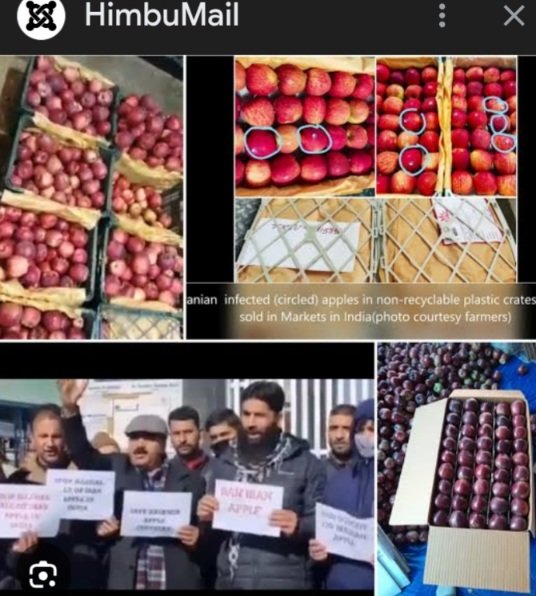
Apple growers across the Himalayan states have intensified their protest against the Centre’s decision to allow free import of apples from the European Union and New Zealand, calling it a direct assault on domestic orchardists and the hill economy.
Farmers’ organisations, including the Himachal Pradesh Seb Utpadak Sangh, Himachal Kisan Sabha, along with apple growers’ bodies from Jammu & Kashmir and Uttarakhand, have announced a united agitation, warning of sustained protests if the decision is not reversed.
In Himachal Pradesh, the apple economy spans a ₹5,000 crore annual business and supports nearly two lakh families, contributing around 13 per cent to the state’s GSDP.
According to figures available with the Himachal Pradesh Horticulture Department, apple production in the state has been recorded at 502,948 metric tonnes, or about 5.03 lakh tonnes. Apple contributes about 79 percent of fruit production in Himachal Pradesh.
Across the Himalayan belt, apple cultivation remains the backbone of rural livelihoods.
Taking a swipe at the ruling party, farmers pointed out that the BJP has maintained silence in Himachal Pradesh on the issue, even as anger mounts among orchardists.
In contrast, Congress Chief Minister Sukhvinder Singh Sukhu had taken up the matter of free import of apples from New Zealand with Union Finance Minister Nirmala Sitharaman, seeking protection for domestic growers.
However, farmers allege that soon after, the India–EU Free Trade Agreement (FTA) was pushed ahead, opening the gates for further imports and deepening the crisis for Indian apple growers.
“This clearly shows where the priorities lie,” said Sanjay Chauhan, leader of the HP Seb Utpadak Sangh.
“The Modi government talks about farmers’ welfare, but its trade policies are destroying hill agriculture.
Apple and all agricultural commodities must be excluded from trade agreements. We demand a minimum 100 per cent import duty on apples and a Minimum Import Price of ₹100 per kg,” Chauhan said.
Growers from Kashmir Valley, India’s largest apple-producing region, also expressed anguish, particularly over the political silence.
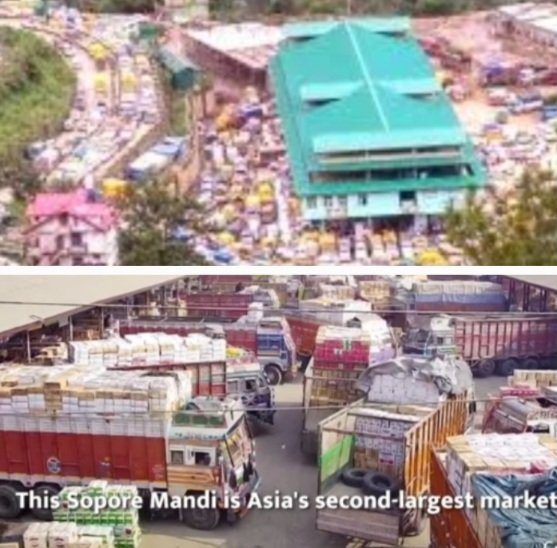
“Apple is the lifeline of Jammu and Kashmir, yet there is no official statement from Omar Abdullah on this issue,” said Ghulam Nabi Bhat, an apple grower from Sopore.
Kashmir Apple Production — The Numbers That Matter
Apple farming isn’t just a crop in Jammu & Kashmir — it’s the economic lifeline of the region, with massive production and livelihoods tied to it.
Jammu & Kashmir produces roughly 20.40 lakh metric tonnes (LMT) of apples in 2022-23, 20.64 LMT in 2023-24, and 20.56 LMT in 2024-25, amounting to around 62 LMT over the last three years.
The horticulture sector supports about 35 lakh people, directly or indirectly benefiting around 7 lakh families across the Union Territory.
Significant volumes are exported — 12.07 LMT in 2021-22, 17.48 LMT in 2022-23 and 18.57 LMT in 2023-24, with apples forming a large share of horticulture exports.
Total Controlled Atmosphere (CA) storage has grown to about 3.07 LMT, but still falls short of annual requirements in the UT, farmers informed.
Together, these numbers underline why apple growers in the Valley argue that free imports without protective duties or minimum import prices could threaten the very fabric of their economy — one that fuels millions of livelihoods and drives both domestic sales and significant exports.
“When cheap imported apples flood the market, our produce is pushed out and prices collapse. This silence is deeply disappointing,” farmers said.
In Uttarakhand, orchardists warned that small hill farmers would be the worst hit.
“Free imports will wipe out small growers in Uttarakhand,” said Ramesh Singh Rawat, an apple farmer from Uttarkashi.
“We stand united with farmers of Himachal and Kashmir. This fight is for survival,” he said.
Farmers’ bodies have called upon all farmers’ organisations across the country to unite, warning that the agitation will intensify unless the Centre rolls back the decision and safeguards domestic apple growers.
“The government cannot double farmers’ income by destroying their markets,” Chauhan said, announcing a phased protest across apple belts of the Himalayan region.
Union Commerce and Industry Minister Piyush Goyal said the proposed India–EU Free Trade Agreement will be a “win-win deal” covering almost the entire spectrum of trade, including textiles and apparel, leather and footwear, gems and jewellery, engineering goods, chemicals, plastics and rubber, pharmaceuticals and medical devices, marine products, tea, coffee and spices, electronics and electrical machinery, besides services such as IT, ITeS, professionals, education and skilled mobility, while ensuring protection for sensitive sectors.
He said the agreement will cut or eliminate EU tariffs on over 90 per cent of Indian exports, with most labour-intensive products getting zero-duty access and the rest seeing phased reductions, making Indian goods more competitive in Europe.
However, Goyal remained silent on what the FTA would mean for the import of fruits, particularly apples, a point that continues to worry growers in India’s Himalayan states.
“This is not a zero-sum agreement; it is a win-win FTA that will power India’s economic growth, create huge opportunities for our exporters and place India at the high table of global trade,” the minister said.