
Shimla: In the mountains, roads without drainage are not roads at all—they are scars carved into fragile hills. Every monsoon in Himachal Pradesh proves this point brutally, as rainwater, blocked natural streams and badly designed slopes turn roads into landslides, rivers and disaster zones.
Public Works Minister Vikramaditya Singh on Sunday announced what he called a long-overdue shift in thinking: a new drainage policy for road construction, built around the principle of “first drainage, then road.”
The announcement came amid rising public anger over repeated road failures triggered by cloudbursts, heavy rainfall and slope collapses.
Singh admitted what engineers, villagers and disaster experts have been saying for years—that Himachal’s roads are collapsing not just because of rain, but because natural drainage systems have been cut, blocked or ignored during construction.
Roads That Fight Water Always Lose
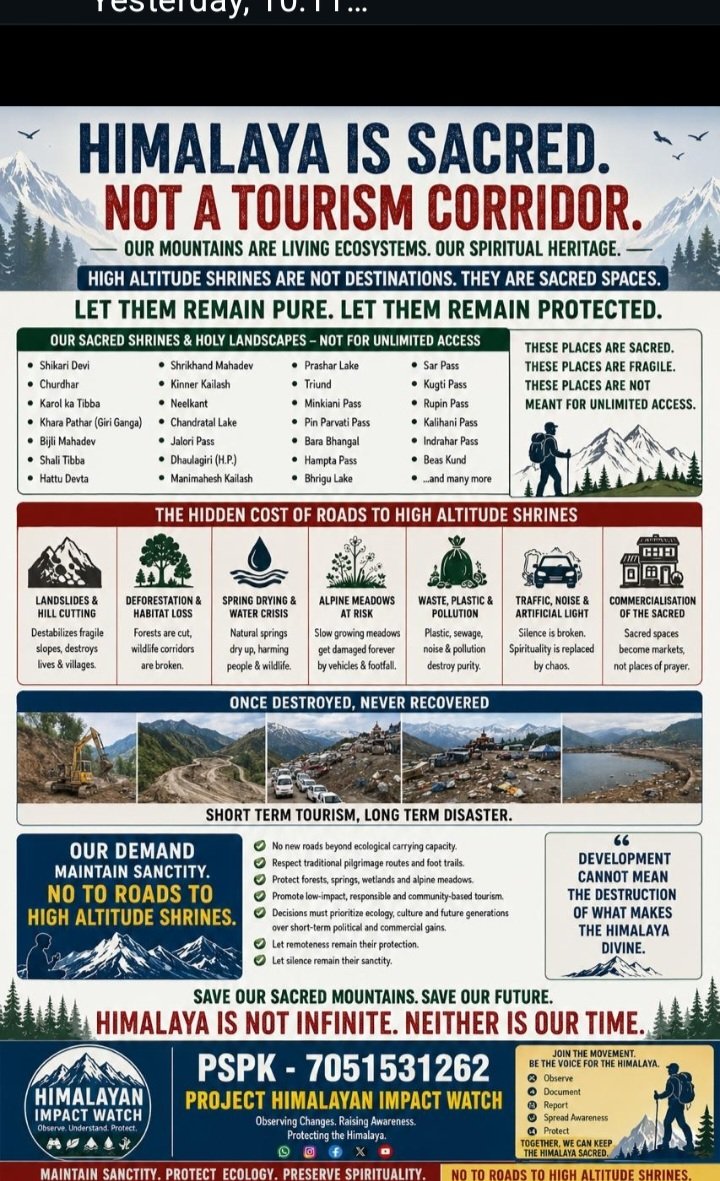
Across Himachal, roads have been pushed through mountains by cutting slopes vertically, choking springs, diverting streams blindly and dumping debris downhill.
The result: water has nowhere to go. It seeps under roads, weakens slopes and triggers landslides—often wiping out the very roads built at huge public cost.
“In the last few monsoons alone, hundreds of roads were shut simultaneously,” Singh noted, acknowledging losses running into thousands of crores, much of it linked to road and bridge damage.
Emergency services, ambulances, school transport and apple supply chains were repeatedly disrupted.

What the New Drainage Policy Promises
According to the minister, the new policy mandates: Scientific surveys before every new road or upgrade
Compulsory side drains, cross drainage works, culverts and stormwater channels
Bio-engineering solutions like grassed slopes, plantation and nature-based slope protection
Drainage audits and regular cleaning, especially in Shimla and district headquarters
Protection of springs and water sources, by channelising them safely instead of blocking them
The policy also talks of community monitoring and discouraging encroachment on drains—an issue often ignored until disaster strikes.
What Mountain Roads Get Right Elsewhere
Singh’s vision closely mirrors practices already standard in Switzerland, Japan and parts of Norway, where mountain roads are designed to cooperate with water, not resist it.
In the Swiss Alps, roads follow natural contours, with frequent cross-drainage channels allowing water to pass beneath roads without pressure build-up. Retaining walls are designed with weep holes and layered drainage.
Japan, despite extreme rainfall and seismic activity, uses deep subsurface drainage, stepped slopes, and flexible retaining systems that allow controlled movement rather than rigid resistance.
Even in Uttarakhand’s better-engineered stretches, newer BRO projects have shown that proper slope angles, gabion walls and planned drainage drastically reduce failures.
The lesson is clear: mountain roads survive not by brute concrete, but by respecting natural hydrology.
The Unanswered Questions
While the policy sounds promising, critical questions remain unanswered:
Who will fix existing roads that already block natural drainage and act as disaster triggers?
Will engineers be held accountable for faulty designs in landslide-prone and slushy zones?
Can PWD resist political pressure for fast, wide roads at the cost of safety?
Will drainage audits be independent—or remain paperwork exercises?
Experts warn that roads in sliding and muck zones need entirely different engineering—shallower cuts, flexible walls, continuous drainage and strict debris management. Applying “one-size-fits-all” designs has repeatedly failed Himachal.
Policy vs Practice
Singh urged PWD officers to implement the policy “not just on paper, but on land.” That line may be the most crucial. Himachal has no shortage of policies; what it lacks is discipline in execution and respect for mountain science.
Unless this policy is backed by design accountability, third-party audits and the political will to slow down unsafe construction, the state risks repeating the same cycle—build, collapse, repair, repeat.
For now, the announcement raises cautious hope. But in the mountains, only the next monsoon will tell whether Himachal has finally learned to build roads that let water pass, instead of inviting it to destroy.