Shimla, February 13
Himachal Pradesh’s battle for financial survival slipped into political crossfire on Friday, when an all-party meeting called to evolve a common stand on the withdrawal of the Revenue Deficit Grant (RDG) ended with the BJP walking out midway, leaving the state without a unified voice at a critical moment.
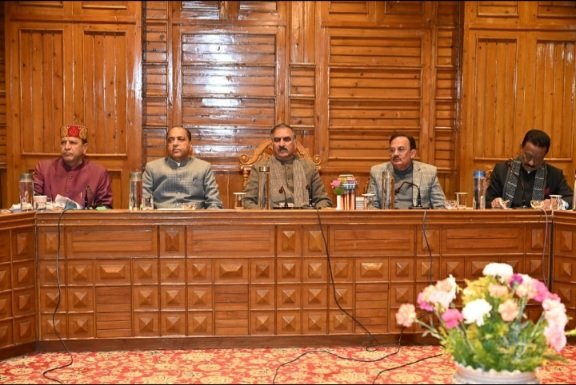
The meeting, chaired by Chief Minister Sukhvinder Singh Sukhu at Peterhoff, was convened in the backdrop of the 16th Finance Commission’s decision not to extend RDG beyond March 2026. For Himachal, the move threatens to open a fiscal gap of nearly ₹6,000 crore every year, even as the state’s total debt approaches ₹1 lakh crore.
RDG is not a new concession. It is a constitutional mechanism under Article 275(1), in place since 1952, meant to help states whose revenues are structurally insufficient to meet basic expenditure. For a hill state like Himachal—constrained by terrain, forests, disaster vulnerability and limited tax base—the grant has long acted as a financial stabiliser. Under the 15th Finance Commission, RDG accounted for about 12.7 per cent of the state budget, largely financing salaries, pensions and welfare commitments.
Addressing the meeting, Sukhu described the proposed withdrawal as a serious threat to governance and development.
“This issue is linked to the financial strength of the state, continuity of development works and public welfare,” he said, stressing that it could not be treated lightly.
He argued that judging hill states by the same fiscal yardstick as plains states ignored ecological and geographical realities, and urged all parties to collectively press the Centre for restoration of RDG or an equivalent untied support.
After the meeting, Sukhu came down heavily on the BJP for walking out. Calling the move “highly condemnable”, he said it showed a lack of seriousness on an issue that affects every household in the state.
“This is not about Congress or BJP. It is about the rights of Himachal,” he said, pointing out that while the previous BJP government received around ₹54,000 crore as RDG and ₹16,000 crore as GST compensation, the present government has so far received only ₹17,000 crore as RDG.
Despite this, he claimed, the state was attempting to move towards fiscal self-reliance through due diligence and restraint.
The BJP, however, accused the Sukhu government of politicising a fiscal issue. Leader of Opposition Jai Ram Thakur said the discussion should have risen above party lines.
“Himachal belongs to everyone—not Congress, not BJP,” he remarked, cautioning against projecting RDG as a permanent entitlement. He recalled that Finance Commissions, including during the UPA years, had always treated RDG as a tapering support, not a lifelong guarantee. Abrupt withdrawal was undesirable, he said, but so was ignoring the need for fiscal discipline.
Yet, the BJP’s decision to leave the meeting midway blunted its own argument. What was expected to be a joint strategy session degenerated into political signalling, with no agreement on how to negotiate with the Centre or what alternative support mechanisms Himachal should seek once RDG ends.
The meeting also exposed deeper contradictions in the state’s fiscal conduct. Officials privately acknowledge that while Himachal has legitimate claims over hydropower royalties, forest services, tourism pressures and horticulture-based revenues, successive governments have failed to convert these into predictable income streams.
At the same time, committed expenditure continues to balloon—driven by a huge salary and pension bill, an oversized administrative structure, 10 DGP-rank officers, more than 100 government-paid legal appointees, and over ₹1,000 crore in pending court liabilities.
Smaller parties struck a different note. CPI(M), Aam Aadmi Party and BSP extended unconditional support to the demand for RDG restoration, citing limited state resources, repeated disasters and post-COVID stress on finances.
Former MLA Rakesh Singha said political parties must rise above differences to safeguard the interests of people facing daily economic pressure.
The absence of Deputy Chief Minister Mukesh Agnihotri from the meeting, too, raised eyebrows and added to the sense that political priorities were eclipsing fiscal urgency.
With the Budget Session beginning on February 16 and a special Assembly discussion on RDG expected, attention now shifts to the floor of the House. Publicly, every party claims to support continuation of RDG.
Privately, the question remains whether that resolve will survive when hard decisions—on cutting non-plan expenditure, restructuring loss-making undertakings and rationalising manpower—come up for debate.
For Himachal Pradesh, the challenge is no longer limited to persuading the Centre.
It is also about proving that the state can manage its finances responsibly, even as it seeks continued support for the structural disadvantages it was born with.