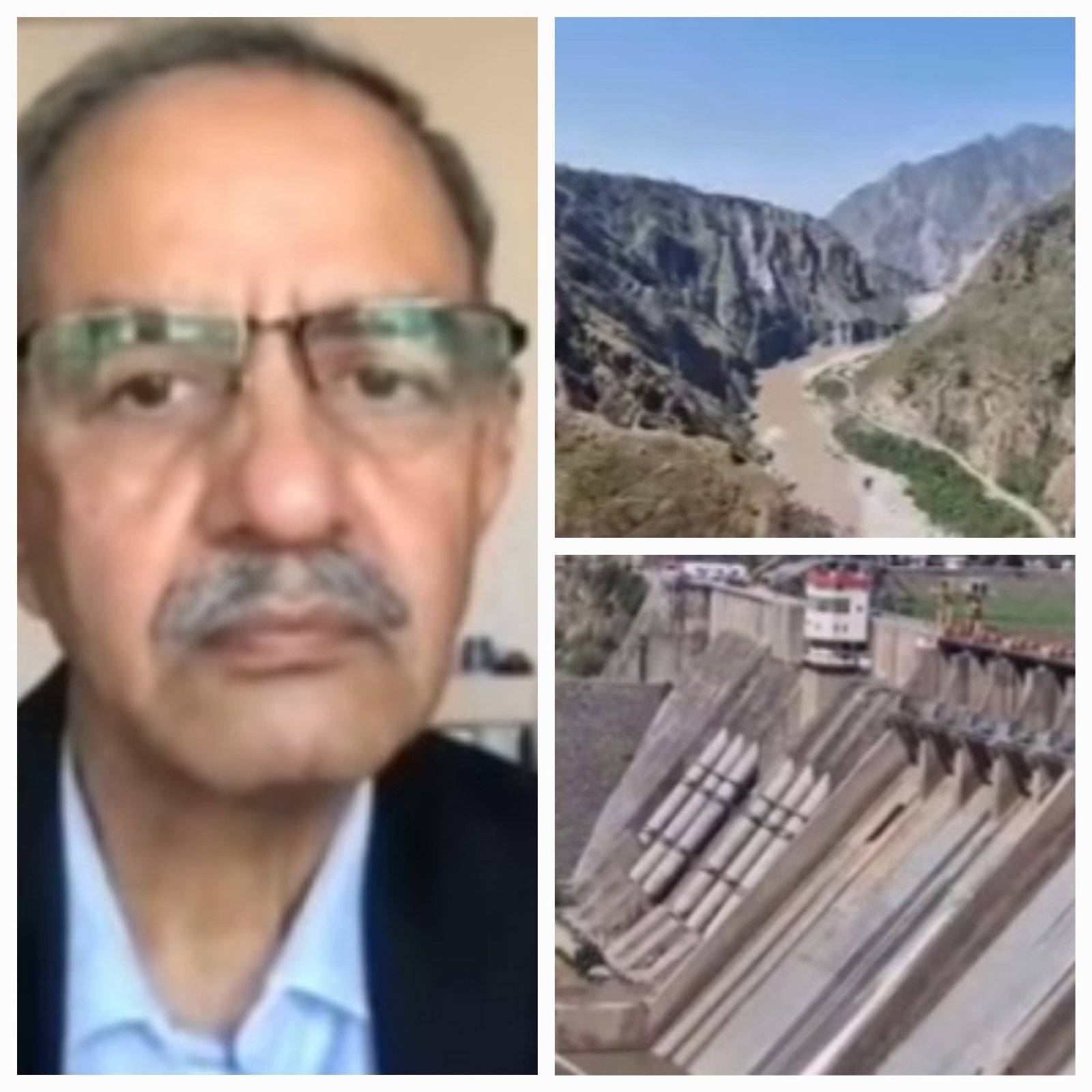
NEW DELHI Delh/SHIMLA: National Security Advisory Board and Former  Chairman of the Bhakra Beas Management Board (BBMB), Devendra Kumar Sharma, has strongly defended India's decision to place the Indus Waters Treaty (IWT) in abeyance, arguing that the move is legally, strategically and morally justified in the wake of Pakistan-sponsored terrorism and decades of obstruction over India's water rights.
Sharma asserted that under the Vienna Convention, India has the legal right to exit or suspend treaty obligations when its supreme national interests are threatened.
He said the recent terror attack in Pahalgam crossed that threshold and provided sufficient grounds for India to reconsider its commitments under the 1960 treaty.
According to Sharma, India had made repeated attempts to resolve outstanding issues through dialogue.
He revealed that New Delhi invoked Article 10 of the treaty on three occasions, the latest being in January 2024, seeking renegotiation of certain provisions. However, Pakistan allegedly refused to engage constructively each time.
Pakistan Used Treaty to Block India's Development.
Sharma accused Pakistan of systematically exploiting technical provisions of the treaty to obstruct India's hydroelectric and irrigation projects in Jammu and Kashmir.
Referring to Annexure D of the treaty, which mandates that projects be designed on "sound and economical principles with satisfactory operation," Sharma said Pakistan adopted modern international engineering standards for its own projects while forcing India into outdated and inefficient designs.
He claimed that Pakistan repeatedly objected to India's proposals for effective sediment management systems, compelling Indian engineers to adopt sub-optimal solutions.
“As a result, India has suffered a loss of thousands of crores on sediment management while at the same time loosing valuable storage in its reservoirs on the Western rivers.”
Salal Dam Reduced to a Sediment Basin
Citing the Salal Hydroelectric Project on the Chenab River as a striking example, Sharma said the dam has become a victim of treaty-imposed design restrictions.
"Today Salal Dam is nearly 97 per cent filled with sediment. If you take a picture of the reservoir, you will find sediment rather than water near the dam," he remarked.
According to him, the inability to incorporate effective sediment flushing mechanisms has severely compromised the project's operational efficiency and long-term viability.
J&K Denied Its Irrigation Rights
Sharma also highlighted what he described as a historic denial of Jammu and Kashmir's rightful share of irrigation benefits.
Under the treaty framework, he said, the region is entitled to irrigate nearly 11,770 square kilometres of land.
However, due to continuous objections raised by Pakistan against irrigation and water storage projects, India has reportedly been able to irrigate only around 520 square kilometres—less than five per cent of the entitled area.
He argued that this has adversely affected agricultural development and economic growth in the region for more than six decades.
2014 Kashmir Floods Cited as Lost Opportunity
Recalling the devastating floods that inundated Kashmir in 2014, Sharma maintained that the treaty also limited India's ability to undertake flood mitigation measures.
He suggested that, in the absence of treaty restrictions, India could have diverted excess Jhelum waters upstream of Srinagar into natural drainage channels, potentially reducing the scale of flooding in the city.
Instead, he argued, authorities were forced to undertake large-scale rescue operations, including aerial evacuations, because available engineering options were constrained by treaty provisions.
Two Strong Grounds to Suspend the Treaty
Summing up his position, Sharma said India was justified in placing the Indus Waters Treaty in abeyance on two independent grounds.
The first, he said, is Pakistan's continued sponsorship of terrorism against India. The second is India's responsibility towards its own citizens in Jammu and Kashmir, Punjab, Haryana, Rajasthan and Delhi, who, according to him, have been deprived of their legitimate water entitlements and development opportunities for decades.
"The treaty has imposed significant costs on India while preventing the optimal utilisation of its own river waters.
The time has come to reassess an arrangement that no longer serves India's national interests," Sharma said.