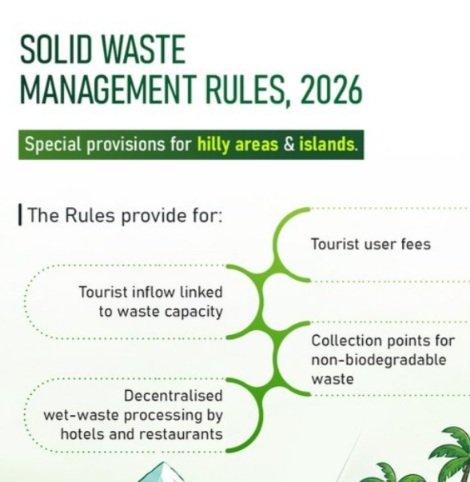
Shimla: The Solid Waste Management Rules, 2026 have put Gram Panchayats at the centre of rural waste management, making village-level segregation, collection, processing and prevention of open dumping a more structured responsibility rather than an occasional cleanliness exercise.
The new rules, effective from April 1, 2026, replace the 2016 framework and mandate segregation of waste at source into four streams—wet waste, dry waste, sanitary waste and special-care waste.
The framework covers rural as well as urban areas and provides specific responsibilities for rural local bodies.
For Gram Panchayats, the immediate task is to establish a system under which household and other village waste is segregated, collected and taken for appropriate processing instead of being burnt, buried or dumped in open areas, drains, water bodies and public places.
In Himachal Pradesh, the State Pollution Control Board has specifically emphasised the role of Panchayats in door-to-door collection, source segregation, scientific processing and prevention of open dumping and burning in villages.
The four-stream system means wet waste such as kitchen and other biodegradable waste should be processed through composting or bio-methanation, while recyclable dry waste such as paper, plastic, glass and metals should move towards sorting and recycling.
Sanitary and special-care waste require separate handling and disposal through appropriate channels.
The rules also require stronger monitoring and reporting. The new national framework provides for online tracking of waste generation, collection, transportation, processing and disposal.
Panchayats therefore face a shift from simply creating sanitation assets to demonstrating that those assets are actually functioning.
Where can Panchayats get the money?
The important financial opportunity for Gram Panchayats lies in convergence rather than depending on a single scheme.
Under Swachh Bharat Mission-Grameen Phase II, Solid and Liquid Waste Management is a core component.
The official SBM(G) framework allows village-level activities including compost pits, vermicomposting, collection vehicles, segregation and storage facilities, plastic-waste storage, waste-processing infrastructure and operation and maintenance.
For village-level SLWM, the current SBM(G) funding framework provides support on a per-capita basis. For villages up to 5,000 population, Solid Waste Management support can go up to ₹60 per capita, while for villages above 5,000 population the SWM component can go up to ₹45 per capita, alongside separate provisions for greywater management.
The framework also requires a 30 per cent Panchayat contribution from the 15th Finance Commission grants for village-level SLWM activities.
This means Panchayats can prepare a village waste-management plan and combine SBM(G) money with their Finance Commission sanitation allocation instead of treating the two funding streams separately.
The official SBM(G) guidelines also permit convergence with MGNREGS for labour-intensive works such as construction of compost pits, soak pits, storage facilities and other community assets.
Additional resources can be mobilised through State schemes, CSR and other government programmes.
For plastic waste, the SBM(G) framework provides for Plastic Waste Management Units at block level, with financial assistance of up to ₹16 lakh per unit.
GOBAR-Dhan projects can receive assistance of up to ₹50 lakh at district level, subject to the applicable guidelines and project requirements.
The Panchayat's Finance Commission money is therefore particularly important because sanitation and water-related expenditure has a designated funding window.
Under the SBM(G) framework, 30 per cent of village-level SLWM funding is to come from the Panchayat's Finance Commission grants, while the remaining support comes through SBM(G).
What a Panchayat should actually do
A Gram Panchayat can start by preparing a village-level Solid Waste Management Plan identifying every household, shop, school, government building, institution and other waste-generating establishment.
It can then use available funds and convergence to establish household-level segregation, collection arrangements, a village collection and segregation point, composting facilities for biodegradable waste and arrangements for transporting recyclable and special-care waste to authorised facilities.
The Panchayat should also identify illegal dumping and burning points and progressively eliminate them.
For larger establishments, Panchayats and other local authorities also have to identify Bulk Waste Generators.
Under the 2026 rules, entities meeting specified thresholds—including 100 kg or more of solid waste generation per day—fall within the bulk-generator framework and have additional responsibilities for managing their waste.
The new system also creates an opportunity for Panchayats to involve Self-Help Groups and local enterprises in collection, segregation, composting, recycling and other waste-related activities.
The national rural sanitation campaign has specifically highlighted the role of SHGs in waste management and plastic-waste management.
For Himachal Pradesh, the financial convergence is particularly significant. The Centre has stated that SBM(G) provides assistance to Himalayan States with a 90:10 Centre-State sharing pattern.
In 2024-25, Himachal Pradesh had a reported central allocation of ₹44.17 crore under SBM(G) for solid waste management.
The message for Panchayats is therefore straightforward: the 2026 rules create the obligation, but Panchayats are not expected to build the entire waste-management system from their own resources.
They can combine SBM(G), Finance Commission grants, MGNREGS labour, State schemes and, where available, CSR resources to create functioning village-level systems.
With the new rules also requiring greater monitoring and reporting, Panchayats that prepare proper plans, create functional assets and maintain records of collection, processing and disposal will be better placed to demonstrate compliance and access available programme support.