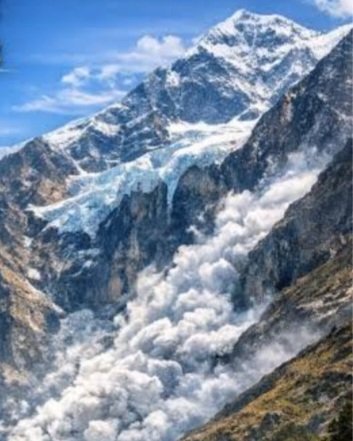
Dehradun, April 25: Even as the Char Dham Yatra gathers pace and plains reel under an advancing heatwave, a chilling warning from the National Green Tribunal has exposed a dangerous blind spot in Uttarakhand’s disaster preparedness — unstable hanging glaciers looming over pilgrim routes.
Reports say even as estimates range from around 219 hanging glaciers across the Himalayan arc to just three major ones in the Alaknanda basin, a worrying ambiguity clouds the data.
There is little clarity on whether these findings are based purely on satellite imagery or backed by rigorous ground verification.
Scientists have also not clarified whether these hanging glaciers have developed suddenly in recent years or have existed for decades as part of the natural Himalayan system—either in a precarious “hanging” state or relatively stable.
This lack of clarity leaves a lingering question—whether the alarm is being amplified to corner climate change projects and funding, or whether it reflects a harsh and imminent reality unfolding in the mountains.
Yet, uncertainty cannot be an excuse for inaction. We have already witnessed devastating Glacial Lake Outburst Floods (GLOFs) in Sikkim, Uttarakhand and Himachal Pradesh over the decades, underscoring how real and destructive these threats can be.
With the Char Dham Yatra gathering pace and thousands of pilgrims heading into vulnerable valleys, the Uttarakhand government cannot afford complacency.
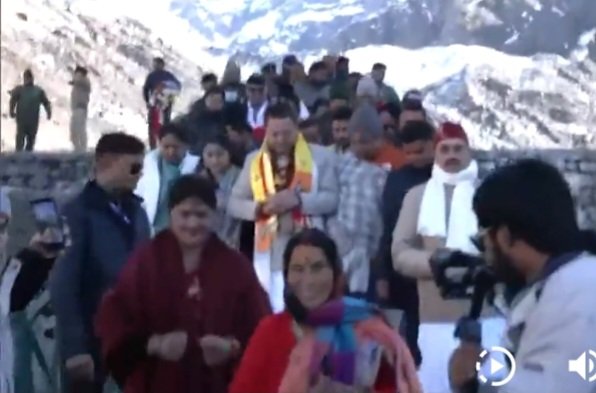
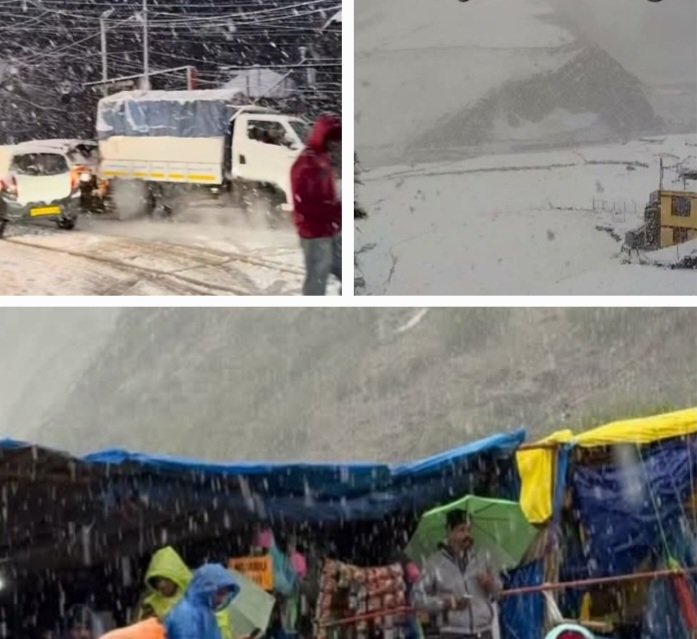
Portals of Kedarnath Dham, still covered by snow upstream has been opened on for pilgrims on April 22. CM Dhami accompanied by stream of pilgrims were first to arrive there that day.
Proactive monitoring, real-time alerts, and preemptive evacuation plans must be put in place to guard against any sudden glacial outburst or meltwater surge, ensuring that faith does not walk blindly into danger.
Taking suo motu cognisance of a report published in The Hindu, the tribunal, headed by Justice Prakash Shrivastava, has flagged the growing danger of “hanging glaciers” in the Central Himalaya — particularly in the fragile Alaknanda basin, the lifeline of the Ganga.
Scientific assessments by experts from Indian Institute of Science, Indian Institute of Technology Bhubaneswar and Defence Research and Development Organisation point to a silent but escalating risk: glaciers clinging precariously to steep slopes, ready to snap and unleash avalanches or flash floods downstream.
Notices Issued, Accountability Sought
In a significant move, the tribunal has issued notices to authorities, demanding detailed responses on risk assessment, mitigation and public safety measures.
Notices have been sent to the Ministry of Environment, Forest and Climate Change, Government of Uttarakhand, Central Pollution Control Board and the Uttarakhand Pollution Control Board.
The tribunal has also sought inputs from scientific and disaster management bodies, including the National Disaster Management Authority and Geological Survey of India, asking them to place on record current monitoring systems, identified high-risk glacier zones, and preparedness strategies for downstream populations and pilgrims.
What makes the situation alarming is the timing.
With lakhs of pilgrims already heading towards Kedarnath, Badrinath and other shrines, rising temperatures are expected to accelerate glacial melt and destabilisation.
Yet, on the ground, there is little evidence of warning systems, hazard signages or evacuation protocols in vulnerable downstream stretches.
The tribunal’s observation comes as a stark reminder of the lessons from the 2013 Kedarnath disaster — a catastrophe that had exposed how fragile Himalayan ecosystems, when ignored, can turn into death traps overnight.
Despite that painful history, authorities appear to be repeating the same pattern: pilgrims surge first, risk assessment later.
Experts warn that retreating glaciers are not just shrinking — they are fragmenting.
Tributary glaciers are detaching from main ice bodies, leaving behind unstable masses hanging over valleys.
A minor trigger — heat, rainfall, or seismic activity — could bring them crashing down, sending debris and water surging into pilgrimage corridors with little or no warning, they caution.
Despite the tribunal’s intervention, the response on the ground remains muted.
There is still no visible large-scale public advisory mechanism for pilgrims, nor any transparent disclosure of glacier hazard mapping in Char Dham routes, reveal locals and pilgrims.
As the yatra season intensifies, the warning from the NGT needs to be taken up seriously as rising mercury and sharp Sunrays can speed up the glacial melt, posing graver risk downstream.
Ignoring it could prove costly. In the Himalaya, disasters don’t announce themselves twice.
Is Uttarakhand CM Pushkar Singh Dhami listening?
#CharDhamYatra #HimalayanCrisis #GlacierThreat #DisasterWarning #UttarakhandNegligence