Shimla, July 12, 2025
In a significant and sharp caution to apple growers across Himachal, noted horticulture scientist and former Vice Chancellor of Dr. YS Parmar University of Horticulture and Forestry,
Dr. Vijay Singh Thakur has raised serious questions on the long-standing leaf yellowing and pre-mature leaf fall problem in apple trees.
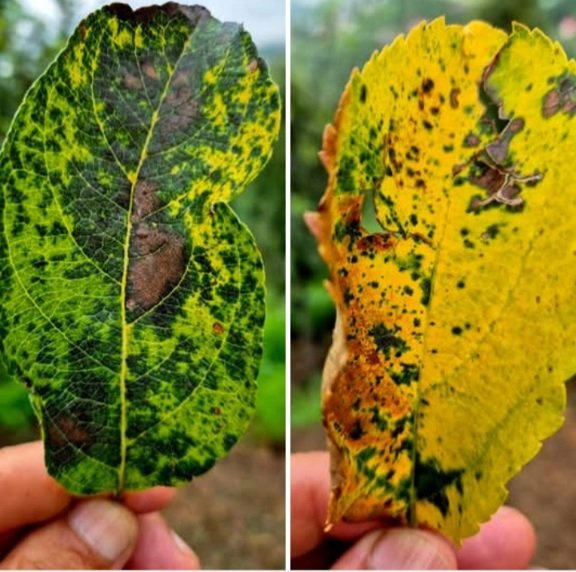
According to Dr. Thakur, the leaf yellowing—long believed to be a fungal disease—could instead be a chemically induced phenomenon, triggered by excessive and indiscriminate use of fungicides, miticides, and plant growth regulators (PGRs).
He termed the current spray-intensive orchard practices as a possible cause of declining tree immunity and the real trigger behind sudden yellowing and leaf drop—sometimes within minutes to hours.
“This yellowing epidemic has been around since 1995. Initially, it was seen as premature leaf fall or a fungal issue. Later, it was tagged as Marssonina leaf blotch and Alternaria spot,” Dr. Thakur said.
“But even then, these fungi were mostly present as saprophytes, not as active pathogens. Their identification might’ve come post-symptom, not as the cause.”
He pointed out that in the pre-1995 era, such yellowing was rarely reported and only observed naturally during autumn leaf senescence due to abscisic acid, not disease.
“Sudden yellowing during monsoon showers in peak growing months cannot happen due to fungal activity alone.
Fungal infections don’t act that fast. This is more likely a chemical reaction, a physiological response to something inside the tree,” he stressed.
Dr. Thakur questioned why the earlier recommended fungicide Indofil M-45 has lost its effectiveness, and whether new generations of miticides or acaricides being added to spray schedules year after year are in fact worsening the problem.
"Why is yellowing more prominent in trees that receive more fungicide sprays?" he asked.
"Could this have been a created disease to promote fungicide sales? Remember, once apple scab came under control by the 1990s, yellowing gave a fresh lease of life to the pesticide business.”
He referred to his first report from 1998, which linked yellowing with Ethrel, a plant aging hormone used to induce early ripening.
“That hormone misuse could’ve triggered the initial outbreaks of yellowing,” he says, calling for renewed research on soil-water-weather interactions, also known as edaphic factors, which may act as a trigger in certain micro-zones.
He also urged scientists to stop blindly attributing leaf symptoms to fungal pathogens based on late-stage samples.
“Some just wanted to be first to report a disease and created a narrative that helped chemical companies.
But no advanced country has ever reported such yellowing in apples the way we see here,” he said.
In his closing note, Dr. Thakur warned:
> “With the continuous use of new chemicals, the tree’s overall immunity is being compromised. Farmers must re-evaluate their spray schedules before it’s too late.”
His observations have ignited fresh debate among researchers and farmers alike, with many now beginning to suspect that the so-called “yellowing disease” might be more of a chemical syndrome than a true pathogen-led epidemic.
#AppleAlert #PesticideOverload #HimachalOrchards #LeafFallMystery #AgriScamExposed