
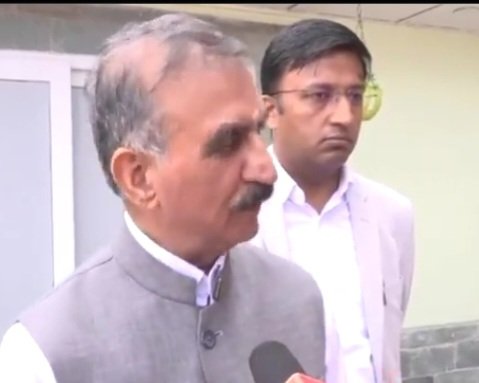
SHIMLA: Chief Minister Sukhvinder Singh Sukhu’s announcement to sharply prune the sanctioned strength of IAS, IFS and IPS officers has upset the bureaucratic apple cart in Himachal Pradesh.
But the move is already raising a larger political question: is this merely fiscal housekeeping, or is Sukhu preparing the administration for a much deeper restructuring in his final year before the next Assembly election?
Experts say that the centre should provide funds to meet out the salary component of the central government officers including IAS, IPS and IFS IN special category states like Himachal and other Himalayan states considering their scarce resources.
Moreover Himachal doesn't get anything from its forests as it needs FCA clearances for even small chunk of forest land as all waste lands ate forestland in Himachal. But salary of IFS is footed by the State.
Sukhu has announced that the government intends to reduce the number of senior administrative positions, saying the state cannot afford an oversized bureaucracy when digitalisation is reducing the need for multiple layers of administration.
According to the Chief Minister, the sanctioned IAS strength of 153 is proposed to come down to 130, while IFS positions would be reduced from 118 to 83.
He also indicated that the IPS cadre would be rationalised, though he did not give a number. The government expects the exercise to generate substantial savings.
The political significance of the announcement, however, goes beyond the arithmetic of senior posts.
Sukhu is effectively telling the bureaucracy that the era of creating or retaining posts simply because they exist may be coming to an end.
He has openly acknowledged that several officers do not have enough work and that their full capacity is not being utilised.
His new message is blunt: officers who want to move to Delhi will not be held back, and their deputation files will be cleared and the relieving process expedited.
That is a striking departure from the traditional politics of bureaucracy in which governments have often been reluctant to let senior officers leave the state.
Sukhu is now signalling that Delhi-bound officers may actually be welcome if the state does not have enough meaningful work for them.
But the proposal carries an important constitutional and administrative caveat.
IAS, IPS and IFS are All India Services, and the Centre's approval is central to any change in the sanctioned cadre strength.
The Personnel Department of the Government of India will therefore have to examine the state's proposal.
Earlier this year, reports had indicated that Himachal had approached the Centre for reducing IAS strength from 153 to 147 and IFS strength from 114 to 83.
The Union government's own 2025 data showed Himachal's authorised strength at 153 IAS and 96 IPS, with 117 IAS and 84 IPS officers in position; the IFS authorised strength was 114.
That makes the Centre's role particularly important. A state government can make a case for rationalisation, but the All India Services are not simply state cadres that can be resized unilaterally.
The proposal will therefore test how far New Delhi is willing to go along with Himachal's argument that digital governance and fiscal stress require a leaner senior bureaucracy.
Sukhu's argument is nevertheless difficult to dismiss outright. Himachal has a relatively small and slowly growing population, while its salary, pension and establishment expenditure has become one of the biggest pressures on the state exchequer.
NITI Aayog has noted that Himachal's population growth is slower than the national average, while the state's fiscal landscape remains under pressure.
The more uncomfortable question is why the rationalisation should stop at the top.
If the government has decided that there is insufficient work for dozens of senior officers, it must also explain why thousands of posts at the lower and middle levels remain vacant or why recruitment has not kept pace with the requirement of frontline departments.
The state needs teachers, doctors, nurses, police personnel, engineers, patwaris, junior staff and technical manpower far more directly than it needs layers of senior officers carrying additional charges.
This is where the move acquires a political edge. The Congress came to power with an ambitious employment promise of five lakh jobs in five years.
With only about a year left in the present government's term, the BJP has already made the employment question a central weapon against Sukhu.
The Chief Minister's own government has highlighted recruitment and appointments made during its tenure, including more than 42,000 jobs claimed over its first two years and thousands of government posts filled across departments.
Yet the opposition is likely to ask a simple question: if there is a financial crisis severe enough to reduce IAS and IFS positions, where is the corresponding administrative restructuring that creates space for the jobs promised to unemployed youth?
There is another political interpretation. Sukhu may be preparing to reallocate the state's limited administrative and financial capacity away from the upper bureaucracy towards service delivery and employment-oriented departments.
If so, reducing sanctioned senior posts is only the first visible part of a much larger exercise involving digitalisation, departmental merger, abolition of redundant posts and tighter control over establishment expenditure.
The Chief Minister's Delhi message strengthens that suspicion. “If you want to go to Delhi, come, get approval and go” is more than a comment on deputation.
It suggests a government that is no longer interested in artificially retaining officers merely to fill sanctioned positions.
There is, however, a counterargument that the government cannot use lack of work among some officers as evidence that the state needs fewer administrative capacity.
A post becoming redundant because departments have failed to utilise an officer's expertise can also expose a failure of political and administrative planning.
As the reaction to the announcement points out, surrendering posts is not automatically a sign of efficiency; it can equally indicate that the government has not been able to extract the available capacity from the system.
The challenge, therefore, is to ensure that downsizing does not become an exercise in headline-making without restructuring.
If posts are surrendered at the top while files, vacancies and service delivery bottlenecks remain untouched below, the fiscal savings could be marginal and the administrative consequences considerable.
For Sukhu, the timing makes the gamble even more significant. The government is facing a difficult fiscal environment, a shrinking revenue support and an increasingly aggressive BJP campaign on governance and jobs.
The Centre's decision on the All India Services cadre proposal will now be closely watched.
The real test will not be how many IAS, IPS or IFS posts Sukhu removes. It will be whether the government can demonstrate that every rupee saved from the top bureaucracy is converted into better services, faster administration and jobs at the bottom.
If that happens, the move could become a genuine administrative reform. If not, the opposition will have an easy political line: the government surrendered posts because it could not create enough work at the top, while unemployed youth continued waiting for the jobs promised at the bottom.
#HimachalPradesh #SukhuGovernment #Bureaucracy #Jobs