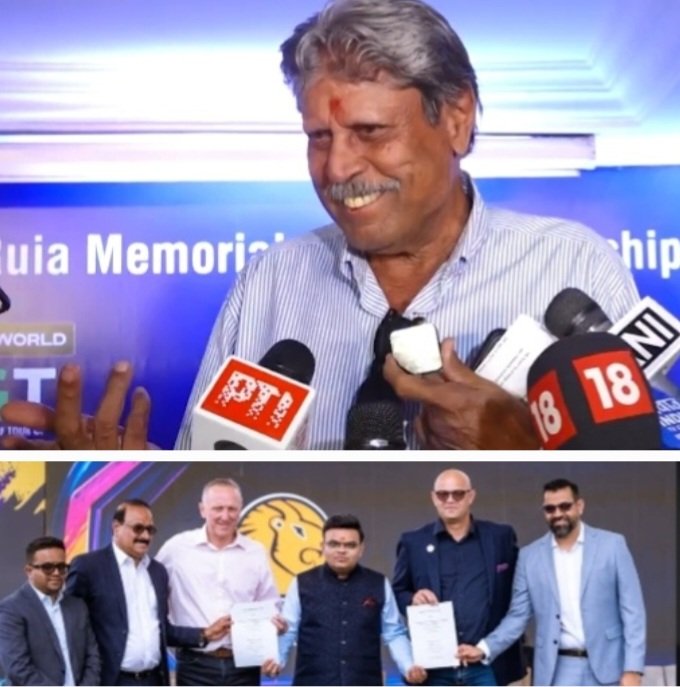
SHIMLA/NEW DELHI — Kapil Dev’s explosive truth-bomb has ripped the mask off modern cricket.
“Everyone wants to be a batsman today. Batsmen are like officers, bowlers are like workers. People just want to sit in air-conditioned rooms.” — Kapil Dev Nikhanj.
The 1983 World Cup legend did not just expose a bias on the pitch. He exposed a rotting hierarchy that runs all the way from the boundary ropes to the air-conditioned boardrooms of the BCCI and the ICC.
It has truned out to be the Glamour vs. The Grind. It bares it all if socalled media anchors, who are as glamorous, as they show up round the clock on TV screens and their new breed of cousins on YouTube channels chasing virality, have some juice left to call a spade a spade.
It has also brought into centrestage the Bollywood, Big Money, and the Batting Syndicate that sometimes are exposed by the Enforcement Directorate’s raids.
Cricket has ceased to be an equal contest. It is now a rigged show run by a batting syndicate where the " hardest workers" are treated like second-class citizens.
The Double Standard: A batter misses a wild swing and is praised for "fearless intent." A fast bowler misses a yorker by two inches after sprinting in under crushing pressure and becomes a social media meme.
The Glamour Trap: A 20-ball cameo turns a batter into an overnight millionaire. Commercial brands, moneybags, and even Bollywood actresses and film stars flock almost exclusively toward batting superstars, completely ignoring the bowlers and all-rounders who toil in the dirt to keep the game fair.
The Sandwiched Wicket: In modern broadcasts, a crucial wicket is barely celebrated before it gets sandwiched between replays of sixes and boundaries.
It is shocking and "batesman commentators" like Navjot Sidhus and Ravi Shashtris are there to weave sensational poems and cliches fanning out it among the batting crazy crowds making the contest crazier pro-batting stars.
Why does a batter get a standing ovation at 50, while a bowler needs five wickets just to be noticed? Don't you need to ponder over it?
Taking two wickets breaks the back of a team—it deserves the exact same fanfare as a half-century.
Taking four wickets is harder than scoring a hundred; it must carry the exact same status, payouts, and glory as a century.
Political Proxies on the Throne: Why Not Kapil at the Helm?
Why is the game so skewed? Because the BCCI and the ICC have stopped being custodians of a sport. They have become ruthless money machines hijacked by political dynasties.
Nothing pains genuine cricket lovers more than watching the game being run by political dummies acting as proxies for powerful rulers.
Kapil Dev should have been the ICC Chairperson, say his fans. He is the titan who dragged Indian cricket out of obscurity and gave the nation a glory nobody had ever achieved before. His knock and bowling spell against Zimbabwe still remains unmatchable in history of cricket.
Instead, the top seat belongs to political scions like Jay Shah—cutting a robotic, gadget-like figure as he struts around the global stage, hogging the limelight as though he were the cricketing star himself.
Icons like Kapil Dev, Sachin Tendulkar, Murlidharan, and Glenn McGrath, bled for this sport and inspired generations. Yet, they are pushed to the sidelines simply because they do not have political parties, Prime Ministers, or corporate oligarchs propping them up.
If a nationwide survey were conducted today asking who truly deserves to lead cricket, 98% of Indians would overwhelmingly back Kapil Dev.
Handing the reins to genuine cricketing icons is the only way to honour their sweat—and the only way to nip these political stooges in the bud before they bring further disgrace to the sport.
A Colonial Bubble vs. The True Egalitarianism of Football
India sits atop a massive financial empire in cricket today, but television revenues cannot hide the truth: cricket remains trapped in a colonial time warp.
Outside England, the craze is confined almost entirely to former British colonies—India, Australia, South Africa, Pakistan, Sri Lanka, and the West Indies. Meanwhile, the true sporting superpowers—the United States, China, Japan, Germany, Russia, and mainland Europe—simply do not care about cricket.
The Hypocrisy of the "Spirit of Cricket"
The ultimate irony lies in the ICC’s own constitution. In its official Spirit of Cricket charter, the global body preaches "Fairness, Integrity, and Respect," while its Cricket Committee explicitly vows to "preserve a fair balance between bat and ball."
Yet, in practice, the ICC and BCCI violate their own sacred manifesto every matchday. How can they preach a "level playing field" while pulling in boundary ropes, rolling out dead highways for pitches, and reducing bowlers to cannon fodder for television ratings?
Worse still, their sermon on "respect for the game’s traditions" rings hollow when political proxies occupy the highest thrones of governance, while the actual titans who bled for cricket’s heritage—like Kapil Dev—are exiled from the decision-making room.
Compare cricket’s aristocratic, classist division of labour to football (soccer). Ninety minutes of pure, egalitarian athleticism has made football a feverish religion across Europe, South America, Africa, and Asia.
On a football pitch, every single player toils equally. Even when exceptional strikers score a goal or two, the defenders and midfielders share the sweat, the struggle, and the spotlight in a continuous 90-minute battle.
Cricket, by contrast, locks itself into an old prejudice that separates "gentlemen" batters sitting in air-conditioned rooms from "player" bowlers breaking their backs in the sun.The Giants Who Built the Game: Where Would Batters Be Without Bowlers?
History proves that batting greatness is meaningless without bowling genius to test it.
Cricket’s golden eras were forged in fire—when all-time batting immortals like Sir Don Bradman, Sachin Tendulkar, Sir Viv Richards, Brian Lara, and Virat Kohli had their techniques and courage pushed to the absolute limit by bowling titans like Muttiah Muralitharan, Shane Warne, Glenn McGrath, Wasim Akram, Malcolm Marshall, and Kapil Dev himself.
Tendulkar’s 100 international centuries and Lara’s breathtaking 400* are legendary precisely because they were earned against the lethal reverse swing of Akram, the relentless accuracy of McGrath, and the wicked turn of Warne and Muralitharan (who combined for over 2,300 international wickets). Viv Richards became the ultimate king because he hooked Malcolm Marshall’s 90-mph thunderbolts without a helmet, recalled a fam.
A Global Appeal from the Fans: Reclaim the Game
Across the stadiums of Mumbai, Melbourne, Johannesburg, London, Lahore, Colombo, and Bridgetown, true cricket fans are speaking with one voice.
Real fans judge and cherish a fiery spell of fast bowling every bit as much as a cover drive—and their collective heartbreak is now boiling over into anger.
"We watch this game for the contest between bat and ball, not to see legends humiliated on the sidelines while politicians' sons hand out trophies," is the growing sentiment echoing across fan clubs from India to the Caribbean.
Defenders of the establishment often point to Jay Shah’s commercial ledger—crediting him with brokering the mammoth ₹48,390 crore ($6.2 billion) IPL media rights deal, launching the Women’s Premier League (WPL), instituting pay parity for women cricketers, and steering cricket into the 2028 Los Angeles Olympics.
Yet, this financial empire-building only proves Kapil Dev’s point: turning cricket into a billion-dollar broadcasting juggernaut is the work of corporate executives, not a justification for replacing the game's legendary soul with political administrators who prioritize television spectacles over the survival of the bowler.
If you ask Fans across the cricketing world, they would be demanding justice: strip the game of its colonial elitism, smash the political monopoly over the BCCI and ICC, and give bowlers a level playing field.
Without great bowlers, great batting is a lie. A 200-run innings means nothing if the opposition has its hands tied behind its back.
If the BCCI and ICC refuse to introspect—if they keep treating legends like outcasts and bowlers like disposable labourers to line the pockets of political proxies and batting aristocrats—cricket will die the day the "workers" finally put down the ball and walk off the field.