
Solan, November 27: Director General of Police, Himachal Pradesh, Ashok Tewari, IPS, on Friday underscored the need for responsible Artificial Intelligence (AI), climate resilience, and value-based policing to achieve the national vision of Viksit Bharat @2047.
However, his address—steeped in philosophical ideals and broad policy aspirations—left several pressing operational questions unanswered regarding how an overburdened state police force plans to execute these high-tech ambitions on the ground.
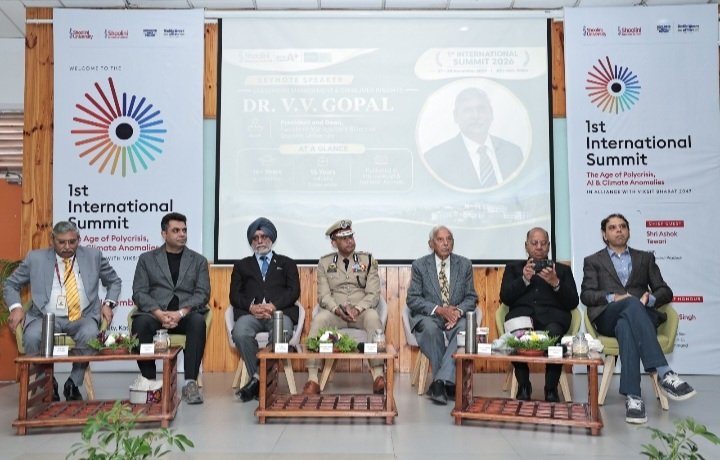
Speaking as Chief Guest at the 1st International Summit on “The Age of Polycrisis: AI and Climate Anomalies,” hosted by Shoolini Business School, Shoolini University, Tewari opened by asking what role the police play at an academic research forum.
Answering his own query, he stated that modern national security extends beyond traditional law-and-order duties to encompass technological, environmental, and social disruptions.
While the DGP accurately diagnosed Himachal Pradesh’s acute vulnerability to climate anomalies—noting how a single extreme weather event in the fragile Himalayan ecosystem can trigger cascading failures across infrastructure, communications, and emergency services—his speech focused largely on conceptual frameworks rather than concrete departmental roadmaps.
No specific budgetary allocations, timelines, or infrastructure upgrades were announced to bolster the force's disaster-response capabilities ahead of increasingly erratic weather cycles.
On the technological front, Tewari highlighted AI’s potential to improve data analysis, institutional coordination, and crisis management, while cautioning that algorithms cannot replace human judgment, ethics, or data privacy safeguards.
Yet, critics and observers often point out that integrating AI into state policing faces significant hurdles, including digital literacy gaps at the station level, legacy infrastructure, and the absence of clear regulatory guardrails governing police surveillance and data collection.
To illustrate the force's technological adaptability, the DGP cited the Emergency Response Support System (ERSS-112), noting its rise from 34th place to first nationally over consecutive months.
He attributed the turnaround to inter-agency coordination, continuous monitoring, and sustained personnel effort rather than technology alone.
While ERSS-112 remains a notable administrative success, translating that single-helpline efficiency into complex, AI-driven predictive policing and disaster management remains an untested leap.
The address also leaned heavily into spiritual and philosophical territory, drawing parallels between modern technological challenges and the teachings of Vedanta and the Bhagavad Gita.
Urging students and researchers to treat AI as a tool to "strengthen, not replace" human thinking, Tewari invoked Krishna’s counsel to Arjuna on duty and clarity of purpose, concluding with a call to “arise, awake and conquer your challenges.”
The summit, which featured delegates from Croatia, Serbia, Spain, and Egypt and opened with a welcome address by Prof. Dr. V. V. Gopal, concluded with a ceremonial tree plantation drive on campus—a familiar symbolic gesture in a state where rapid infrastructure expansion continues to test the limits of ecological sustainability.