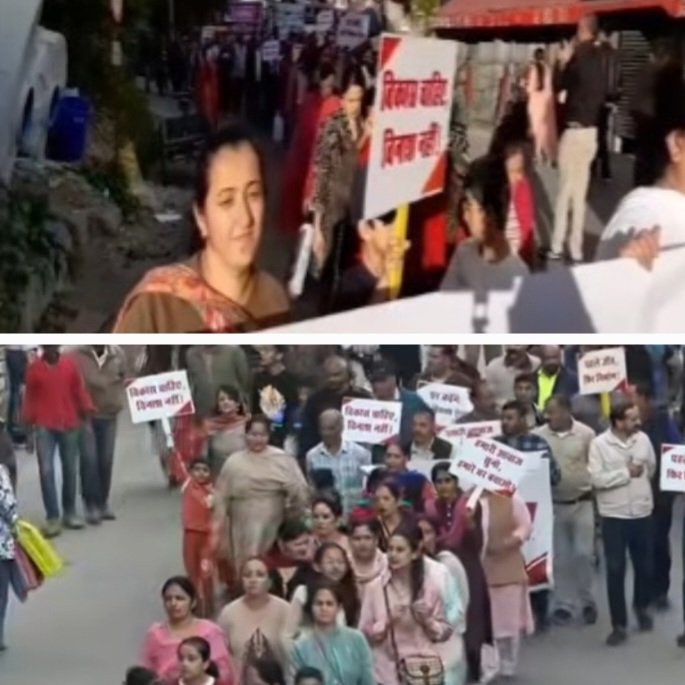

SHIMLA/ NEW DELHI:
She did not raise her voice. She did not accuse the government by name. Yet her words have become the most powerful indictment of the Union Budget.
In a video that has gone viral across platforms, the wife of a war-wounded Indian Army soldier asks a question that has jolted the nation’s conscience: “Is losing a leg income?”
Her husband returned from the battlefield 22 years ago with an artificial limb and permanent pain. He returned with dignity — not a demand slip.
“When my husband wore the uniform, he did not negotiate risk,” she says in the video. “He did not calculate whether sacrifice would be tax exempt.”
“He gave his limb to the nation, and today we are told disability pension can be treated as income.”
Her statement has become the emotional flashpoint of a growing storm over the Union government’s proposal to restrict income-tax exemption on disability pension for Armed Forces personnel.
Under the proposed clause in the Finance Bill, tax exemption on disability pension will apply only to soldiers invalided out of service. Those who suffer service-related disabilities but continue to serve and retire on superannuation will lose the exemption.
In effect, two soldiers with the same injury will be treated differently based solely on how they exited service.
The proposal has put the government led by Narendra Modi on the defensive, triggering sharp reactions from veterans, military families, legal experts and opposition MPs.
Critics say the move is arbitrary, discriminatory and morally indefensible. Many warn it could carry serious political consequences if the status quo is not restored.
Raising the issue in Parliament, Congress MP Shashi Tharoor called the proposal a direct assault on the social protection owed to disabled veterans.
“Withdrawal of income-tax exemption on disability pensions weakens the State’s moral duty towards those who risk their lives for the nation,” he said.
“It draws an indefensible line between service-related disabilities and abdicates responsibility towards wounded soldiers.”
Congress MP Karti P Chidambaram, has mounted a formal challenge through a sharply worded letter to Finance Minister Nirmala Sitharaman.
Calling disability pension compensatory rather than income, he termed the proposal “arbitrary, immoral and legally infirm.”
“Disability pension is paid for permanent injury suffered while defending the country,” Karti Chidambaram wrote.
“Treating it as taxable income violates Article 14 of the Constitution and erodes the dignity guaranteed under Article 21.”
He warned that fiscal powers cannot override the State’s constitutional and moral obligations to injured soldiers.
Veterans have been even more blunt.
Brigadier Daleep S. Chhajta summed up the anger in one line: “Disability is service-linked, not exit-linked.”
“The very basis of disability pension lies in service conditions, not the manner in which a soldier exits the force,” he said.
Senior veterans point out that many soldiers continue serving despite medical downgrading.
They do so due to operational requirements, manpower shortages and an ingrained sense of duty.
“Penalising those who continue to serve despite disability amounts to punishing resilience and commitment,” a veteran said.
The proposed distinction, experts argue, violates the equality clause of the Constitution.
Two soldiers with identical service-attributable disabilities, identical medical board findings and identical pension components will be treated unequally.
The only difference will be whether one was invalided out or served till retirement.
Legal experts say this classification has no rational nexus with the objective of disability pension or tax relief.
They also warn it runs contrary to settled law laid down by the Supreme Court of India.
The apex court has consistently held that disability pension is compensatory in nature, not a concession or charity.
Veterans fear the government is attempting legislatively what earlier executive instructions failed to achieve after judicial scrutiny.
They say the move will disproportionately hit those who retire on superannuation — the majority among disabled Armed Forces personnel.
For many, this means a sharp drop in post-retirement income amid rising healthcare costs and limited civilian employment prospects.
Beyond finances, the policy is being seen as a blow to military ethos and morale.
Critics warn it sends a dangerous message: serve despite injury and you will be penalised later.
Such signals, veterans caution, could encourage early invalidation, litigation and risk-averse behaviour, hurting operational readiness.
Veterans have also questioned the fiscal logic behind the proposal.
Disability pensioners form a minuscule fraction of taxpayers, making revenue gains marginal at best.
The institutional cost — erosion of trust, increased litigation and civil-military strain — could be far higher.
Representations submitted to the Finance Minister and Defence Minister demand immediate withdrawal of the proposal.
Veterans want uniform income-tax exemption on the entire disability pension for all service-related disabilities, irrespective of retirement mode.
“A nation that honours its soldiers only in speeches but penalises them in policy weakens its own foundations,” one joint representation states.
Back in the viral video, the soldier’s wife makes no constitutional argument. She speaks only of honour.
“When policies touch the dignity of those who have already paid in blood, it stops being a financial decision — it becomes a moral one,” she says.
Her final words now spread far beyond social media. “Sacrifice is not taxable.” “And dignity is not optional.”
#VeteransFirst #DisabilityIsNotIncome #HonourTheUniform #RollbackNow