SHIMLA: Over the decades our mountains have been speaking through repeated disasters. The question now is whether policymakers are finally listening.
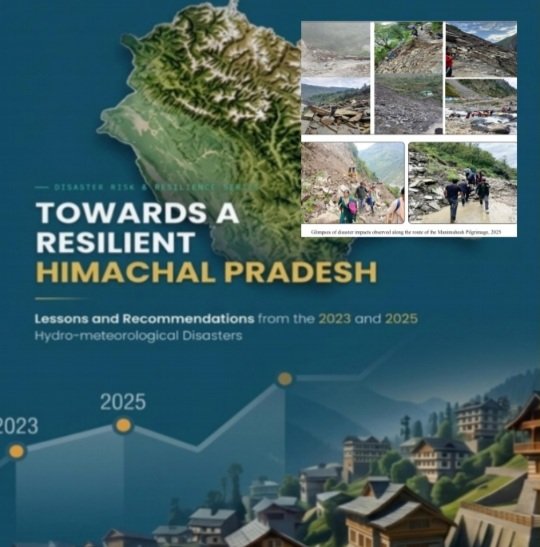
After the devastating hydro-meteorological (a technical jargon) disasters of 2023 and 2025, the Dr. Manmohan Singh Himachal Pradesh Institute of Public Administration (MSHIPA) Shimla here has presented a 162-page report titled Towards a Resilient Himachal Pradesh, urging the state government to fundamentally rethink the way it plans roads, hydropower projects, tourism, urban expansion and public infrastructure.
What is commendable is that it is for the first time that MSHIPA team headed by director Rupali Thakur, and associate director Prashant Sirckek has engaged top experts and bureaucrats into debate on disasters and produced this report and sent its recommendations to the government seeking a change on the ground zero.
Rather than treating disasters as isolated events requiring relief and compensation, the report argues that resilience must become the foundation of governance, development and public policy.
Prepared after two high-level colloquiums involving scientists, engineers, geologists, administrators, disaster management experts, environmentalists and legal professionals, the report seeks to provide a roadmap for 'rebuilding Himachal' after successive monsoon disasters exposed the vulnerability of mountain infrastructure and local population and tourists.
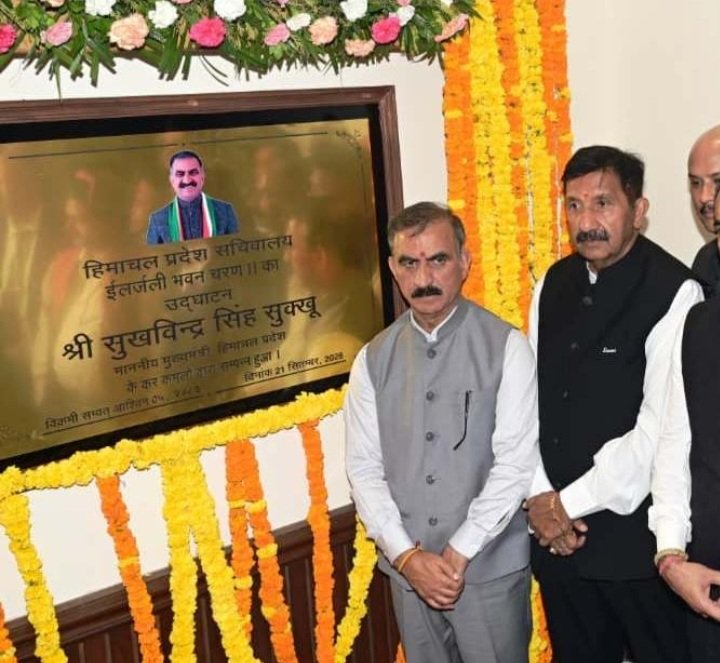
Chief Minister Sukhvinder Singh Sukhu, in his message, says the disasters have underlined the urgency of integrating sustainability, scientific planning and resilience into every future development project.
Yet, while the report is among the most comprehensive official policy documents produced on disasters in last two years in Himachal, it should be seen as the beginning of a larger debate rather than the final prescription.
It raises many important questions, but leaves several equally important ones wide-open.
Mountains Cannot Be Planned Like Plains
One of the report's strongest recommendations is that development in Himachal must be rooted in geology. Geological Survey of India Director Dr. Atul Kohli warns that the Trans-Himalayan region is inherently unstable because of its complex geological setting and recommends mandatory geological investigations, hazard mapping, topographical studies and micro-zonation before approving roads, bridges, hydropower projects and major buildings.
The report further recommends district-specific zoning regulations instead of uniform planning. But what about the existing network of roads, buildings, projects and the like?
The recommendation reflects an important shift in thinking. However, Himachal's geography demands an even finer approach.
The Beas valley cannot be understood through the experience of the Satluj. Kinnaur's fractured fragile mountains bear little resemblance to Kangra's deeply weathered slopes.
Lahaul-Spiti's cold desert follows different hydrological processes from Chamba's high rainfall catchments. Pangi, Parvati, Seraj, Shimla, Rohru and Dodra-Kwar all respond differently to rain, snow and seismic activity.
Disaster planning therefore has to move beyond district planning towards watershed and valley-specific planning because rivers, mountains and natural drainage systems do not recognise administrative boundaries.
Former HFRI field botanist Dr. Vaneet Jishtu and formet HPPCFC G.S. Goraya make a distinctive argument that Himachal's disasters are not just the result of climate change but also of ecological degradation caused by unsustainable development and poor forest management.
They caution against knee-jerk responses such as indiscriminate felling of "dangerous" trees after disasters, arguing that such measures can worsen future risks.
Instead, they advocate restoring biodiversity-rich native forests rather than monoculture plantations or exotic tree species, preserving shrubs, herbs and root systems that stabilize slopes, scientifically assessing trees before removal, enforcing the carrying capacity of tourist destinations, and curbing indiscriminate slope cutting, debris dumping and construction that weakens mountain ecology.
Their view is that ecological restoration must become a core disaster risk reduction strategy, not merely a post-disaster environmental exercise.
Roads Need Engineering That Understands Mountains
The report devotes considerable attention to roads, acknowledging that repeated monsoon damage has exposed weaknesses in mountain engineering.
Road engineering expert Dr. Manoj Kumar Shukla of CSIR-CRRI recommends improved drainage, slope stabilisation, cement-treated bases, geo-synthetics, stronger retaining structures and mandatory third-party quality audits before contractors receive final payments.
Contractors and NHAI and PWD need to be made accountable for the quality of work they execute.
It also recommends inspecting roads after every monsoon to assess their actual performance rather than treating completion certificates as the end of engineering responsibility.
The recommendation is timely because resilience cannot begin only with future roads.
Thousands of kilometres of highways, district roads, village roads, bridges, retaining walls and culverts built over the past four decades continue to deteriorate every monsoon. Many were designed before present-day rainfall intensity became common.
The report could therefore become a starting point for scientifically auditing existing infrastructure instead of focusing solely on new construction. Retrofitting vulnerable roads may prove more important than announcing new highways.
Communities Must Become Partners, Not Mere Victims
Another recurring recommendation is stronger community participation.
Former Shimla Deputy Mayor Tikender Singh Panwar observes that local residents are almost always the first responders because they know the terrain better than anyone else.
The report recommends village disaster management teams, mock drills, community volunteers and greater participation of local communities in disaster preparedness.
This opens perhaps the most important debate arising from the report.
Although the document extensively discusses geology, engineering, governance and technology, it contains little discussion on documenting and integrating the vast repository of traditional mountain knowledge accumulated over generations.
It needs to be mentioned here that Himachal's shepherds, orchardists, farmers, traditional builders and village elders possess intimate knowledge of seasonal streams, unstable slopes, groundwater movement, avalanche paths, snowfall behaviour, traditional construction house techniques and weather indicators.
Such knowledge has evolved through centuries of observation rather than scientific instrumentation.
Modern science and traditional knowledge need not compete. They complement each other. Future Himalayan planning may become stronger if engineering studies are tested alongside local ecological memory before projects are approved. But who cares for this?
Tourism Needs Nature's Calendar
Tourism restructuring forms another major chapter of the report.
It recommends carrying-capacity studies, diversification of tourism beyond Shimla and Manali, eco-tourism, agro-tourism, wildlife tourism, regulation of homestays, green taxes where necessary and scientific planning of tourism infrastructure to reduce ecological stress.
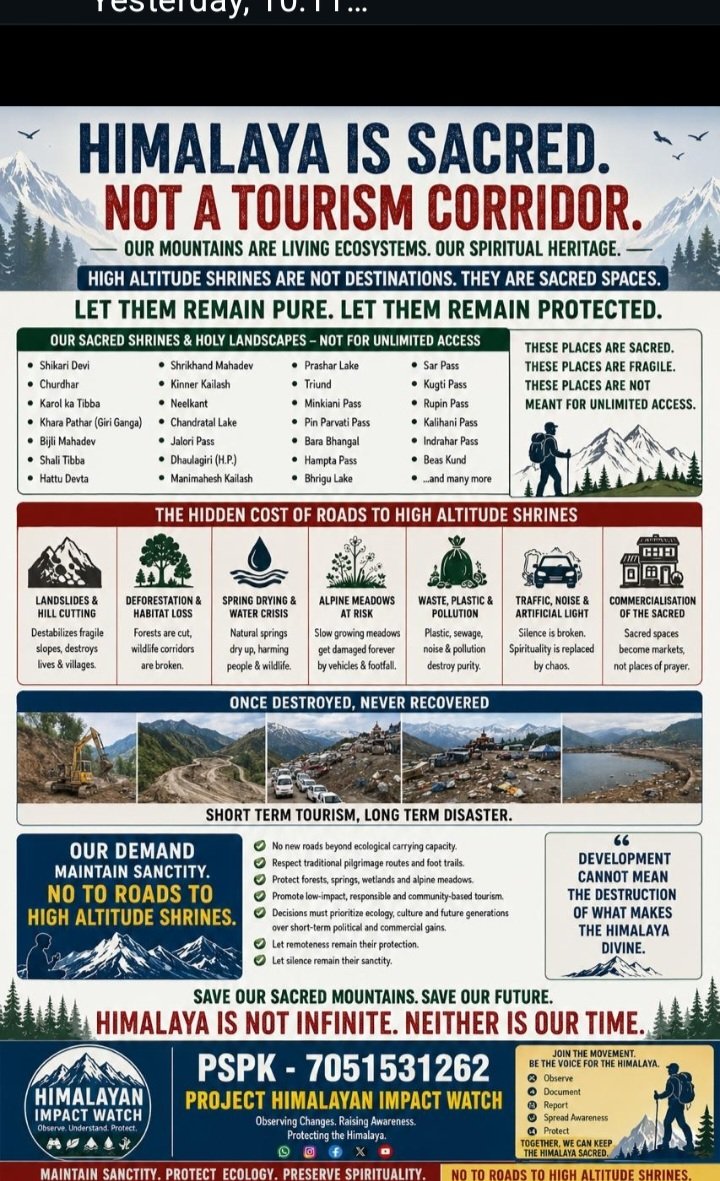
The recommendation assumes greater importance as pilgrimages and trekking activities continue to expand into fragile high-altitude regions.
Every year thousands travel to Manimahesh, Kinner Kailash, Shrikhand Mahadev, Churdhar and Shikari Devi, while trekkers head towards Pin-Parvati, Chandratal, Mantalai, Chanshal and several other alpine destinations.
The larger challenge is aligning these movements with the mountain calendar rather than administrative calendars. It is a new normal that rain shadow areas in high attitude region is experiencing rains and freak snowfall.
Monsoon has historically remained the season of landslides, cloudbursts, flash floods and unstable slopes, while heavy snowfall defines another distinct risk period.
Mountain communities traditionally planned movement according to weather, snow conditions and seasonal changes. Scientific weather forecasting, well equipped communication networks and satellite monitoring can significantly strengthen this traditional understanding and is handy in disasters.
Climate Adaptation Means Understanding All Six Seasons
The report rightly recommends climate-resilient infrastructure, local disaster management plans, stronger communication systems, underground utilities, resilient reconstruction and customised planning.
But resilience also requires understanding how Himachal's six traditional seasons are changing.
Flowering cycles, snowfall timing, snowmelt, spring discharge, monsoon onset, winter rainfall and temperature patterns are no longer behaving uniformly across the state.
Some valleys continue to follow traditional weather cycles while others have experienced significant shifts.
Future planning for horticulture, agriculture, hydropower, tourism, pilgrimages, road construction and disaster preparedness must increasingly follow seasonal behaviour rather than fixed administrative schedules.
Protect Natural Drainage Before Building More Concrete
The report calls for stricter regulation of muck dumping, land-use planning, slope stabilisation, waste management, GIS monitoring, remote sensing and stronger enforcement of environmental laws.
The underlying lesson is simple.
Nature has its own drainage network.
Seasonal streams, underground water channels, floodplains and mountain slopes have evolved over thousands of years.
When roads block drainage, rivers are narrowed, slopes are excessively cut or debris is dumped into natural watercourses, mountains eventually reclaim their space.
Engineering should therefore begin by understanding natural systems rather than attempting to replace them.
A Beginning, Not a Cure-All
MSHIPA's report is one of the most important policy documents produced after Himachal's recent disasters. It brings together valuable scientific expertise and administrative experience and offers policymakers substantial food for thought.
However, it should not be viewed as a know-all or cure-all prescription for Himalayan resilience.
The report is strongest when it advocates science-based planning, stronger institutions and resilient infrastructure. Its next evolution could lie in combining these technical recommendations with exhaustive valley-by-valley field studies, long-term hydrological research and systematic documentation of local ecological knowledge that has guided Himalayan communities for centuries.
The Himalayas cannot be understood through one template as it has become fashionable among socalled experts to put it so.
Every valley has its own geology, hydrology, ecology, weather behaviour and history of disasters.
True resilience will come not merely by building stronger roads or larger retaining walls, but by improving what already exists, planning future development with greater humility and learning to work with nature instead of constantly attempting to overpower it.
Nodoubt MSHIPA report is among the most comprehensive policy documents produced after Himachal's recent disasters. It brings together scientific expertise, engineering practices and administrative experience, offering policymakers valuable food for thought.
But it should be viewed as the beginning of a much larger conversation, not as a know-all or cure-all prescription for making the Himalayas disaster-resilient.
Its recommendations will have to evolve further through exhaustive valley-by-valley studies that combine geology, hydrology, meteorology, ecology, engineering and, equally importantly, the accumulated wisdom of mountain communities.
Surprisingly, despite its exhaustive discussions, the report scarcely addresses how folk wisdom and common sense—refined over generations by shepherds, farmers, orchardists and village elders—can be integrated into modern planning. Development in the Himalayas cannot rely solely on conference-room deliberations or standard engineering models; it must also be informed by the lived experience of people who have read these mountains for centuries.
For this writers , after decades of reporting from disaster-hit valleys across Himachal Pradesh, one lesson has emerged repeatedly. Cloudbursts, intense rainfall, snowfall and earthquakes are natural events.
But the scale of devastation that follows—the collapse of roads and bridges, houses being swept away and the tragic loss of lives—is very often amplified by human intervention. Roads carved across natural drainage channels, indiscriminate hill cutting, muck dumped into rivers and seasonal nullahs, construction on floodplains and unstable slopes, and relentless interference with fragile mountain systems have repeatedly turned natural hazards into human disasters. Nature may trigger the event, but human actions frequently determine its magnitude.
The Himalayas have their own rhythms, their own drainage systems and their own six seasons.
Rivers eventually reclaim their floodplains, seasonal streams reopen blocked channels and mountains respond to every disturbance in their own time.
The real challenge before Himachal is therefore not merely to build stronger roads or higher retaining walls, but to improve what already exists, plan future development valley by valley, understand how seasonal patterns are changing, and learn to work with nature instead of constantly trying to overpower it.
Only then can resilience become a living practice rather than another policy document on the shelf.