Himachal Monsoon Session: Congress, BJP Brace for a Political Showdown
SHIMLA, AUGUST 19: The Himachal Pradesh Assembly’s monsoon session is set to become a fresh political battleground, with the ruling Congress and opposition BJP preparing to use the 10-day sitting to put each other on the defensive over governance, corruption allegations, disaster relief, election guarantees and the Centre’s financial commitments to the state.
Adding another layer to the political equation is talk of internal dissension within the ruling Congress, which could complicate the government’s floor strategy during the session.
PWD Minister Vikramaditya Singh was reportedly not assigned, or did not receive, the responsibility of presiding over the state-level Republic Day and Independence Day functions, a development that has fuelled speculation about differences within the party.
There is also talk of a growing disconnect between Deputy Chief Minister Mukesh Agnihotri and Education Minister Rohit Thakur on the one hand and Chief Minister Sukhvinder Singh Sukhu on the other.
Revenue Minister Jagat Singh Negi, too, is said to be unhappy following the appointment of N. Bhandari as Kinnaur Congress president.
Against this backdrop, Sukhu, who is currently camping in New Delhi and is expected to return to Shimla tomorrow, will have the additional task of clearing the air within the party and ensuring that internal differences do not spill over into the Assembly session.
The 12th session of the 14th Himachal Pradesh Legislative Assembly will be held from August 21 to September 3, with 10 sittings scheduled.
The session will begin at 11 am on August 21 with obituary references to former legislators late Vijender Singh and Ram Chand Bhatia. August 27 has been earmarked as a private members’ business day.
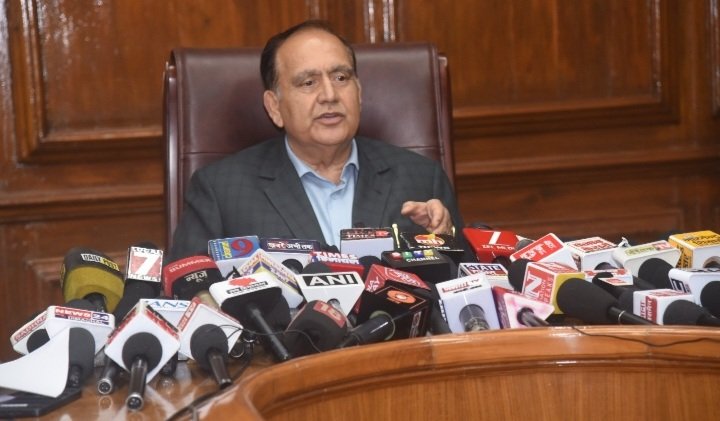
Announcing the session schedule at a press conference in Shimla on Wednesday, Assembly Speaker Kuldeep Singh Pathania said the House had received 1,036 questions from legislators—787 starred and 249 unstarred. All the questions were received online and forwarded to the government for necessary action.
The questions indicate the issues likely to dominate the session: the Centre’s financial assistance for disaster management, floods and recent heavy rainfall, the government’s response to natural disasters, roads and bridges, DPRs of sanctioned roads, the proposed merger of schools, upgrading colleges and health institutions, vacancies in government departments, tourism, horticulture, drinking water, drug abuse among youth, crime and public transport.
But beneath the formal legislative agenda lies a sharper political contest.
BJP likely to turn the House into a political battlefield
The BJP is expected to use the session to intensify its attack on the Sukhu government, particularly over the Vigilance investigations involving members of the opposition, while also seeking to put the government on the defensive over its election guarantees and questions of financial management.
The opposition’s broader strategy is likely to be to portray the Congress government as having fallen short of the expectations created during the 2022 Assembly campaign.
The issue of guarantees remains politically useful for the BJP because it allows the opposition to connect promises made before the election with questions over implementation, fiscal constraints and the state’s financial position.
The Vigilance issue, meanwhile, could give the BJP an opportunity to turn the narrative from administrative performance to alleged political targeting.
The government is likely to maintain that investigations are being conducted through established legal mechanisms and that allegations of wrongdoing cannot be shielded merely because the accused are political figures.
That confrontation could produce some of the most heated exchanges of the session.
Congress mulling counter-offensive
Congress, meanwhile, is also mulling a counter-offensive, although both the ruling party and the BJP have so far kept their cards close to their chest on the precise strategy they intend to deploy during the session.
With the political temperature expected to rise over the Vigilance investigations, election guarantees and the Centre’s financial assistance to Himachal, Congress strategists are weighing how aggressively to turn the spotlight on the BJP-led Union government and its commitments to the state.
The ruling party is also expected to coordinate its floor strategy closely so that the opposition’s attacks do not dominate the proceedings.
The BJP, for its part, is maintaining a degree of ambiguity over the issues it will prioritise, leaving scope for the opposition to spring surprises during the debate.
Sukhu puts focus on Centre’s ₹1,500 crore commitment
Chief Minister Sukhvinder Singh Sukhu has already sought to shift the focus towards the Centre’s responsibility towards Himachal Pradesh, particularly in the aftermath of repeated natural disasters and heavy rainfall.
A key political counter from the ruling party is expected to be the issue of the ₹1,500 crore assistance announced by Prime Minister Narendra Modi during his visit to Himachal Pradesh. Sukhu has been asking BJP leaders in the state to remind the Prime Minister of the announcement and press the Centre for release of the funds.
This could become an important Congress strategy during the session: while the BJP highlights the state government’s promises and governance record, the Congress is likely to argue that Himachal’s financial and disaster-related challenges cannot be viewed in isolation from the Centre’s commitments and pending assistance.
The disaster issue has particular political resonance because several of the questions submitted by legislators relate to floods, heavy rain, infrastructure damage and financial assistance from the Union government.
Speaker seeks a smooth House
Pathania has sought cooperation from both sides to ensure that the House functions without unnecessary disruption.
He has convened a meeting of leaders of both parties on August 20 at 4:30 pm, ahead of the session.
Parliamentary Affairs Minister Harshwardhan Chauhan, Leader of Opposition Jairam Thakur, Deputy Chief Whip Kewal Singh Pathania and BJP chief whip Sukhram Chaudhary are expected to participate.
The Speaker said his appeal to the treasury and opposition benches would be to provide constructive cooperation so that Assembly time could be used for issues of public interest and meaningful debate.
The appeal is significant because the political stakes are higher than the relatively short 10-sitting schedule might suggest.
Disaster, roads and jobs could bridge the political divide
While the Congress-BJP confrontation is expected to dominate the headlines, the list of questions suggests that legislators will also raise issues with immediate public impact.
Disaster management is likely to be one of the central themes, with Himachal continuing to grapple with the consequences of heavy rainfall and damage to roads, bridges and other infrastructure.
Questions on sanctioned road projects and DPRs could provide MLAs an opportunity to raise constituency-specific grievances.
Employment and vacancies in government departments, upgrading educational and health institutions, drinking water supply and tourism are similarly likely to feature prominently.
The issue of drug abuse among young people and rising crime could provide the BJP with another avenue of attack, while the government is likely to point to its administrative and enforcement measures.
A contest over the political narrative
The coming session therefore appears less likely to be defined simply by legislation and more by a contest over who controls the political narrative.
The BJP will seek to frame the session around accountability of the Congress government—its guarantees, governance, finances and the Vigilance proceedings involving opposition leaders or members.
The Congress, in turn, is expected to argue that the BJP must answer for the Centre’s commitments to Himachal, particularly financial assistance related to disasters, while highlighting what it sees as the Union government’s responsibility towards a financially constrained hill state.
With 1,036 questions already submitted, the government will face scrutiny across a wide range of departments.
For the opposition, the challenge will be to convert those questions into a coherent political attack rather than a series of isolated constituency issues.
For the Congress, the challenge will be to prevent the session from becoming a referendum on unfulfilled guarantees and instead make disaster relief, Centre-state relations and development the dominant themes.
The August 20 all-party meeting may offer an early indication of whether the two sides choose cooperation on the functioning of the House—or prepare for another politically charged Assembly session.