Are CM Sukhu and Deputy CM Agnihotri on the same page ?
SHIMLA, April 28 —
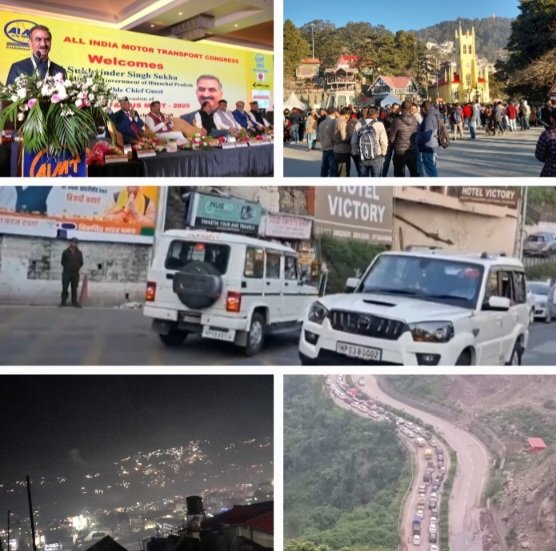
A green Himachal Pradesh by 2026? Chief Minister Sukhvinder Singh Sukhu’s ambitious claim made at the All India Motor Transport Congress in Solan sounds more like a distant dream than an achievable target, especially when viewed against the grim ground reality.
While CM Sukhu passionately appealed to all sections of society to support the green energy push, the state today runs on fossil fuels — quite literally. Over 40i lakh private vehicles — cars, bikes, taxis — still run on petrol and diesel.
Even the Himachal Road Transport Corporation (HRTC), the state’s own transport arm, continues to expand its fleet of diesel buses, exposing a clear disconnect between policy announcements and ground-level action.
In fact, murmurs within the government hint that the Chief Minister and his Deputy, Mukesh Agnihotri, are not entirely on the same page when it comes to greening the transport sector.
Even the capital Shimla, a supposed showpiece for the state, operates largely on diesel-run private and public transport.
Talk of "green corridors" has been circulating for years, but on the ground, little has changed.
There is no pollution check for private or HRTC buses on the roads, and commuters inhale fumes right under the nose of the Pollution Control Board in Shimla city, let alone other towns.
If Shimla — touted as a model for the state — is not addressing such basic issues, the path to a green Himachal seems more like a pipe dream.
Add to this the fragile economic situation: crop failures, a debt burden ballooning over ₹1 lakh crore, and no real incentives for the common man to switch to prohibitively expensive electric vehicles (EVs).
In such an environment, how realistic is the goal of a Green Himachal in just about 22 months?
Globally, even financially stronger and infrastructure-ready cities are struggling to shift to greener transport systems.
Take Delhi, for instance: despite huge investments, incentives, and one of the highest densities of EVs, diesel and petrol vehicles still dominate the roads.
Norway, a global leader in EV adoption, took nearly a decade of sustained policy support, tax incentives, and infrastructure building to reach 80% EV sales.
In contrast, Himachal’s push looks like a top-down dream with little grassroots support.
So far, under the state's startup scheme, only 50 e-taxis have been added to government departments. Charging stations are still too few and scattered to support mass EV adoption.
Promises of 297 new e-buses and six green corridors sound good on paper but are no match for the lakhs of diesel-run tourist vehicles that flood the state every season.
The government's offer of 50% road tax exemption and 40% subsidy on e-vehicles is welcome, but remains out of reach for most citizens struggling with rising living costs and falling incomes.
Even if subsidies are enhanced, without an extensive charging network, maintenance support, and cheaper EV options, people won't easily ditch their fossil-fuelled vehicles.
Moreover, there’s a critical missing piece in the conversation: trees and forests. Electric vehicles alone cannot "green" a state. Without large-scale afforestation, preservation of catchment areas, and restoration of degraded forests, carbon emissions will continue to rise.
In fact, forest fires, landslides, and climate-induced disasters are already battering Himachal. A 'Green Energy State' without a parallel push for 'Green Cover State' will remain hollow.
The CM’s push to make Hamirpur a model district for e-vehicle adoption is a good beginning.
But without heavy investments in public transport electrification, aggressive tree plantation drives, stringent pollution checks, and citizen awareness campaigns, the 2026 target will remain a political slogan rather than a real achievement.
Sukhvinder Sukhu may well be right in saying it is the right time to invest in "green industry" — but for Himachal Pradesh, the real investment must begin with realistic planning, grassroots mobilization, and sustained execution, not just ambitious declarations.
#GreenEnergyState #HimachalNeedsAction #PollutionUnchecked #ElectricVehicles