
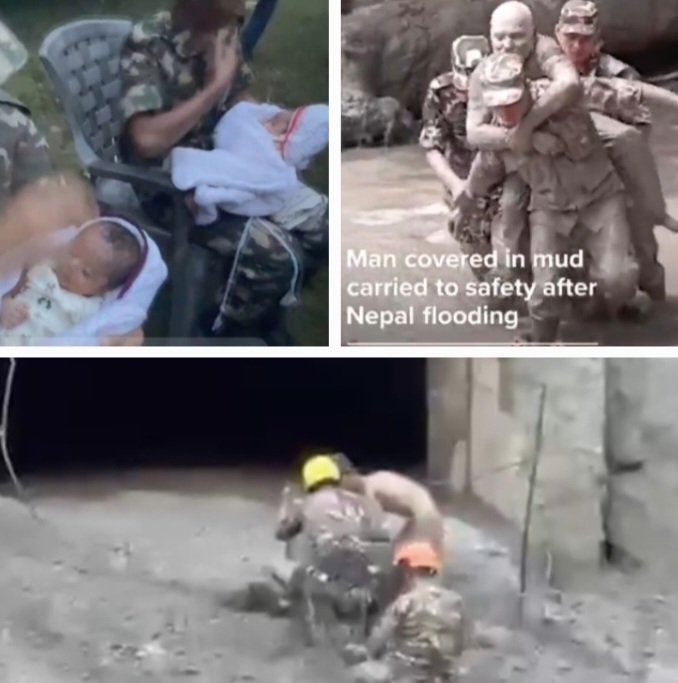
KATHMANDU/NEWDELHI: In the middle of Nepal’s worst flood disaster in years, a deeply human moment has emerged from the devastation — two rescued twin babies held safely in the arms of Nepali Army women soldiers.
Images and videos of the soldiers carrying, comforting and protecting the tiny survivors have gone viral on social media, offering a rare moment of warmth amid scenes of death, destruction and desperation.
The rescue operation has showcased not only the scale of the disaster but also the courage of Nepal’s security forces, who have been working in flooded valleys, damaged roads, unstable slopes and isolated settlements.
The Nepali Army has so far rescued 883 people in Rasuwa, including 350 workers and locals who were trapped inside a tunnel of the Upper Trishuli Hydropower Project.
More than 100 people were initially still reported to be inside the tunnel as rescue teams continued their operation.
The dramatic rescue comes as Nepal battles a catastrophe triggered by a massive ice-and-rock avalanche and subsequent flash flooding along the Bhote Koshi river system.
The disaster has swept away homes, bridges, roads and power infrastructure and left thousands of people unaccounted for.
Nepal Police put the death toll at 469 on Friday, with 977 people still missing in the latest figures.
The crisis has now been compounded by a fresh threat upstream.
A newly formed barrier lake near the Nepal-China border began overflowing, prompting authorities to warn people living along the Bhote Koshi and Trishuli river systems to move to safer, higher ground.
Rescue operations were temporarily suspended amid fears that a secondary flood, landslide or avalanche could strike the already devastated valleys.
The situation has also triggered an international search for missing tourists and pilgrims.
The Ministry of External Affairs said 21 Indian nationals from Tamil Nadu, travelling on the Kailash Mansarovar route, had been rescued and arrangements were being made to bring them to Kathmandu and subsequently return them home.
The pilgrims were travelling in a convoy of three buses when the flood struck. According to accounts from survivors, two buses were feared to have been swept away, while those in the third bus managed to escape and climb to higher ground.
The humanitarian crisis extends across nationalities. Chinese authorities have reported 558 people missing in Tibet’s Gyirong area, including 260 foreigners, while three deaths had been confirmed on the Chinese side.
The disaster has also highlighted the vulnerability of Himalayan infrastructure to sudden glacial, landslide and flood events.
But amid the grim statistics, the sight of Nepali Army women soldiers protecting two tiny survivors has become one of the most powerful images of the disaster — a reminder that even when nature overwhelms everything around them, rescue workers remain the last line of hope.