
Chandigarh: Punjab’s technology and investment pitch is gaining momentum as the Aam Aadmi Party government moves into election mode, with captains of industry and policymakers stepping up the push to position the state as a technology, GCC and innovation hub for North India.
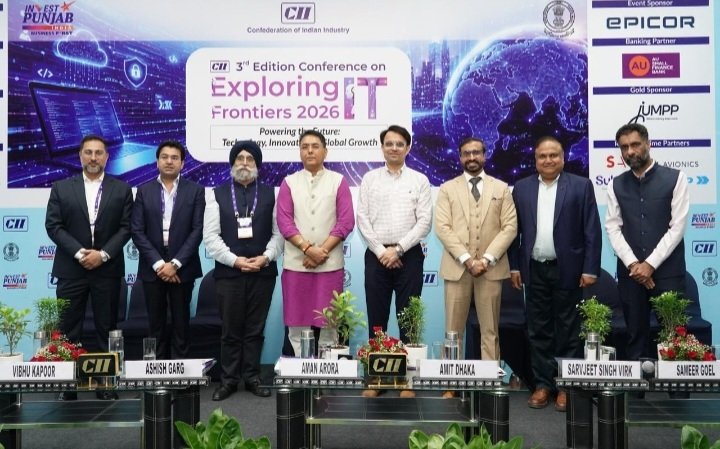
At the 3rd Edition of the CII Conference on IT Frontiers in Chandigarh, Industries and Commerce Minister Aman Arora made a direct pitch to global enterprises, inviting them to explore Punjab’s investment potential and leverage its talent pool, infrastructure and comparatively competitive operating costs.
Arora said Punjab was positioning itself as a preferred destination for Global Capability Centres (GCCs), technology investments, innovation centres, AI laboratories and digital enterprises, with Mohali emerging as the focal point of the state’s technology ambitions.
The minister highlighted the Punjab IT, ITeS, Data Centre and GCC Policy 2026, saying the government was seeking to facilitate investments and accelerate the establishment and expansion of technology-driven businesses through Invest Punjab.
The industry push comes at a politically significant juncture, with the AAP government entering the run-up to the next Assembly elections and seeking to project investment, employment and technology-led growth as key elements of its governance narrative.
Punjab Bureau of Investment Promotion CEO Amit Dhaka underlined the scale of the state’s talent and institutional base, pointing to 32 universities, 190 engineering colleges, more than 350 ITIs and over 1,000 skill centres. The Tricity region alone has an estimated 1.2 lakh IT and technology professionals.
Mohali, he said, was seeking to combine the capabilities of a Tier-I technology destination with the operating economics of a Tier-II city. The city has more than 150 IT units and over ₹7,500 crore invested in IT and ESDM sectors.
The message from industry was equally focused on technology-led competitiveness.
Ashish Garg, Vice Chairman, CII Punjab and Managing Director of Happy Forgings, said artificial intelligence, automation and Industry 4.0 could significantly improve productivity, quality and efficiency while strengthening the competitiveness of Punjab-based enterprises in global markets. He stressed that workforce skilling would have to keep pace with the technological transition.
The defence sector also emerged as a potential growth area for Punjab’s technology and manufacturing ecosystem.
Maj Gen Vikram Jeet Singh Varaiach, Chief Signal Officer, Western Command, said secure communications, networks, data and artificial intelligence would increasingly shape military capabilities, opening opportunities for Indian companies, particularly MSMEs, through initiatives such as iDEX and ADITI.
Sarvjeet Singh Virk, Conference Chairman and Managing Director, Finvasia India Pvt Ltd, said the convergence of technology, entrepreneurship and innovation could create significant opportunities for Punjab, while stronger government-industry engagement would be necessary to convert investment ambitions into execution.
The conference also sought to connect Punjab’s traditional manufacturing base with emerging technologies. Vibhu Kapoor, Regional Vice President, Middle East, Africa & India, Epicor, described the opportunity as a transition towards “Punjab 3.0”, linking the state’s manufacturing heritage with digital intelligence.
With more than 120 representatives from the IT, manufacturing, startup, MSME and government sectors participating, the conference placed technology investment, AI, digital transformation and GCCs at the centre of Punjab’s economic conversation.
For the AAP government, the growing industry focus offers a platform to showcase an investment and technology narrative ahead of the electoral battle.
For industry, however, the larger test will be whether Punjab can translate policy announcements and investment pitches into actual projects, jobs, technology clusters and sustained private-sector growth.